At the Scene: AI Attacks Accelerate, Defense Remains Fragmented... “A Common Security Standard Is Needed”
IT DAILY ·
✦ AI Summary
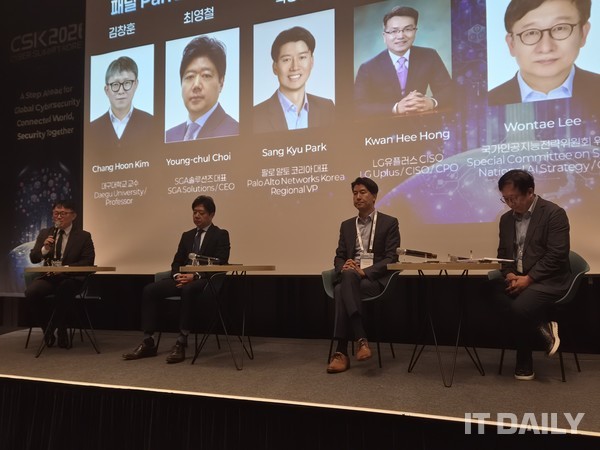
On the 17th at CSK 2026, the session "National AI Security Strategy Needed in the AX Era" was held, with Kim Chang-hoon, a professor at Daegu University; Choi Young-cheol, CEO of SGA Solutions; Park Sang-kyu, CEO of Palo Alto Networks Korea; and Lee Won-tae, chair of the security special committee of the National AI Strategy Committee, in attendance.
At the session, participants said AI combines account, endpoint, and network vulnerabilities to create attack paths, and that security strategies need to be reorganized to respond to attacks that cross industry and institutional boundaries.
Experts urged the establishment of a common national security standard with different application levels by sector, and said a defense system that makes Zero Trust and detection, blocking, isolation, and recovery function in practice is needed.
On the 17th, the session "National AI Security Strategy Needed in the AX Era" was held at "CSK 2026." The session was attended by Kim Chang-hoon, a professor at Daegu University; Choi Young-cheol, CEO of SGA Solutions; Park Sang-kyu, CEO of Palo Alto Networks Korea; and Lee Won-tae, chair of the security special committee of the National AI Strategy Committee. The photo was taken by reporter Kim Ho-jun.
At the session, it was suggested that AI targets accounts, endpoints, and networks as combined vulnerability points to generate attack paths, and that cyberattacks are therefore becoming more advanced in terms of speed and scale. Participants also said security strategies need to be reorganized because AI's scope of activity crosses industry and institutional boundaries.
Experts said that, in this situation, dispersed security control items by sector should be aligned and a common security standard should be established at the national level. They also proposed avoiding a simple integration of existing compliance frameworks and instead setting a common baseline first, then differentiating application levels by sector. They explained that this is intended to secure a reference point for introducing new security architectures such as Zero Trust and to ensure that real defense functions in security systems actually operate.
On the 17th, "Cyber Summit Korea (CSK) 2026" was held. At the event, the session "National AI Security Strategy Needed in the AI Transformation (AX) Era" took place, and its topic was national AI security strategy.
The session was chaired by Lee Won-tae, chair of the security special committee of the National AI Strategy Committee. Participants included Kim Chang-hoon, a professor at Daegu University; Choi Young-cheol, CEO of SGA Solutions; and Park Sang-kyu, CEO of Palo Alto Networks Korea.
Kim Chang-hoon, a professor at Daegu University, presented at the CSK 2026 session on the 17th. The related photo was taken by reporter Kim Ho-jun.
The session said that, as AI spreads, the objects of cyber defense protection are expanding. The starting point for management was server infrastructure, and management now also includes cloud and applications, as well as AI agent-related work and judgment and data processing. It was also suggested that, because AI operates by linking multiple systems and data, the number of attack entry points increases as a result of those connections.
Attack methods are becoming more advanced. Attackers are not stopping at separately targeting endpoint, account, and network vulnerabilities; they are exploring new intrusion paths through combinations of vulnerabilities. Such linked attacks can lead to system collapse. AI performs this analysis faster than humans can.
Professor Kim explained that AI-based attackers do not look at endpoint, account, and network vulnerabilities separately, but raise the level of attacks by analyzing and combining relationships among vulnerabilities. He also said AI agents are less time-consuming than humans in attacks and are superior to humans in attacks.
By contrast, security systems are lagging in keeping up with these changes. Many existing tools detect threats mainly through preset rules and known attack patterns. Threat modeling is needed to block attacks that unfold across multiple domains. Professor Kim said threat modeling should analyze protected assets, system layers, expected threats, and the level of damage together.
AIDC is relatively highly vulnerable to such attacks. The GPUs that make up AIDC send and receive data based on RDMA, or Remote Direct Memory Access. RDMA is a high-speed method of data transfer that does not use an intermediate device, but it was explained that its security controls may be weak.
On this point, Professor Kim proposed a future security analysis method. He said it is necessary to analyze protected assets, the layer where an attack occurs, and the type of threat from the perspectives of confidentiality, integrity, and availability. He then suggested determining security control items and their application levels based on the results of threat modeling.
He also explained that security control items and application levels need to be linked with the Security Operations Center (SOC). The point was that the results derived from threat modeling should not stop at setting control levels, but must be connected to the actual operating system.
However, South Korea's security framework is fragmented by ministry and industry. The public sector applies the National Network Security System (N2SF), the military applies the Korean Risk Management Framework (K-RMF), and private companies are expected to comply with the Information Security Management System and Personal Information Protection Management System (ISMS-P). Experts said that, under the current structure, responding to threats in the AI era is difficult.
Although the various frameworks differ in their scope and purpose, they were presented as overlapping in technical elements such as asset identification, access control, and threat analysis. In response, experts proposed identifying control items that can be commonly applied to AI threats and using those items as a national baseline. Professor Kim pointed to technical duplication among the systems and argued for the need to integrate and strengthen common technologies.
Professor Kim said the ministries overseeing security need a consistent stance on technical issues, and that the purpose is to reduce confusion in the field. Experts also agreed on the need to establish a common standard while maintaining the current system, and raised the need for a reference point.
However, there was also an opinion that the same security strength does not need to be applied across all sectors. Defense was cited as an example where stronger controls are needed in areas where confidentiality is important. Accordingly, while maintaining the current system, a different level of control strength was proposed depending on confidentiality and data importance by sector, along with differentiated levels of separation and isolation for some systems based on data importance.
Choi Young-cheol, CEO of SGA Solutions, said in his presentation at the CSK 2026 session on the 17th that the common core of several security frameworks lies in their control items. He argued that, rather than creating a new system, the priority should be to compare and organize the contents of existing systems.
CEO Choi said there is a need to create a structure that related agencies can use together. To that end, he said AI-related security control items need to be quickly reorganized, and added that the reorganized control items should be reflected in each compliance framework.
He also said that an agency in charge of carrying out this work needs to be designated. Alternatively, he said, a joint task force (TF) of related agencies could be formed.
There was also criticism that establishing standards alone is not enough and that the actual operating stage is important. Experts pointed out that simply reorganizing security compliance has limits in responding to AI-based attacks and makes it difficult to keep up.
Experts said there is a need to move away from the approach of simply checking whether a solution is in place. Instead, they stressed that security functions must be continuously verified in real environments, and they said Zero Trust is essential. The photo was taken by reporter Kim Ho-jun.
CEO Choi said that as attack sophistication accelerates through AI agents, security responses are failing to keep up. He said the on-site security structure continues to center on internal and external boundaries, and that a shift in the security framework is urgent.
Zero Trust was presented as a way to implement that shift. A Zero Trust architecture checks contextual information such as the accessing subject, device, location, and service, grants only the necessary permissions, and blocks sessions when risk is detected. It was also explained that the scope of Zero Trust can extend beyond people to nonhuman identities such as AI agents and service accounts.
However, it was said that Zero Trust is not a new concept. The government has published guidelines twice and has also run related support programs several times. Even so, CEO Choi attributed the failure to establish Zero Trust to the absence of standards and pointed out that the essential functional criteria for Zero Trust "adoption" are unclear.
Park Sang-kyu, CEO of Palo Alto Networks Korea, said in his presentation at the CSK 2026 session on the 17th that CEO Choi had viewed threats as having become more lethal in the AI era. CEO Choi therefore saw Zero Trust as essential.
CEO Choi explained that for autonomous SOC systems and other automated response frameworks to be effective, design and preparation based on Zero Trust must come first. He said that as AI spreads and security threats become more serious, the effectiveness of automated response systems can only be secured on such a foundation.
He then said that related security requirements need to change. He emphasized that the starting point is compliance.
CEO Park also presented actual Security Operations Center operating cases. Through the case of Palo Alto Networks' Security Operations Center, he explained that in security operations centers, it is difficult for human staff to handle every alert, and that the scale of security alerts for companies and institutions reaches several thousand or tens of thousands.
CEO Park said that responding to the speed of attacks requires AI-based classification and automated processing of repetitive content. He also introduced a structure in which AI handles preliminary analysis and processing when large-scale alerts and security incidents occur, and only cases that cannot be resolved automatically are delivered to security staff. The gist is that AI handles the first pass of alert triage, while humans handle high-risk judgments.
CEO Park said it is impossible for humans to directly analyze every alert in the scale seen at security operations centers. Accordingly, he said AI-based alert triage is necessary, and that humans must judge the parts AI cannot resolve automatically. This does not mean AI deployment completely replaces security personnel; rather, it suggests a structure in which AI handles repetitive alert analysis and initial response, while humans take on the remaining tasks.
Under such a structure, AI's role can be focused on repetitive alert analysis and initial response, while the human role can shift to high-risk incident judgment and exception handling. At the same time, the possibility of changing roles for security personnel is expanding, and CEO Park stressed that existing monitoring staff need to transition into threat analysis and response strategy development work.
CEO Park said human control is also needed when using frontier AI for vulnerability checks. That is because AI agents can detect many vulnerabilities in a short time, but they may also unintentionally disrupt live services. To do this, it is necessary not only to secure model performance but also to set agent permissions and define the scope of agent tasks, while ensuring expertise in result validation.
CEO Park cited frontier AI experience, cyber security knowledge, and vulnerability testing capabilities as important future factors in AI security response. He also said it is necessary to control and inspect AI agents without disrupting actual services.
Lee, who then summarized the discussion as chair, said the need to transform defense systems for AI was clear in responding to AI attacks. However, he said that before automation, the scope of AI judgment and the set of actions it can execute must be clearly defined, and that beyond preemptive blocking, resilience should also include the rapid isolation of compromised systems and recovery of core functions.
Lee said a national security standard in the AI era should not stop at adding documents of control items. He added that a national security standard must implement a real defense system that leads from detection to blocking, isolation, and recovery.
Source: IT DAILY · Kim Ho-jun
Original: https://www.itdaily.kr/news/articleView.html?idxno=241734
References
This article was produced with the help of an automated content generation algorithm.
Source: IT DAILY
View originalThis article was summarized and organized by BizCrush based on the original article from IT DAILY. For exact quotations and full details, please refer to the original article.