SKT Brings Mobile Service Counter Directly to Rural Areas Without Retail Stores
IT DAILY ·
✦ AI Summary
SK Telecom signed a memorandum of understanding (MOU) for a "visiting service" with Sancheong County, Hamyang County, Geochang County, and Hapcheon County. This service will be held 8 times in total, twice in each of the 4 counties, and will provide voice phishing prevention education, smartphone usage training, telecommunications consultations, and device management. Going forward, the company plans to expand the program into a participatory model in which local governments jointly design resident demand and operating methods.
SK Telecom said on the 13th that it will operate a mobile telecommunications service counter with local governments for older rural residents who have difficulty visiting retail stores and using digital services. To that end, SK Telecom signed a memorandum of understanding (MOU) for a "visiting service" with Sancheong County, Hamyang County, Geochang County, and Hapcheon County. The purpose of the agreement is to help local residents use telecommunications services safely and narrow the digital divide.
A key feature of the new operating model is that it moves away from the traditional approach in which a carrier unilaterally provides a program. Local governments take part in identifying regional demand, and jointly design the service locations and operating methods with SK Telecom.
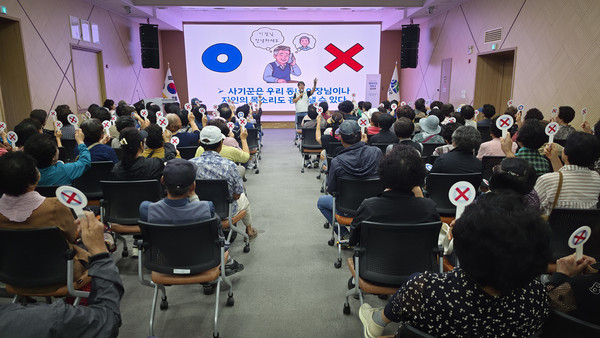
Under the agreement, the "visiting service" will be held 8 times in total, twice in each of the 4 counties. On site, it will offer financial crime prevention education such as voice phishing, smartphone usage education, telecommunications service consultations, smartphone sterilization and cleaning, screen protector replacement, and device checks.
Device management services are provided regardless of the user’s carrier. The photo shows local residents in Hamyang County, South Gyeongsang Province, taking part in SK Telecom’s "visiting service."
SK Telecom cited the high share of older residents as the background for selecting the 4 counties in northwestern South Gyeongsang Province as priority cooperation areas. As of the end of July, the reference date for resident registration population statistics from the Ministry of the Interior and Safety, the share of people aged 65 and older stood at 46.3% in Sancheong County, 42.2% in Hamyang County, 34.7% in Geochang County, and 48.9% in Hapcheon County. Compared with the national average of 21.7% for people aged 65 and older, the elderly population ratio in the 4 counties is 1.6 to 2.3 times higher.
Rural areas with high elderly populations like these tend to lack digital education and physical touchpoints for service delivery. As a result, when problems arise with smartphones, it is difficult to travel to a retail store, and even after taking voice phishing prevention classes, it is not easy to immediately resolve questions that come up during device setup and use. SK Telecom took these conditions into account.
Rather than lecture-centered one-off education, SK Telecom focused on hands-on practice in which residents participate directly. To this end, it decided to offer voice phishing scenario experiences and encourage repeated learning of smartphone usage methods. The education sites will also provide individual telecommunications consultations and device inspection services.
A notable point in this project is the expanded role of local governments. Previously, SK Telecom handled region selection and service provision, but going forward, local governments will operate the program in a way that reflects residents’ needs and accessibility by town and township. They will decide event locations, operating methods, and participation scale, and will also use local networks to inform residents and recruit participants.
This change reflects a structural shift in which the center of program operations moves from a standalone SK Telecom model to a local-government participation model. The aim is to combine telecommunications companies’ social contribution activities with local governments’ administrative networks to more accurately identify and reach residents who need the service. The agreement with the 4 counties in South Gyeongsang Province is the trigger for this transition and expansion, and the program is planned to shift from individual site visits to a jointly operated model with local governments.
SK Telecom operated the visiting service 145 times this year across 74 cities and counties nationwide, reaching about 13,000 people. The average number of users per session was about 90. Other rural and fishing villages are the target for further expansion of this model, and if expanded, it is expected to help supplement older residents’ digital capabilities and improve access to telecommunications services. This model is a public-private partnership model.
Lee Hye-yeon, head of SK Telecom’s Customer Value Innovation Office, said the company is committed to working with local governments, the entities most familiar with regional conditions, and expressed its intention to use that cooperation to help residents access safer and more convenient telecommunications services. She added that the company plans to continue pursuing field-centered activities as its operating method.
Source: IT DAILY · Lee Jae-young
Original: https://www.itdaily.kr/news/articleView.html?idxno=241562
References
This article was produced with the help of an automated content generation algorithm.
Source: IT DAILY
View originalThis article was summarized and organized by BizCrush based on the original article from IT DAILY. For exact quotations and full details, please refer to the original article.