Turing Expands GPAI, Its AI App for College Students, With Problem Generation, AI Drive and PPT Tools
TECHWORLD · · 1 views
✦ AI Summary
Turing has added three new features to GPAI, its AI service for college students: problem generation, AI Drive and PPT creation.
GPAI is now designed to run as a continuous flow from material input to presentation material creation, in addition to its existing lecture material organization, exam preparation and presentation prep features.
Turing plans to expand integration between AI Drive and university lecture portals in the future and broaden its functions to support the full academic process, including lecture material organization, exam preparation and presentation prep.
Turing has expanded the functions of GPAI, its AI service for college students. On the 22nd, Turing announced that it had added three new features to GPAI: problem generation, AI Drive and PPT creation. The direction of this expansion is to provide support across academic life.
GPAI had already been supporting lecture material organization, exam preparation and presentation prep. With the addition of the new features, it will broaden the scope of academic support it provides to college students.
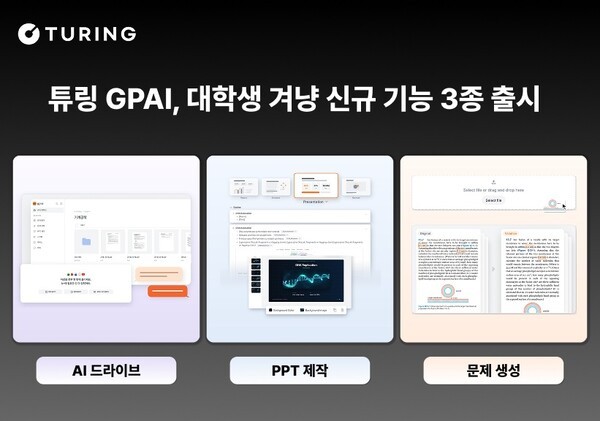
The AI Drive feature is designed to integrate and manage lecture materials, notes and assignment files. It also links users to AI queries based on uploaded materials, and connects to report writing, problem solving and PPT creation.
The problem generation feature works by uploading past exam questions and textbook examples, then generating anticipated questions of similar type and difficulty. It is aimed at demand for repeated study-based preparation for major exams through variations of existing questions.
The service has been built so that the process flows continuously from material input to presentation material creation. The PPT creation feature automatically generates a slide structure when users enter a topic and related materials. It can also create presentation materials based on lecture materials and assignment content, and the process can be carried out sequentially within a single service.
approach that lets users check and revise the direction before the output is generated. In PPT creation, the system first presents a slide outline so users can adjust the order and content. In problem generation, users can choose the desired type and difficulty level.
Turing said this approach allows user intent to be reflected at intermediate stages, compared with the way AI creates outputs all at once. The same approach has also been applied to visualization features. The purpose of applying it to visualization features is to reduce repeated requests for revisions.
Looking ahead, Turing plans to expand integration between AI Drive and university lecture portals. Once users connect their university lecture portal, they will be able to use materials directly within GPAI without having to download or upload them again separately.
Turing supports lecture portals used by more than 25 universities in Korea, with examples including Seoul National University, Korea University and Sungkyunkwan University. The company plans to continue expanding the range of supported lecture portals.
Co-CEOs Shin Ji-eun and Kim Ji-yoon said the launch of these new features is the first result of their AI vision for all college students, regardless of their major. They also said they plan to expand GPAI's features, with the expansion direction centered on support across the entire academic process, including lecture material organization, exam preparation and presentation prep.
Source: TECHWORLD · Kim Seung-gi
Original: https://www.epnc.co.kr/news/articleView.html?idxno=407305
References
This article was produced with the help of an automated content generation algorithm.
Source: TECHWORLD
View originalThis article was summarized and organized by BizCrush based on the original article from TECHWORLD. For exact quotations and full details, please refer to the original article.