[In Practice] Fold, Rotate, and Stand It Up, and the Screen Responds... Apple's First Foldable, the “iPhone Duo”
IT DAILY ·
✦ AI Summary
IT Daily reported on its hands-on experience with Apple’s first foldable smartphone, the “iPhone Duo,” on the 18th.
When unfolded, it could run two apps at the same time, and its layout and screen configuration changed depending on the device’s orientation and folding and unfolding.
The iPhone Duo features iOS 27.1’s Split View, a custom-designed hinge and vapor chamber, displays with the same aspect ratio, and support for some third-party apps.
[IT Daily]’s hands-on review, [In Practice], covered the experience of using Apple’s first foldable smartphone, the “iPhone Duo,” on the 18th. Although it features a large 7.6-inch display, the first impression was that the usage experience created by folding and unfolding stood out more than the screen size itself.
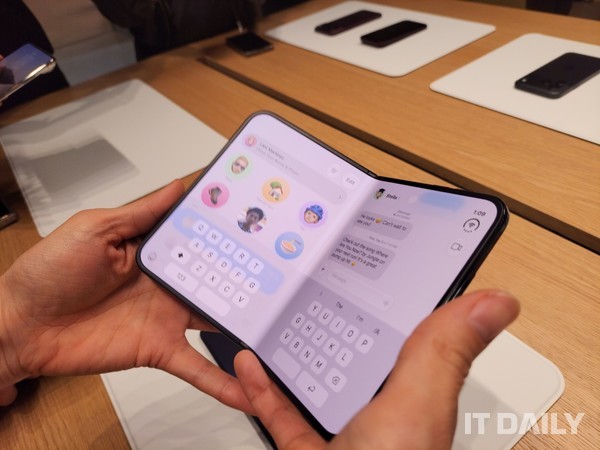
When the iPhone Duo was unfolded, two apps could run simultaneously, and when the device was switched from portrait to landscape, the layout and size of the two apps changed to match the screen orientation. When the device was folded again, the content in use moved to the outer display. In this way, the app layout and interface changed depending on the device’s orientation and screen state, and the OS and apps responded in step with folding, unfolding, rotating, and standing the device up.
To match these characteristics, the hinge structure was newly designed specifically for the foldable form factor, and the thermal management structure was also newly designed specifically for the foldable form factor. A photo caption showed the iPhone Duo being used with two screens while unfolded.
The iOS 27.1 installed on the iPhone Duo supports Split View for the first time on an iPhone. This allows two apps to run side by side at the same time. One example use case showed playing a video on one side while writing a message on the other.
Apps can also be moved to the edge of the screen and placed side by side with another app. This transition to a parallel layout involves almost no stutter. iOS 27.1 was designed so that the flow of using two apps together continues naturally in line with the foldable form and changes in screen orientation.
When the device is rotated, the way the app areas are divided changes according to the screen orientation. The app areas are also rearranged to match vertical unfolding and horizontal unfolding. As a result, even during folding, unfolding, and rotation, the screen layout is adjusted to fit the changing form.
The same aspect ratio is applied to both the internal and external displays. The purpose of applying the same aspect ratio is to reduce changes in content ratio when folding and unfolding. iOS handles screen transitions by moving or rearranging content and the user interface to the appropriate screen when the device is closed, rotated, or flipped.
The foldable screen of the iPhone Duo is also reflected in the app experience. Changes caused by screen transitions were visible while Netflix was running, and when the device is unfolded while browsing content on the outer display, the interface changes to one suited for the larger screen. Apple said that some third-party apps, including Netflix, Zoom, and Slack, support interfaces tailored to the iPhone Duo’s screen structure.
The iPhone Duo can also be used while propped up without opening the device fully. It supports the StanBy feature, which can display the clock, photos, and widgets even when the charger is not connected.
This kind of use is closely tied to the benefits of the folding structure. The iPhone Duo can be set at a mid-angle, making it possible to use the screen upright without a separate stand. Behind this ability to stand it up without a separate stand is a hinge function that maintains a certain angle.
At first, the hinge resistance felt unfamiliar, but using the device upright made the reason for that resistance clear. The photo was taken by reporter Kim Byeong-ju (김병주).
During repeated opening and closing, the iPhone Duo’s hinge resistance varied by angle. The feel when starting to fold it immediately after full opening differed from the feel after it was partially folded. In particular, resistance became stronger in the section where the folding angle narrowed further.
That resistance was linked to the device’s ability to hold its shape at a mid-angle. Even when the hands were removed, the two screens stayed fixed at a certain angle. For that reason, no separate support was needed when watching video or using the camera.
The iPhone Duo’s hinge is made up of more than 100 parts. This hinge supports the center of the display when unfolded and is responsible for controlling opening and closing movements. An internal magnet arrangement has also been applied.
This magnet arrangement helps the two sides engage securely when closing. When fully closed, the feel of the two sides moving close together and then snapping shut as if pulled by magnets was distinct. Even after repeated opening and closing, the two sides still engaged at a set position at the end.
When examining the crease at the center of the foldable smartphone’s screen, the visibility of the crease varied depending on viewing conditions and the angle of reflection. Under bright content and a head-on view, the central crease was difficult to identify.
By contrast, it could be seen when the screen was dark or when light reflected at an angle. This indicated that the crease had not been completely eliminated.
Apple applied a Nano-texture finish to the internal display. The purpose of Nano-texture is to reduce reflected light, and as reflected light was reduced, the crease also became less visible.
Based on the brief hands-on experience, the crease did not significantly distract the eye when viewing bright content head-on. However, that did not mean the crease itself had disappeared.
In terms of heat, warmth was noticeable on the iPhone Duo while running high-performance content, and heat was present even in the thin foldable structure. However, because the vapor chamber spreads and dissipates heat generated by the chip, it is difficult to judge thermal management performance by surface temperature alone, and the heat felt on the device surface and throttling of the chip should be considered separately.
The iPhone Duo is equipped with the same A20 Pro chip as the iPhone 18 Pro. A custom-designed vapor chamber has been applied to the iPhone Duo, and the structure connects the A20 Pro directly to the vapor chamber to disperse the heat generated. Apple said the iPhone Duo’s sustained performance is up to 35% better than the iPhone 17 Pro’s.
Use cases when the screen is unfolded include running two apps simultaneously and playing high-performance games. Because such usage environments involve sustained heavy load, not only peak performance but also how long performance can be maintained is an important factor. The photo shows a high-performance game running on the iPhone Duo.
However, this hands-on session alone could not verify sustained performance. To verify it, it would be necessary to measure processing speed and temperature changes while repeatedly running games and video processing over an extended period.
What was confirmed on site was that the device surface felt warm after heavy-load tasks. The gist of the photo caption was that Apple claims improved sustained performance through the application of the A20 Pro and the custom-designed vapor chamber.
On a foldable, the camera can take advantage of the two screens separately. When the rear camera is being used for shooting, running Duo Preview displays the shooting screen on the outer display. This is a way of sharing the camera view with the subject, allowing the subject to directly check their position and expression.
The same structure also applies to rear-camera selfies. When taking a rear-camera selfie, the composition can be checked on the outer screen. It is a way of connecting spare screen space to the camera function.
The same structure extends to the “eye contact” feature as well. This feature displays a Peanuts animation on the outer screen. Its purpose is to encourage children to look at the camera.
However, evaluation of heat and performance changes during prolonged use is not possible from a short hands-on session alone. Durability testing of the hinge and internal display after repeated opening and closing is also not possible from a short hands-on session alone.
In addition, the range of third-party app support is a variable that will determine practical usability. For that reason, it is difficult to conclude the overall level of usability, including areas beyond camera functions, based on a brief hands-on experience alone.
Apple is helping developers adjust their apps to the iPhone Duo’s screen structure by using the SDK and API, and currently some apps, including Netflix, Zoom, and Slack, are responding to the Duo’s screen structure. Going forward, the extent to which the two screens can be used as actual workspaces may expand depending on third-party app support.
Source: IT DAILY · Kim Byeong-ju
Original: https://www.itdaily.kr/news/articleView.html?idxno=241724
References
This article was produced with the help of an automated content generation algorithm.
Source: IT DAILY
View originalThis article was summarized and organized by BizCrush based on the original article from IT DAILY. For exact quotations and full details, please refer to the original article.