MS: AI Leaders See 4x Return on Investment, With Scale and Governance Driving the Gap
TECHWORLD ·
✦ AI Summary
Microsoft and IDC analyzed performance differences among companies according to AI maturity through the 'Business Opportunity of AI Study.'
The average return on AI investment for Frontier Firms, the top 10% in the IDC AI maturity assessment, was 4x, while companies in the bottom 30% recorded 2.7x.
Frontier Firms showed higher levels in organization-wide use, large-scale agent deployment, management and oversight, and capability building.
BizCrushWant to follow Korean talks and live streams in real time?Try CapCrush on the web
Microsoft conducted the 'Business Opportunity of AI Study' with IDC and on the 26th presented differences in performance among companies based on AI maturity. The study analyzed differences in return on investment and operating methods between companies with high AI maturity and those that have been slow to adopt AI. More than 5,200 IT and business senior leaders from 28 industries around the world participated in the survey.
The survey classified the top 10% in the IDC AI maturity assessment as 'Frontier Firms,' and their average return on AI investment was 4x. By contrast, the average return on AI investment for companies in the bottom 30% that have been slow to adopt AI was 2.7x.
MS pointed to scale and governance capabilities as factors behind the gap between leading companies and later adopters. It also identified the adoption of AI agents, governance, performance measurement, and organizational capability building as conditions for expanding AI outcomes across the organization.
In responses from business leaders on AI adoption results and return on investment, Frontier Firms showed higher figures than other companies. The share of respondents reporting more than 5x return on investment was 39% for Frontier Firms and 4% for companies slow to adopt AI. However, IDC explained that these figures show correlation, not causation, between the level of AI use and return on investment.
Companies delivering results from AI adoption appear to be increasing. Among all respondents, 66% said AI was producing significant or transformative outcomes. However, only 48% of all respondents said they had expanded AI use across multiple business units, showing differences in organization-wide diffusion.
A gap was also seen in performance measurement capabilities. The share of companies saying they were highly confident in measuring AI business value and return on investment was 61% overall, compared with 93% for Frontier Firms. This underscores the gap in performance measurement capabilities.
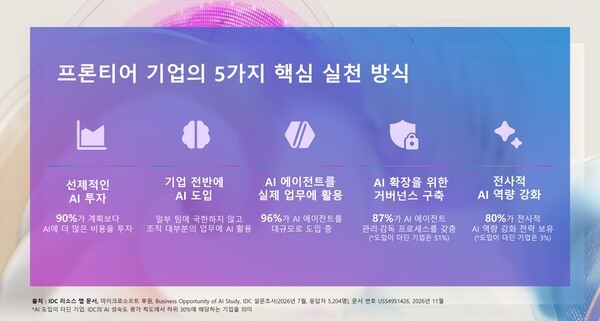
Differences in the level of AI agent adoption also continued. Thirty-six percent of all companies said AI agents were still in pilot operation. By contrast, 96% of Frontier Firms were found to have AI agents deployed at scale.
Frontier Firms were also found to be using agents more by connecting them to multiple work processes. Fifty-three percent of Frontier Firms said they were linking and using AI agents across multiple work processes. Return on investment from agents was also higher for Frontier Firms at 3.8x, compared with 3x for companies that have been slower to adopt AI.
As the use of agents expands, the importance of management and oversight systems has also grown. Sixty-five percent of all companies had AI agent management processes in place. Sixty percent of all companies said they were confident in responding to security and governance risks.
There were also differences among company groups in the extent to which related processes were in place. Eighty-seven percent of Frontier Firms had agent management and oversight processes in place. By contrast, 51% of companies slow to adopt AI had agent management and oversight processes, the survey found.
On the organizational side, the gap among company groups widened in relation to systems supporting AI use. Sixty-seven percent of all companies said employee trust in AI was high. However, only 20% of all companies had a strategy in place to strengthen AI capabilities across the organization.
The gap between Frontier Firms and companies slow to adopt AI was especially large. While 80% of Frontier Firms had an organization-wide AI capability-building strategy in place, only 3% of companies slow to adopt AI were found to have such a strategy.
Based on the differences among companies, IDC grouped the common traits of Frontier Firms and summarized the results into five areas: expanding AI investment, organization-wide use, putting agents into actual work, establishing governance, and strengthening organizational capabilities. IDC said it drew the five-point summary based on these differences. It also found that 90% of Frontier Firms expanded AI investment beyond their original plans.
The survey also found that the scope of AI use among surveyed companies was expanding. The average number of business areas using AI among surveyed companies was 6.5. The areas with the most active AI use were IT infrastructure, cybersecurity, and customer service.
Based on this, Microsoft presented four operating principles for expanding AI value. The principles consist of selecting task-fit AI models, redesigning work processes around AI agents, governance for AI decision-making and execution, and measuring and optimizing investment returns.
Microsoft explained that when selecting AI models, companies need to consider not only performance but also cost, security, intellectual property, and data protection at the same time. In the IDC survey, the main criteria for choosing an AI platform were trust and security at 44%, the latest technology at 44%, and model performance at 44%.
When applying AI agents, work processes need to be redesigned, and human oversight should be maintained at key decision-making and execution stages, the report said. It explained that the process of introducing AI agents requires both work redesign and the maintenance of human oversight.
It then pointed out that as the deployment of multiple agents expands, the scope of management also needs to expand. It said the scope of management includes model responses, agent judgments, and actual execution processes.
It also raised the task of continuously measuring AI investment results and explained that AI investment and usage data need to be linked with actual business performance. As business performance items, it cited revenue, customer experience, and productivity, and added that investment priorities need to be adjusted by comparing changes before and after adoption.
At the same time, 71% of surveyed companies were expected to increase their AI budgets by more than 10% within the next 12 months. Kathy Lange said companies that expand AI value do not stop at simply increasing investment, but move to integrated management of AI investment, models, agents, governance, and organizational capabilities. She also said it is important to turn early gains into value that can be repeatedly created across the organization.
Alysa Taylor, CMO of Microsoft Commercial Cloud and AI, said while explaining the next phase of AI development that the deciding factor for AI's next stage is not whether a company uses AI, but whether it is the one driving value expansion and maintaining control.
Source: TECHWORLD · Kim Seung-gi
Original: https://www.epnc.co.kr/news/articleView.html?idxno=410355
References
This article was produced with the help of an automated content generation algorithm.
Source: TECHWORLD
View originalThis article was summarized and organized by BizCrush based on the original article from TECHWORLD. For exact quotations and full details, please refer to the original article.
Keep reading
BizCrush