Tencent Unveils Translation AI for 102 Languages to Target Localization
AI TIMES ·
✦ AI Summary
According to AI TIMES, Tencent said on Nov. 24 that it unveiled an open-source translation AI, "Hunyuan MT3," that supports 102 languages, i…
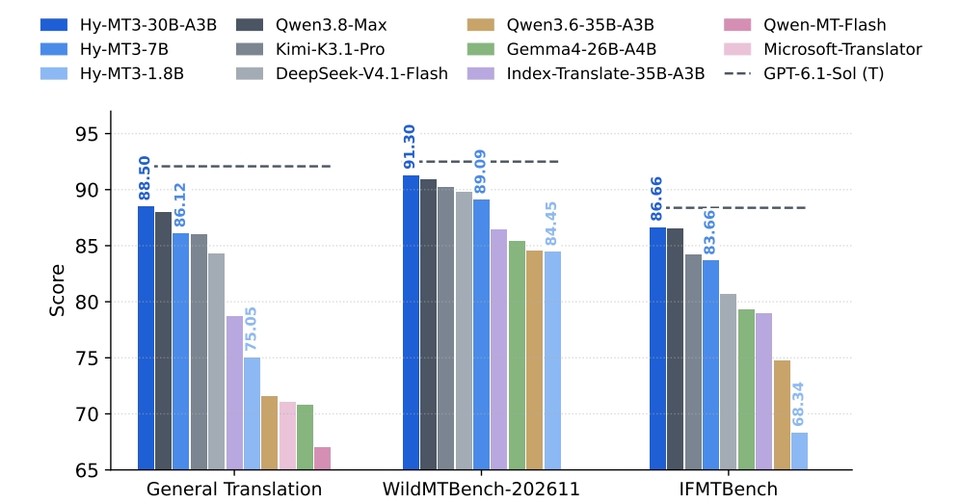
According to AI TIMES, Tencent said on Nov. 24 that it unveiled an open-source translation AI, "Hunyuan MT3," that supports 102 languages, including Korean, and reduced mistranslations by 43% compared with the previous generation. The core of the announcement is that, together with a quality evaluation tool released alongside it, the company has improved translation accuracy and instruction-following capabilities. The model stands out for raising performance in low-resource languages and strengthening functions that are immediately needed in industrial settings, such as game localization and OCR-based image translation. It is also designed to make it easier for companies to adopt or further train the system to fit their own environments by offering options ranging from lightweight versions to mixture-of-experts architectures. Tencent also highlighted use cases not only for general translation but also for game development pipelines, content distribution, e-commerce, and multilingual enterprise services. By making both the translation model and the evaluation framework open source, Tencent appears to be pursuing a strategy that goes beyond performance competition and extends to real-world service operations and quality management.
Perspective
This issue shows that the benchmark for translation AI competition is shifting from simple sentence generation capability to controllability and operational convenience in real work environments. In particular, the approach of releasing not only the model but also the evaluation framework is meaningful because it can create a process in which adopting companies verify and improve results. In the end, the broader the field of use, the more important it becomes to reliably preserve the desired format and terminology rather than the performance number itself, and this release can be read as a shift aimed at that kind of demand.
This perspective is BizCrush's own commentary and is not part of the reporting by AI TIMES.
This article was produced with the help of an automated content generation algorithm.
Source: AI TIMES
View originalThis article was summarized and organized by BizCrush based on the original article from AI TIMES. For exact quotations and full details, please refer to the original article.