[On Site] KOSA Unveils AI·SW Project Fee Roadmap to Set Appropriate Rates Based on AI Characteristics
IT DAILY ·
✦ AI Summary
KOSA said it is pushing ahead with overhauling its fee-calculation framework to reflect the changing cost structure of SW projects brought on by AI adoption.
At the "2026 Software Project Fee Seminar" held on the 24th, it unveiled the "AI·SW Project Fee Roadmap" and "Reference Materials for AI Project Fee Calculation."
The roadmap includes specifying AI specialized job roles and technology systems, securing and verifying actual project data, reviewing new calculation methods, and advancing standards for AI-specific costs and life-cycle criteria.
BizCrushWant to follow Korean talks and live streams in real time?Try CapCrush on the web
As AI spreads and changes the cost structure of SW projects, calls have grown for updates to the fee-calculation standards. In response, the Korea AI and Software Industry Association (KOSA) said it will push ahead with overhauling its fee-calculation framework to reflect changes in SW project costs brought on by AI adoption.
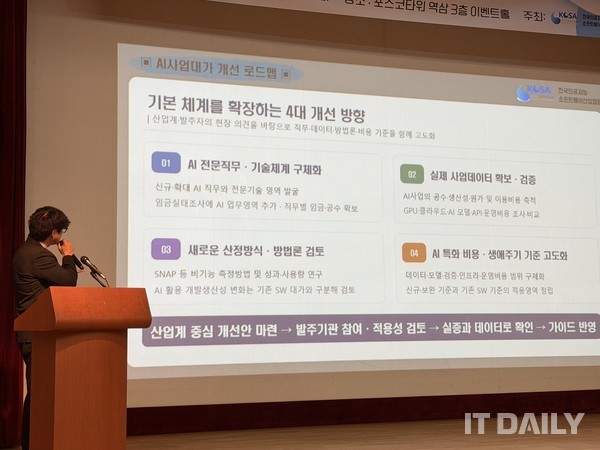
KOSA held the "2026 Software Project Fee Seminar" on the 24th at Posco Tower Yeoksam in Gangnam-gu, Seoul, and unveiled the "AI·SW Project Fee Roadmap," which includes short- and mid- to long-term plans to improve the fee-calculation framework for AI projects. On the day, KOSA Team Leader Kim Kyu-il presented the details at the "2026 Software Project Fee Seminar" on the 24th.
KOSA said the roadmap calls for surveying the costs of AI specialist technologies and development and operations. It added that it will then carry out verification based on actual project data and gradually supplement the existing calculation standards. The on-site photo was taken by reporter Yang Seung-gap.
KOSA has been publishing and operating the "SW Project Fee Calculation Guide" to help commissioning agencies calculate appropriate costs when budgeting and ordering SW projects. KOSA is working to improve the current guide.
The push for improvement stems from the current guide's failure to reflect the characteristics of AI projects. As AI spreads, development productivity changes, project execution methods change, and cost structures change, leading to the view that it is difficult to calculate appropriate project costs based only on existing standards.
Examples of costs not reflected include specialized technology costs for fine-tuning large language models (LLMs), specialized technology costs for building retrieval-augmented generation (RAG), and specialized technology costs for operating and managing machine learning models (MLOps). These specialized technology costs, it was explained, are not sufficiently reflected in project fees.
At the same time, AI-related technical job categories have not been defined. As a result, differences of opinion are emerging between clients and contractors over the application of the average SW engineer wage.
Explaining the related plan, KOSA Team Leader Kim Kyu-il cited token usage as an example. Discussions do exist about calculating the cost of AI projects based on API call volume and token usage.
However, it was determined that those indicators alone have limitations in representing the total cost of AI projects, and that there is also a lack of practical, verifiable data and supporting evidence. Kim Kyu-il stressed the principle of gradually reflecting validated elements rather than adopting any one method uniformly.
Accordingly, the roadmap is intended to supplement the current guide's AI project fee-calculation framework. It also said the basis for the supplement would be the earlier review items, and that it would push ahead with supplementing AI project fees.
The roadmap presented four improvement directions, and it will maintain the basic calculation framework in the 2025 revised version of the SW Project Fee Calculation Guide. It will also review additional cost and performance factors across the full life cycle of AI projects.
The starting point for verification will be service fees, labor input, and existing SW development cost calculations, and the scope of specialized costs and the reflection of operations, quality, and performance will be clarified through verification of actual project costs. This direction was presented as a way to gradually reflect validated elements.
Four improvement directions were shared as tasks for overhauling the AI fee system. Improvement direction 1 is to specify AI specialized job roles and technology systems, improvement direction 2 is to secure and verify actual project data, improvement direction 3 is to review new calculation methods and methodologies, and improvement direction 4 is to advance standards for AI-specific costs and the life cycle.
Among these, KOSA Team Leader Kim Kyu-il identified securing and verifying actual project data as the top priority to address. He said it is necessary to accumulate labor input, productivity, cost, and usage expenses for AI projects. A photo of Kim Kyu-il was also published, and the photographer was Yang Seung-gap.
KOSA unveiled a plan to simultaneously improve on-site reference materials and secure basic data for fee-system upgrades. In the medium to long term, KOSA plans to conduct studies on changes in development productivity due to AI adoption, research into AI specialized job roles, and broader research into fee-system issues such as specialized cost factors. It also plans to review the feasibility of introducing the non-functional requirements measurement method (SNAP).
KOSA then plans to proceed with verification based on project data and carry out pilot applications. It plans to sequentially incorporate the results of these studies into the existing guide.
Kim said the improvement measures will be developed with the industry at the center. He explained that participation from commissioning agencies and reviews of applicability will be carried out.
Kim said the participation of the client side is essential. He also explained that there is a need to share on-site conditions from actual ordering processes. In addition, he said opinions will be gathered and supplemented to reflect industry realities.
He explained that the guide will be updated after validation and data checks. He also said that the appropriateness of calculation methods and cost structures will be verified through validation and project data, and that the results will be reflected in the fee guide after that work is completed.
Kim said the direction presented since 2025 has been consistently maintained. He added that the goal is to develop standards into AI·SW project fee criteria tailored to the field and to continue making sustained efforts to that end.
On the day, KOSA released "Reference Materials for AI Project Fee Calculation" as a roadmap task. The reference materials, intended for practical use in the field, contain guidance on practical calculation standards for AI specialist technologies. KOSA said this is intended to resolve disagreements between clients and contractors and create a fair trading environment.
The fee-calculation scope for AI introduction projects in the existing guide was expanded to cover the entire AI build project process. As a result, the specialized technology area needed to complete an AI project was defined for the first time as an "AI-specialized technology element." The "AI-specialized technology element" was presented as separate from customization and system development, and the cost calculation for the input of related specialists was linked to the existing SW project fee system.
With this overhaul, the cost structure of AI build projects was organized into five categories. The five items are service fees, customization work costs, AI-specialized technology element costs, AI system development costs, and AI infrastructure build costs.
In the process, AI-specialized technology element costs were newly created, and the calculation standards for AI system development costs and AI infrastructure build costs were made more specific.
However, these standards are not the official standards for incorporation into the guide, and the material is intended as a reference for practical use in the field. KOSA Senior Executive Kim Chang-soon said labor-input methods are widely used in the field, and that the material is a reference designed to explain how to use them.
On the premise that analysis, hardware engineering, and quality work for AI projects differ from existing tasks, the speaker said that the separate classification of job roles and separate surveys of average wages are being reviewed from a long-term perspective. However, the job classification is not necessarily a standard that must be chosen, and since differences of opinion may arise between clients and contractors over whether a worker is a system SW developer or an application SW developer, the job classification is only a reference criterion for resolving such disagreements between the two sides.
Source: IT DAILY · Yang Seung-gap
Original: https://www.itdaily.kr/news/articleView.html?idxno=243172
References
This article was produced with the help of an automated content generation algorithm.
Source: IT DAILY
View originalThis article was summarized and organized by BizCrush based on the original article from IT DAILY. For exact quotations and full details, please refer to the original article.
Keep reading
BizCrush