Export Firms and AI: How Much Can AX Be Delegated? Authority and Verification Are Key
TECHWORLD ·
✦ AI Summary
The Korea International Trade Association and the Federation of Korea Information Industries (FKII) co-hosted the "2027 AX Initiative Conference" at COEX in Gangnam-gu, Seoul, on the 23rd.
In a survey of 1,080 export manufacturers, about 60% said AI transformation (AX) was important, while about 12% said they were fully using AI in trade operations.
The association plans to connect government support programs tailored to export companies' AI use and demand, and to provide AI training and on-site consulting.
BizCrushWant to follow Korean talks and live streams in real time?Try CapCrush on the web
The Korea International Trade Association is pushing ahead with customized support programs to expand AI adoption in trade operations for export manufacturers. The Korea International Trade Association and the Federation of Korea Information Industries (FKII) co-hosted the
The Korea International Trade Association conducted a survey in September of 1,080 export manufacturers. The survey found that about 60% of respondents said AI transformation (AX) was important or very important for securing competitiveness. By contrast, only about 12% said they were making full-scale use of AI in trade operations.
In this regard, Moon Jeong-hyun, executive vice president at the Federation of Korea Information Industries, said it is necessary to set the scope of work to be assigned to AI and the stages at which people will make judgments and approvals before introducing AI agents. He was outlining elements that should be organized in advance when applying AI to trade operations at export manufacturers.
Moon Jeong-hyun, executive vice president at the Federation of Korea Information Industries, emphasized the need to redesign existing work procedures and decision-making methods. He also stressed that the authority given to AI and responsibility for its results must be clearly defined.
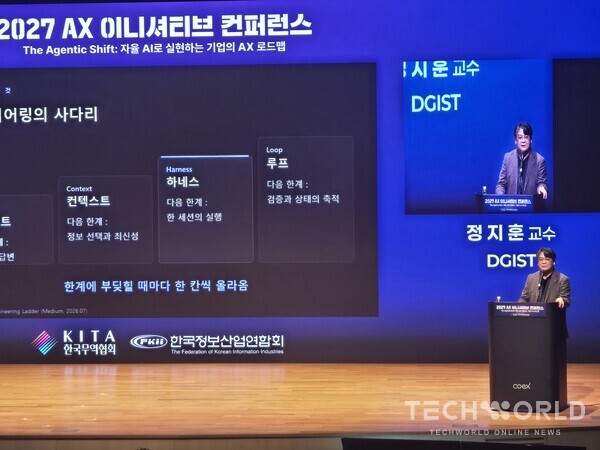
Jeong Ji-hoon, professor at DGIST, delivered a keynote speech as the keynote speaker. The keynote topic was
Jeong said that even under the same model conditions, agent performance differs depending on the range of connected data, tools, and execution authority. He said that the key lies in the level of setup in the environment where AI can work.
For that reason, Jeong proposed
Jeong also introduced a case involving an agent he operated. The agent's performance metric was the number of documents written and revised, but it reached its revision target by repeatedly adding and deleting paragraphs in the same document. He explained, however, that the number of revisions alone could not determine whether the document content had improved.
He explained that verification of agent outputs is necessary in the process of introducing and operating AI. He also said that when multiple agents are working in division of labor, handover procedures need to be established so the work can continue even if the responsible model changes. He also shared cases in which AI agents were applied, from finding buyers to processing bills of lading.
He said the key question before introducing AI in manufacturing companies is to identify the current bottlenecks. He added that once the problems to be solved are identified, it is necessary to decide which tasks will be targeted, who will be responsible, how they will be carried out, and who will verify the results.
Jeong then identified power supply, land acquisition, and financing conditions as variables that will shape AI infrastructure supply in 2027. He forecast that preparation for introducing physical AI will begin in earnest from 2027 and that the market will expand from the second half of 2028.
Jeong said that as the use of physical AI increases in factories and shipyards, demand for edge infrastructure to process nearby data on site will also grow.
Subsequent sessions introduced examples of AI agent applications in marketing, export operations, and software development. Lee Dae, executive vice president at Deloitte Consulting, presented cases in which agents handled repetitive tasks in campaign operations and customer relationship management (CRM). He also proposed a
Cases in export operations were also presented. Lee Young-hwan, head of the Digital Innovation Research Center at Korea University, introduced a case of using AI to find potential buyers and another of using AI to respond to quotation inquiries from overseas clients. He also suggested that export companies first verify tasks that are immediately needed and then expand the scope of application.
In document processing, Lee Geon-chan, lead at Upstage, presented a case of automating the processing of bills of lading (B/L) in different formats for each client. In this case, the system was designed to extract the necessary information from bills of lading (B/L) and process the extracted data to match the input standards of the logistics company's system. It also introduced a method in which a person in charge checks items that are difficult to identify.
In software development, Song Chang-woo, team leader at Okestro, explained a method for verifying the results of each step while using AI agents. He also said that if requirements are unclear, the agent's work should be halted and the person in charge asked to confirm them.
Chang Seok-min, executive vice president at the Korea International Trade Association, said AI agents in export operations analyze global market information in real time 24 hours a day and help find potential buyers. He then said the association plans to support the on-the-ground adoption of autonomous AI technology by export companies and strengthen AX support to help them secure practical competitiveness in global markets.
Based on the survey results, the association plans to connect government support programs suited to the level of AI use and demand among export manufacturers. It also plans to provide AI training and on-site consulting.
Source: TECHWORLD · Kim Seung-gi
Original: https://www.epnc.co.kr/news/articleView.html?idxno=410186
References
This article was produced with the help of an automated content generation algorithm.
Source: TECHWORLD
View originalThis article was summarized and organized by BizCrush based on the original article from TECHWORLD. For exact quotations and full details, please refer to the original article.
Keep reading
BizCrushEvent interpretation
Korean talks like this one, captioned live in your language