AI Agent Era Dawns with 1 Billion Agents, and Why AWS Is Redesigning the Cloud
TECHWORLD ·
✦ AI Summary
AWS is redesigning its cloud infrastructure across computing, storage, and databases in response to the spread of AI agents.
AWS is changing agent workflows, computing resources, and execution environments for the AI agent era, while also using Trainium, Graviton, and Nitro Sandboxes.
It is also adding analytics features to S3, preparing AWS Context and Amazon Bedrock AgentCore, and revamping sign-up and deployment processes as it shifts toward an FDE-centered model.
BizCrushWant to follow Korean talks and live streams in real time?Try CapCrush on the web
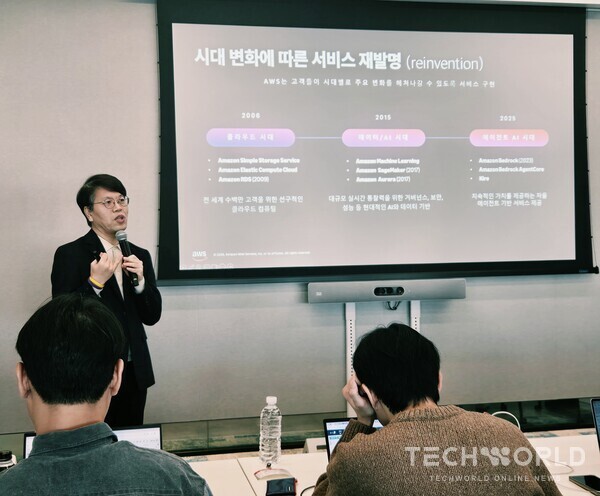
Amazon Web Services (AWS) is redesigning its cloud infrastructure across the board in response to the spread of AI agents. The redesign covers computing, storage, and databases. On the 24th, AWS held a press briefing to introduce the technological changes and business strategy of the agentic AI era under the theme, "The cloud is changing in the AI agent era."
The briefing was held ahead of AWS re:Invent 2026, which will run from the 30th through December 4. Since launching its cloud services in 2006, AWS has led the shift of physical servers and storage to the cloud. It has also expanded into ML and AI in line with growing demand for enterprise data use.
Recently, AWS has been changing its service architecture so that AI agents can perform tasks on behalf of people and directly use infrastructure. As a result, AWS has begun redesigning its entire cloud infrastructure, spanning computing, storage, and databases, to respond to the spread of AI agents.
Yoon Seok-chan, AWS Korea senior technical evangelist, said the center of the cloud is shifting from people and operators to agents. AWS forecasts that more than 1 billion AI agents will be deployed by 2029.
AWS said AI agents are evolving from single agents handling specific tasks to multi-agent systems that collaborate with one another. It also said that as multi-agent systems spread, their scope of use is expanding from the individual and department level to collaboration between companies.
Against this backdrop, the role of agents is expanding beyond model inference to actual work execution. AWS cited 'AWS Emulator,' software for testing cloud services, as an example.
AWS said it deployed several thousand autonomous AI agents to AWS Emulator to handle testing, error detection, and fixes, and automated everything from feature implementation to deployment. Through this, it said it is operating a structure in which AI agents carry out real work.
This shift is also changing demand for computing resources. AWS explained that while GPUs are mainly used for model training and inference, CPUs are the dedicated resource for database queries, API calls, and code execution.
AWS said that in agent workflows, LLM calls occur 1 to 2 times per task iteration, while tool execution occurs 5 to 15 times. Yoon said CPUs handle 80% of actual work in AI agent workflows.
Yoon said that even as agents shift to autonomous task execution, CPU dependence will continue for most tasks. AWS explained that tool execution outnumbers LLM calls in agent workflows, and that a large share of actual processing therefore rests on CPUs.
AWS is expanding its supply of Nvidia GPUs to meet this demand. It also has Trainium, its own AI training and inference semiconductors, and Graviton, an Arm-based CPU.
AWS said it is addressing computing demand with Trainium and Graviton. Yoon said more than 90% of AWS's top 1,000 customers use Graviton.
AWS put its AI infrastructure investment this year at USD 200 billion. It plans to secure 3 million Nvidia GPUs by 2028 and double infrastructure capacity by the end of 2027.
On questions about external uncertainties, Yoon said that while external uncertainties such as data center regulations do exist, AI computing resources are expensive and demand for them will continue. He said the current investment stance is therefore expected to remain unchanged.
At the same time, the expansion of computing resources is underway, and work is also progressing to segment execution environments by agent. This is because assigning a conventional virtual machine (VM) to each individual agent can cause execution delays and idle resource costs, and if multiple agents share infrastructure, data access controls are needed.
In response, AWS has Nitro, its own security and virtualization technology, and has unveiled Nitro Sandboxes based on Nitro. Nitro Sandboxes provide hardware-level isolation for container workloads, and AWS also offers Lambda MicroVMs, which run user-generated code and AI-generated code in separate virtual machines.
Yoon said he expects the number of agents handling more granular tasks to increase in the future. He explained that the narrower an individual agent's scope of work becomes, the easier it is to verify whether that agent is performing properly.
As AI agents spread, data storage and analysis methods are also changing. The traditional approach was for people to write the necessary queries and analyze the results. In contrast, the AI agent approach repeatedly runs multiple queries and compares the results.
This shift is also changing infrastructure requirements. In environments where several thousand agents access data simultaneously, companies need to secure both processing performance and cost efficiency.
Accordingly, AWS has added table and vector data storage features for analytics to its object storage service, Amazon S3. The feature is intended to reduce the process of moving data to separate analytics environments and to help analytics services directly access stored data.
Yoon said that while the focus of traditional data repositories has been on storage, future systems need to be designed so that analysis is possible from the storage stage itself.
In line with this shift, the use of open standards and open-source technologies is expanding to improve data interoperability and analytics performance. Apache Iceberg, an open table format, allows different analytics engines to use the same data, and DuckDB, an analytics database, is also being cited as a representative technology in use.
AWS is preparing to launch AWS Context. Based on a knowledge graph and ontology, AWS Context includes features that help AI agents understand the meaning, relationships, and business rules of internal enterprise data.
AWS is also offering Amazon Bedrock AgentCore, which uses the data and business context it has secured for actual agent operations. Through this, companies can keep their existing systems and data, while selecting and using agent-building functions such as execution environments, memory, external system integration, authentication, and permission management.
As AI agents become involved in building and operating cloud infrastructure, the way services are used is also changing. In response, AWS has revamped its sign-up process. Developers can create AWS accounts from AI development tools without separately accessing the cloud console, and they can also deploy applications from the same AI development tools.
With these changes, the technical barrier to cloud building and operations is being lowered. As a result, changes in the role of existing MSP and SI companies are also expected.
Yoon said that in this trend, the importance of Forward Deployed Engineers (FDEs), who are directly dispatched to customer sites, is expected to grow. The traditional SI business model focuses on building systems based on customer requirements and handling maintenance.
By contrast, FDEs work with customers to identify problems in the workplace and focus on implementing solutions. They also support the internalization of technology so that customers can operate the system themselves after deployment.
AWS is shifting its existing Professional Services organization toward an FDE-centered model and has also started related training for cloud partners. Yoon said this trend means he expects the cloud ecosystem to shift into an AI-era model.
Yoon summed this up as a shift toward building what customers need. He also said that support for customers to build and operate their own AI agents is likely to expand.
AWS plans to introduce cloud infrastructure and new services for the AI agent era at the upcoming re:Invent. AWS's strategy is to support the selection and use of the technologies needed at each stage of computing, data management, model training, inference, and agent development and operations.
Source: TECHWORLD · Kim Seung-gi
Original: https://www.epnc.co.kr/news/articleView.html?idxno=410234
References
This article was produced with the help of an automated content generation algorithm.
Source: TECHWORLD
View originalThis article was summarized and organized by BizCrush based on the original article from TECHWORLD. For exact quotations and full details, please refer to the original article.
Keep reading
BizCrush