Lowering the Barrier to Expensive Test Equipment... Supporting Validation for Intelligent On-Device Devices
IT DAILY ·
✦ AI Summary
As connectivity demands grow for intelligent on-device devices such as AI smart glasses, XR devices, and autonomous mobile robots, domestic small and medium-sized enterprises and startups are struggling to secure expensive test equipment and to verify performance and obtain certification.
On the 19th, at the "2026 Korea Radio Industry Exhibition," TTA and GERI shared progress on government tasks under the "2026 ICT Convergence Intelligent Device Development Vitalization and Diffusion Infrastructure Establishment" project.
At the exhibition site, a high-speed mobility test solution, the PDA "LM75," a "5G on-device AI" solution for mobile CCTV, and the industrial IoT (IIoT) gateway "SMAC+" were introduced.
BizCrushWant to follow Korean talks and live streams in real time?Try CapCrush on the web
As the functions of intelligent on-device devices such as AI smart glasses, XR devices, and autonomous mobile robots become more advanced, connectivity demands for these devices are also expanding as AI develops. However, domestic small and medium-sized enterprises and startups are struggling to secure expensive test equipment, and the burden of test equipment is also making it difficult to verify product performance and obtain certification. In response, public projects aimed at supporting product development and commercialization were introduced, and field application cases were also reviewed.
Against this backdrop, the "2026 Korea Radio Industry Exhibition" was held on the 19th. Within the event, a technology outcome exchange meeting for the "2026 ICT Convergence Intelligent Device Development Vitalization and Diffusion Infrastructure Establishment" project was held. The Telecommunications Technology Association of Korea (TTA) and the Gumi Electronics and Information Technology Institute (GERI) shared the status of government tasks.
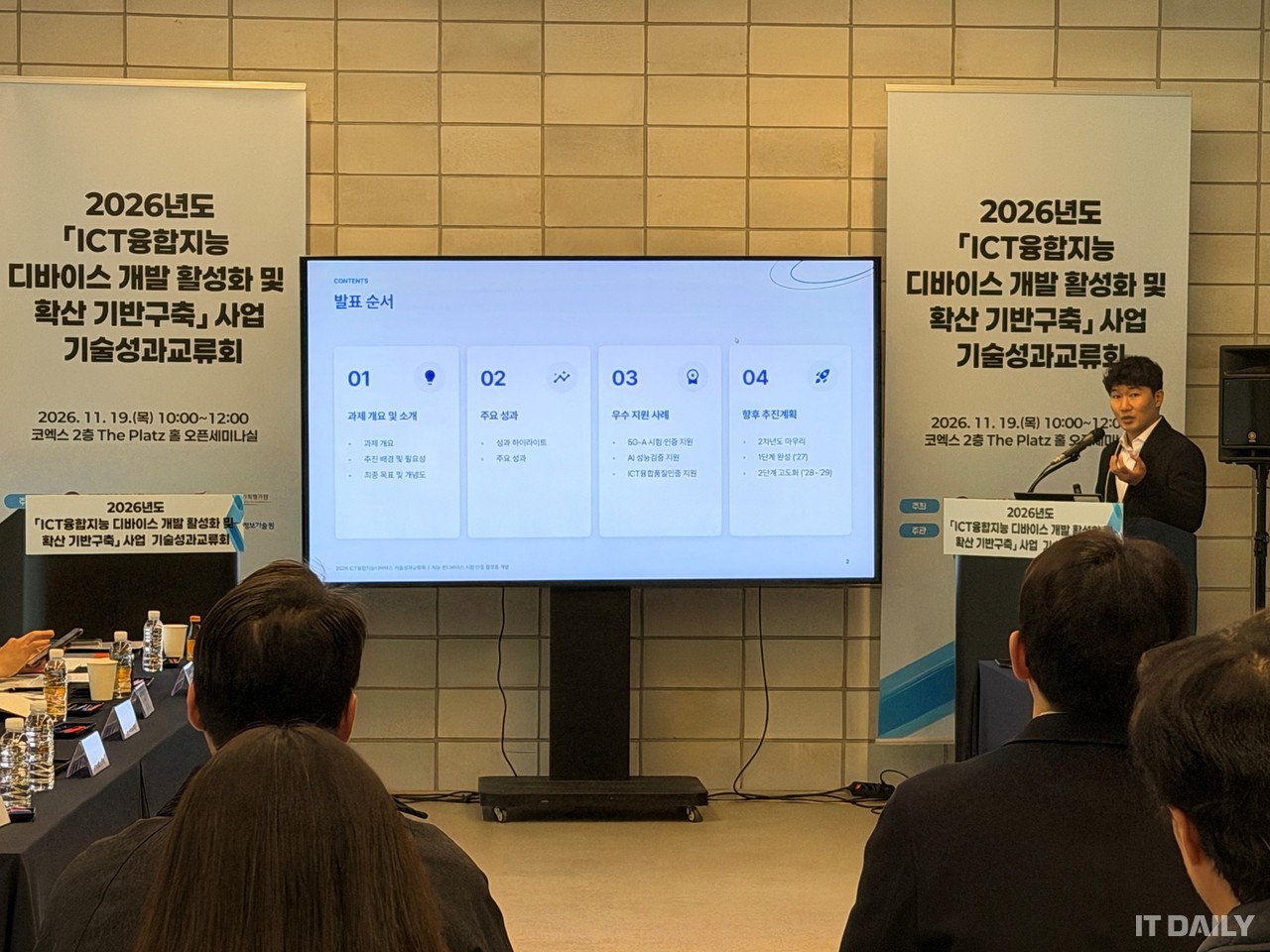
Products from participating companies were gathered at the exhibition site. The photo shows the presentation site of the technology outcome exchange meeting for the "2026 ICT Convergence Intelligent Device Development Vitalization and Diffusion Infrastructure Establishment" project. Photo by Seong Won-young.
An intelligent on-device is a terminal that performs AI computation on the device itself. This device incorporates communication technologies such as 5G and 5G Advanced (5G-A) as components and has the function of providing intelligent services.
However, infrastructure for performance verification after domestic companies develop related devices remains insufficient. This is because securing expensive test equipment is necessary, and equipment for responding to changes in communication standards must also be added or replaced. As a result, the cost burden is growing.
To address this, TTA has been carrying out the "Development of an Intelligent On-Device Testing and Certification Platform" project as part of the "ICT Convergence Intelligent Device Development Vitalization and Diffusion Infrastructure Establishment" project from July last year through 2029. The core of the project is securing expensive test equipment and specialized personnel that companies find difficult to secure individually.
The purpose of the project is to improve product reliability and support commercialization at home and abroad. The support scope covers performance verification through certification and commercialization. The total research budget is KRW 15.19 billion, and this year's government contribution is KRW 2.4 billion.
Sursofttech, a joint research institution, is responsible for AI performance verification. The Korea Network Industries Association is in charge of commercialization and overseas expansion support. The Smart Technology Promotion Association is responsible for competitions and commercialization.
This July, TTA established an internationally accredited test infrastructure for 5G Advanced communication performance verification and a testbed for video- and image-based on-device AI performance verification. It then added "intelligent on-device" to the scope of ICT convergence quality certification. As a result, on-device products equipped with AI can obtain ICT convergence quality certification.
TTA plans to complete the first-stage test platform by next year. It also plans to develop a speech-recognition AI performance verification testbed in 2028. In addition, it plans to pursue the establishment of an internationally accredited testing and certification platform with 6G in mind.
GERI is carrying out the "Development of an Intelligent On-Device Network Interworking Test Platform" project. The project supports companies in using test equipment at the level of mobile carriers. The purpose of the support is to verify interworking performance between products and mobile networks.
A network interworking test is a procedure that comprehensively checks the connection and operation of intelligent on-device devices and mobile communication networks. In the network interworking test, transmission speed, latency, and other factors are measured. This is verification to determine whether there are problems in actual service use. A test report is also issued based on the results.
The total research and development budget for this project, which runs for 4 years and 6 months from last July through December 2029, is KRW 8.244 billion, of which the government-supported R&D budget is KRW 7.2 billion.
At the exhibition site, public projects involving TTA and GERI and related test solutions were introduced. The subheading is preparedness for communication disruptions and remote management of facilities.
GERI presented a high-speed mobility test solution as an exhibition item. The goal of the solution is to verify whether a terminal maintains a stable connection to the communication network while moving.
The solution consists of a base station emulator, a channel emulator, and a shield box. The base station emulator simulates base station signals, the channel emulator reproduces the wireless signal transmission environment, and the shield box blocks external radio waves. Testing is conducted by transmitting communication signals from a high-speed mobility environment generated by test equipment to a mobile phone inside the shield box to verify performance.
The solution is characterized by allowing repeated tests of whether a terminal operates normally in high-speed mobility situations without actually boarding a train. The photo shows communication performance being verified by transmitting communication signals from a high-speed mobility environment to a mobile phone inside a shield box while external radio waves are blocked, and the photo is credited to Seong Won-young.
CyberTel Bridge exhibited the personal digital assistant (PDA) "LM75." The "LM75" can be used in communication dead zones and is designed to enable communication even when connections to mobile networks such as LTE and 5G are cut off. The device uses a separate ultra-high-frequency (UHF) band as its communication method.
Based on these features, CyberTel Bridge supplies the device to the police, fire services, the Coast Guard, and defense sectors, and also exports it overseas, including to Europe. The form of the product is divided into smartphone-type, walkie-talkie-type, and vehicle-type versions depending on the intended use.
Hupcom Wireless unveiled a "5G on-device AI" solution for mobile CCTV. The solution is built around a router with an AI chip installed and recognizes and processes on-site data based on CCTV footage. The fields of application include industrial sites and construction sites.
The solution detects whether a hard hat is being worn, fire outbreaks, and people collapsing. When a dangerous situation is detected, it is operated so that an alert is displayed to the manager.
SMAC unveiled the industrial Internet of Things (IIoT) gateway "SMAC+." SMAC equipped "SMAC+," a device that connects manufacturing site data, with support for Wi-Fi 6 and a 5G private network. This device transmits data collected at manufacturing sites to a central system. The photo credit is listed as Seong Won-young.
Previously, workers directly checked equipment status, but based on "SMAC+," it is now supported to understand operating conditions remotely and monitor equipment operating status. The data collected this way can be used for training manufacturing AI and can also serve as a foundation for implementing physical AI. Accordingly, "SMAC+" supports digital transformation (DX) and AI transformation (AX) at manufacturing sites.
Source: IT DAILY · Seong Won-young
Original: https://www.itdaily.kr/news/articleView.html?idxno=243074
References
This article was produced with the help of an automated content generation algorithm.
Source: IT DAILY
View originalThis article was summarized and organized by BizCrush based on the original article from IT DAILY. For exact quotations and full details, please refer to the original article.
Keep reading
BizCrush