Denotitia Unveils Real-Time ASIC-Powered VDPU Operation at SC26
IT DAILY ·
✦ AI Summary
Denotitia said it had unveiled, for the first time, real-time operation of its ASIC-based AI data retrieval semiconductor, the VDPU (Vector Data Processing Unit), at SC26 in Chicago, the United States.
The on-site demonstration was carried out with a VDPU card equipped with an actual ASIC, and it searched and compared vector data from more than 2.6 million video frames in real time.
The company said that applying VDPU shifts search operations away from the CPU, improving search performance and reducing host CPU usage by more than 90%.
BizCrushWant to follow Korean talks and live streams in real time?Try CapCrush on the web
Denotitia said on the 19th that it had unveiled, for the first time, real-time operation of its ASIC-based AI data retrieval semiconductor, the VDPU (Vector Data Processing Unit), at Supercomputing 2026 (SC26) in Chicago, the United States.
The company had previously demonstrated VDPU retrieval performance using FPGA at AI Infra Summit 2026 in September.
What it unveiled at the event was a VDPU card equipped with an actual ASIC. The on-site demonstration was carried out in response to a user's natural-language query.
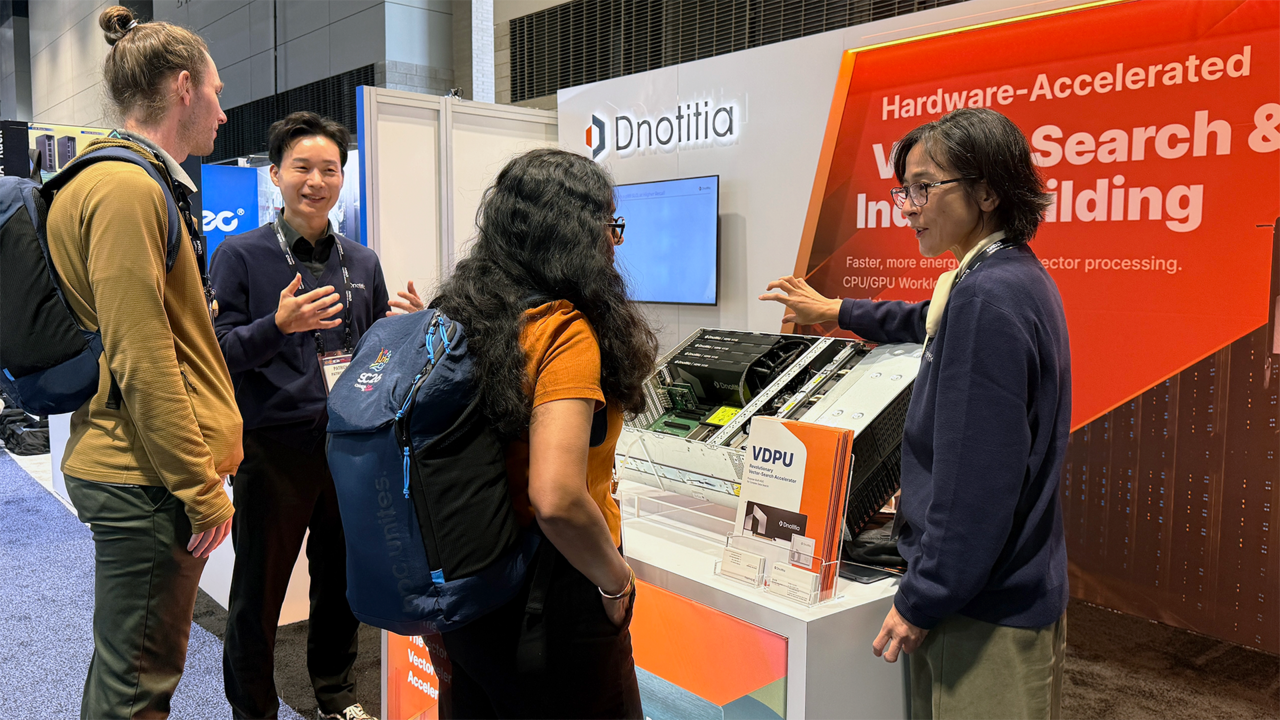
During the demonstration, it searched and compared vector data from more than 2.6 million video frames in real time to derive information with high semantic relevance. The photo shows the SC26 Denotitia booth.
The company said that applying VDPU shifts search operations away from the CPU, improving search performance compared with CPU-only execution for the same search tasks and reducing host CPU usage by more than 90%. By offloading search operations to VDPU, the CPU resources secured can be used to run AI agents and handle other services.
AI agents repeatedly query the materials needed to perform tasks and their past usage history, and semantic search is used for these repeated queries. Semantic search goes beyond simple keyword matching and looks for information that matches the context and intent of a question.
The core technology behind this kind of semantic search implementation is vector search. Vector search quantifies the semantic characteristics of documents, images and other data before comparing them, and as the scale of an agent's tasks and data grows, the amount of search and comparison computation increases sharply. Accordingly, the need for dedicated hardware to handle these operations is also rising.
Denotitia is optimizing a server architecture centered on VDPU. The target configuration is a single server equipped with multiple VDPU cards, and the performance goal is about 10 times the retrieval performance of a conventional 2-socket CPU server. To this end, it is pursuing improved overall computing-resource efficiency by applying a workload-sharing strategy in which the CPU handles service execution, the GPU handles AI model computation, and the VDPU handles vector search.
While combining hardware and software development, Denotitia is also developing its own vector DB, Seahorse. At the same time, it is developing AI agent software and reflecting the requirements of real search workloads in the VDPU design.
Based on this, Denotitia is expanding its core business into 'AI storage' for enterprise data storage, retrieval and AI model supply. It is also verifying VDPU installation technology for external server and storage systems.
Denotitia CEO Jung Moo-kyung said the demonstration verified the search performance and real-world operation of the first VDPU ASIC. He added that the company is continuing PoCs with global server and storage companies and plans to verify performance and stability through those PoCs.
SC26 is an international event that shares the latest technologies and research achievements in HPC, networking and storage. Denotitia is introducing its technology at a booth at McCormick Place in Chicago from the 17th to the 19th local time.
Source: IT DAILY · Kwon Young-seok
Original: https://www.itdaily.kr/news/articleView.html?idxno=243065
References
This article was produced with the help of an automated content generation algorithm.
Source: IT DAILY
View originalThis article was summarized and organized by BizCrush based on the original article from IT DAILY. For exact quotations and full details, please refer to the original article.
Keep reading
BizCrush