From Defect Prediction to Process Judgment: Manufacturing AI That Captures Expert Know-How
TECHWORLD ·
✦ AI Summary
Manufacturing AI is expanding beyond predicting equipment failures and quality defects to analyzing the causes of anomalies and suggesting process response measures.
Han-koo Park, honorary chairman of the Korea Industry 4.0 Association, proposed an AI-based decision-making system that combines manufacturing data with expert knowledge and the "AI Brain OS Platform."
The platform converts in-house technical materials and experts' tacit knowledge into judgment rules to derive response scenarios when process anomalies occur, and then recommends the results to workers.
BizCrushWant to follow Korean talks and live streams in real time?Try CapCrush on the web
The role of manufacturing AI is expanding. The trend is moving beyond predicting equipment failures and quality defects to analyzing the causes of anomalies and suggesting process response measures.
At the core of this manufacturing AI is the use of experienced workers' expertise and know-how. Digitalizing the tacit knowledge of experts has been proposed as a key direction.
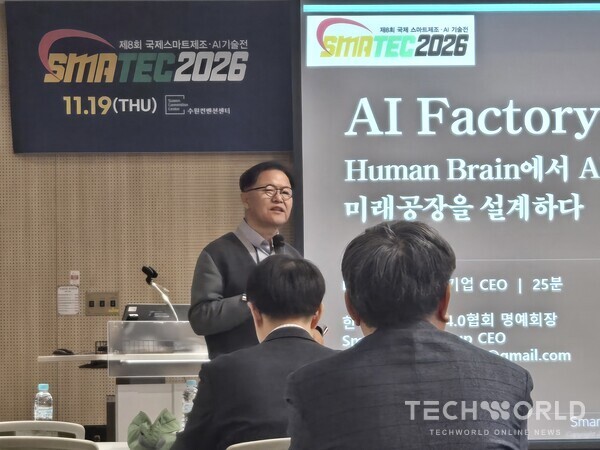
The Korea Industry 4.0 Association held the 6th Industry 4.0 and Industrial AX International Conference at SMATEC 2026, which opened on the 19th at the Suwon Convention Center in Gyeonggi Province. At the event, Han-koo Park, honorary chairman of the Korea Industry 4.0 Association, gave a presentation on the theme, "AI Factory: Designing the Future Factory from Human Brain to AI Brain."
Honorary Chairman Park pointed out the problem of one-off proof-of-concept (PoC) projects in domestic manufacturing AI initiatives and proposed building an AI-based decision-making system that combines manufacturing data with expert knowledge. He also presented the subtheme, "Prediction by AI, judgment by humans."
On manufacturing floors, companies have traditionally accumulated production data and managed processes using ERP and MES. Recently, they have been introducing ML-based AI solutions to analyze equipment and process time-series data, with the goal of predicting quality defects and equipment failures in advance.
However, AI does not take on cause analysis and response decision-making after notifying users of possible defects or failures, and workers are responsible for those tasks. In addition, the lack of passing down skilled workers' techniques and experience to the next generation, along with data being dispersed across manufacturing systems, has been cited as a constraint on the use of AI.
Honorary Chairman Park said that although work standards, technical standards, quality standards, and equipment management manuals exist, on-site work tends to rely on experience. He added that it is necessary to record data on the extent to which quality improves or failures decrease after equipment changes, and that feedback on the results of those changes is also needed.
As a solution for responding to problems on manufacturing floors, Honorary Chairman Park proposed the "AI Brain OS Platform." The proposal links data from existing manufacturing systems with specialized AI solutions. The technologies to be used include RAG, Knowledge Graph, and Knowledge Engineering.
The platform has a function that converts in-house technical materials and experts' tacit knowledge into judgment rules. When a process abnormality occurs, it derives response scenarios based on those rules. The response items are maintaining production, adjusting equipment parameters, and stopping the production line.
The derived scenarios are analyzed through a Light Digital Twin, with defect, rework, production stoppage, and delivery delay costs compared across scenarios. The results are then provided to workers as recommended response measures. Honorary Chairman Park said it is necessary to calculate the loss costs for choosing Option A or B, and also to calculate the costs incurred when stopping the production line with Option C. He also said economic analysis using actual data is needed.
After measures are taken, the company goes through a process of recollecting production data, improving the judgment rules, and improving the economic analysis model. Once AI judgment capabilities are verified, the plan is to consider introducing AI agents and physical AI, and then expand into process operation automation and equipment control automation.
For this flow, a point was raised that standardizing data structures for the use of manufacturing data across different AI solutions is important. Honorary Chairman Park said that applying the international standard IEC 63278-based Asset Administration Shell (AAS) can reduce data conversion costs for manufacturing companies when introducing new solutions.
Honorary Chairman Park also emphasized that domestic manufacturing AI companies need to review the technical and operational methods of overseas validated solutions. Examples of overseas validated solutions cited were Falkonry, a time-series data analysis company; Augury, a specialist in equipment failure prediction; and KITOV.ai, an AI-based visual inspection company.
It was also suggested that companies need to move beyond one-off PoC projects. Regarding AI evaluation criteria, it was emphasized that on-site loss reduction should be valued more than AI accuracy.
As examples of manufacturing AI solutions, Falkonry was first cited for analyzing manufacturing-floor time-series data to detect new signs of anomalies and prevent recurrence of existing problems. Augury was introduced as a system that analyzes temperature, vibration, and magnetic field data from rotating equipment with AI, combines expert remote diagnostics, predicts equipment failures, and supports maintenance. KITOV.ai was described as providing automated visual inspection technology using 3D design CAD drawings, specifying inspection locations and items on the drawings, and automatically inspecting product surface defects and assembly defects without separate robot motion programming.
Honorary Chairman Park introduced examples of overseas solutions being applied on site. The gist of his remarks was that manufacturing companies need AI development that can be used continuously.
The criteria for evaluating the results of manufacturing AI adoption should focus more on reducing defect rates, rework costs, and unplanned equipment downtime than on model accuracy, it was said. The standard for judging the value of AI was linked to how much it reduces losses on the manufacturing floor and how much it improves operational performance, rather than the technology's performance alone.
The conditions for sustaining the use of manufacturing AI were presented as quality improvement, cost reduction, and on-time delivery. Tangible results such as lower carbon emissions and improved worker safety were also mentioned as conditions for continued use of manufacturing AI.
As an initial approach to expanding manufacturing AX, there was a proposal to select one or two recurring problems in a specific process at the start of the demonstration phase. To this end, the use of 3 to 12 months of accumulated process data, technical standards, and expert interviews was proposed, along with building judgment rules and an economic analysis model based on those materials.
As conditions for the future expansion of domestic manufacturing AX projects, moving beyond one-off demonstrations was presented. The scope of expansion was identified as other production lines and factories, and the requirements for that expansion were identified as using experts' manufacturing knowledge in AI decision-making, proving cost reduction effects in actual processes, and proving productivity improvement effects in actual processes.
Source: TECHWORLD · Kim Seung-gi
Original: https://www.epnc.co.kr/news/articleView.html?idxno=410018
References
This article was produced with the help of an automated content generation algorithm.
Source: TECHWORLD
View originalThis article was summarized and organized by BizCrush based on the original article from TECHWORLD. For exact quotations and full details, please refer to the original article.
Keep reading
BizCrush