SK Telecom Wins Minister’s Award for 'Driverless Autonomous Transfer Technology' Using AI-RAN
IT DAILY ·
✦ AI Summary
SK Telecom unveiled a driverless autonomous transfer technology (AVM) that uses AI-RAN to gather sensor data and propose an optimal driving route.
The technology collects Point Cloud data through LiDAR sensors, and the AI-RAN base station creates a digital twin to judge the situation and calculate driving commands before transmitting control signals to the vehicle via 5G SA.
SKT received the minister’s award for the technology on the 18th at the "27th Radio and Broadcasting Technology Awards," hosted by the Ministry of Science and ICT, and set a record of receiving the minister’s award for 5 consecutive years from 2022 through this year.
BizCrushWant to follow Korean talks and live streams in real time?Try CapCrush on the web
SK Telecom (SKT) unveiled technology in which AI-RAN consolidates sensor data and then proposes an optimal driving route. The technology is characterized by using artificial intelligence radio access network (AI-RAN) instead of the vehicle's own judgment.
AI-RAN-based AVM is a system in which AI-RAN, rather than the vehicle, perceives the site, makes decisions, and then directly controls the vehicle. The technology unveiled by SKT is structured so that network-side AI-RAN collects surrounding information, makes decisions, and instructs the vehicle to drive, instead of relying on onboard judgment.
Conventional finished-vehicle logistics has relied on human labor. SKT said it has addressed those limitations with AI-RAN, a next-generation network infrastructure that provides telecommunications and AI services simultaneously.
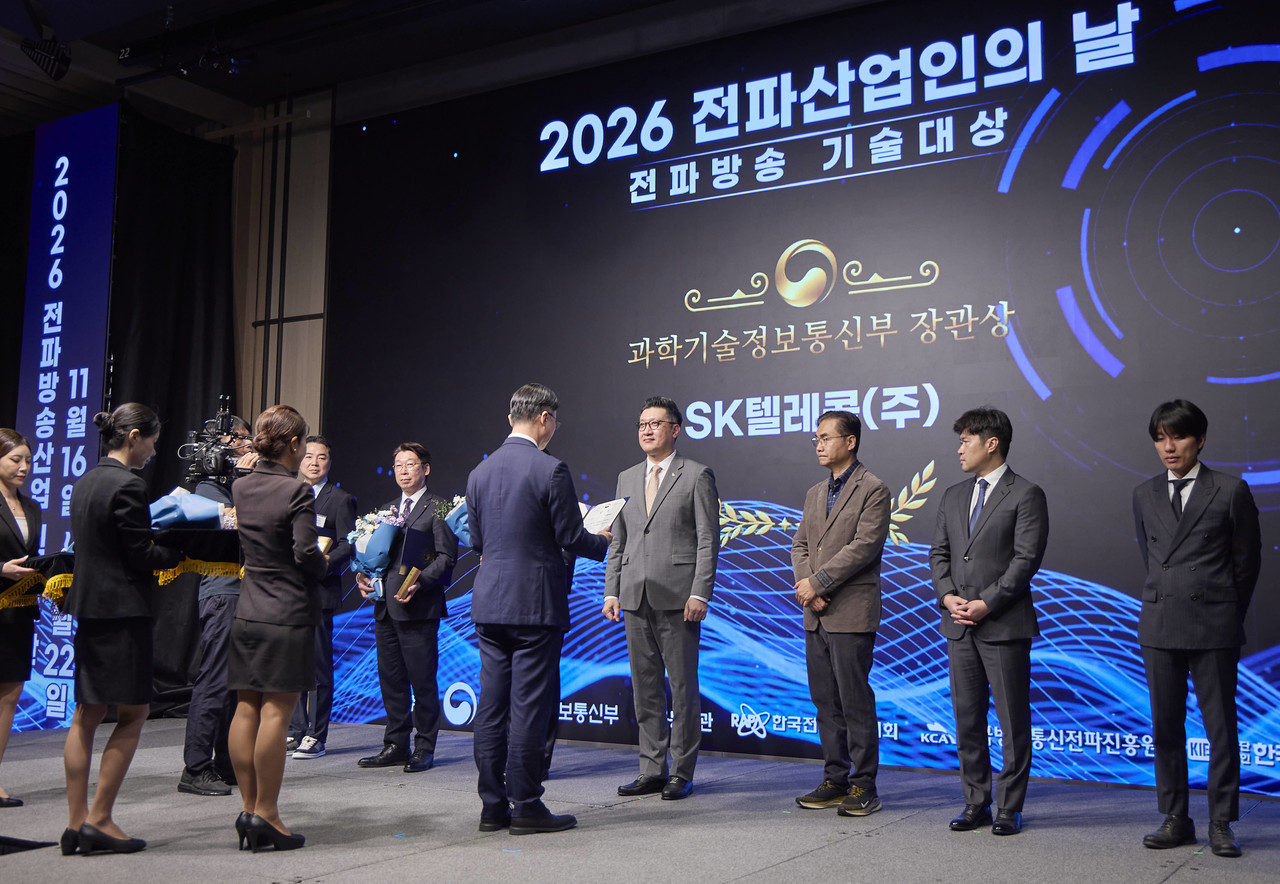
On the 18th, SKT received the minister’s award for its "AI-RAN-based finished-vehicle driverless autonomous transfer technology (AVM)" at the "27th Radio and Broadcasting Technology Awards," hosted by the Ministry of Science and ICT. With this award, SKT has set a record of receiving the minister’s award for 5 consecutive years from 2022 through this year.
According to photo information, Ryu Tak-gi, head of network technology at SKT, attended the Radio and Broadcasting Technology Awards held on the 18th at The Westin Seoul Parnas and received the award. AI-RAN is defined as a technology that applies AI to wireless communication base station infrastructure to improve the efficiency of network operation and management.
LiDAR sensors installed on site collect Point Cloud data and transmit it to the AI-RAN base station. Point Cloud refers to a collection of 3D coordinates of numerous points measured by LiDAR sensors, data that three-dimensionally represents the shape and location of objects.
The AI-RAN base station creates a digital twin based on this Point Cloud. It then judges the situation, calculates the optimal route, and also calculates driving commands.
After that, the base station directly sends control signals to the vehicle using 5G standalone (5G SA) communication. The signals delivered to the vehicle are steering, acceleration, deceleration, and gear-shift control signals.
This system was a technology secured by SKT last year. SKT, HFR, and Seoul Robotics jointly carried out the tasks of developing the core technologies for "Edge AI-based autonomous driving PoC" and AI-RAN.
In this process, SKT was in charge of core Edge AI and AI-RAN technologies, HFR handled 5G private network base station equipment, and Seoul Robotics was responsible for LiDAR-based spatial perception and vehicle control technology. The three companies conducted a joint demonstration of autonomous parking operations at an actual parking facility, and also confirmed the possibility of driverless transfer for ordinary vehicles without autonomous driving functions.
As a result of the demonstration, the entire process needed for driverless vehicle control, from sensor data collection to AI judgment and driving-command transmission, was completed within the required time. This also confirmed that driverless transfer is possible for ordinary vehicles without autonomous driving functions.
SKT is advancing the technology it has secured by linking it with the demonstration project for "Hyper-AI network infrastructure development." SKT was selected this year as the lead organization for the project, and in this first year, together with Seoul Robotics on the basis of HFR's AI-RAN, it is building a physical AI living lab in Pangyo and testing a driverless autonomous transfer service.
In the second year, 2027, SKT plans to deploy Ericsson's AI-RAN leading network, which integrates 5G technology, at KG Mobility's Pyeongtaek plant and apply it to an actual logistics site. Through this, it will verify in an industrial setting whether AI-RAN functions as an infrastructure for physical AI execution.
SKT plans to unveil the AI-RAN-based AVM in Incheon Songdo at "6G Vision Fest 2026," which will be held from Dec. 9 to 11.
Source: IT DAILY · Seong Won-young
Original: https://www.itdaily.kr/news/articleView.html?idxno=243014
References
This article was produced with the help of an automated content generation algorithm.
Source: IT DAILY
View originalThis article was summarized and organized by BizCrush based on the original article from IT DAILY. For exact quotations and full details, please refer to the original article.
Keep reading
BizCrush