From AI Agent Adoption to Operations: Microsoft Fleshes Out Its “Frontier Ecosystem”
IT DAILY ·
✦ AI Summary
MS said the “frontier ecosystem” is a structure in which companies use AI agents based on their own data and directly manage their execution and operations.
It outlined adding Copilot features, adding agent management tools, expanding AI model options and strengthening cloud infrastructure based on its own chips.
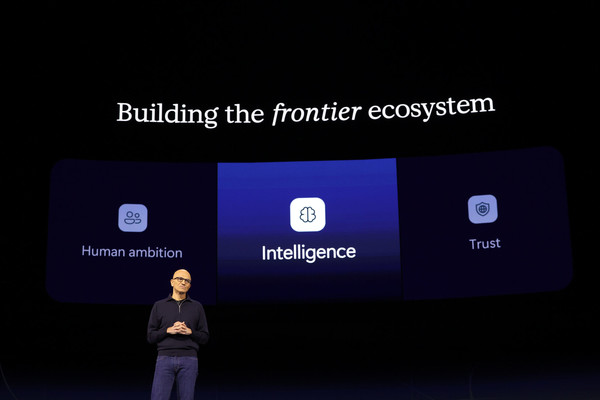
CEO Satya Nadella presented human-centeredness, organizational autonomy and trust as principles, saying that in the era of the democratization of intelligence, companies need to realize human aspirations and secure control over their own intelligence.
BizCrushWant to follow Korean talks and live streams in real time?Try CapCrush on the web
Microsoft fleshed out its vision for the “frontier ecosystem.” It described the frontier ecosystem as a structure in which companies use AI agents based on their own data and directly manage their execution and operations. Microsoft unveiled the details at the “Microsoft Ignite 2026” event it held on the 17th (local time).
As practical steps to support the effort, Microsoft proposed adding Copilot features, adding agent management tools, and expanding AI model options. On the infrastructure side, it also outlined strengthening cloud infrastructure based on its own chips as a key measure.
Satya Nadella, in his capacity as Microsoft chairman and CEO, presented the principles for building the frontier ecosystem. He cited three principles — human-centeredness, organizational autonomy and trust — and said all technological progress must be tied to tangible outcomes and new possibilities for people, organizations and society as a whole. He stressed that this requires putting human aspirations at the center, enabling each organization to secure control over its own intelligence and learning, and maintaining trust.
Microsoft held “Microsoft Ignite 2026” on the 17th (local time) and outlined a direction to expand Copilot from a simple question-and-answer tool into a central tool that covers work across the board. CEO Satya Nadella announced a plan to integrate chat, cowork, code and autopilot into Copilot.
The goal of this integration is to support knowledge work, coding and business processes in one place. Copilot “Home” will handle simple questions and support multi-step task delegation.
“Code” is responsible for building customized SaaS applications and dashboards. The autonomous agent “Autopilot” continuously carries out assigned tasks in team collaboration spaces.
Nadella said the foundation of these features is “Work IQ.” Work IQ is designed to understand work context based on documents, email, meetings, chats and projects.
Microsoft said it will broaden the scope of connections between Copilot and business applications. It also presented collaboration spaces and plugins as part of the user environment.
Microsoft provides plugins for business applications starting with Dynamics 365. It also unveiled a preview of “Salesforce in Copilot” based on its collaboration with Salesforce.
Microsoft also introduced “Copilot Workspace,” a shared space for multiple users to collaborate with their own agent-based workflows. Through this, the company presented a collaboration environment alongside the expanded integration between Copilot and business applications.
Microsoft emphasized the need to accumulate and manage work knowledge for enterprises' AI agents. As a measure to address this, it presented “Microsoft IQ,” and CEO Nadella explained that Microsoft IQ connects Fabric, Foundry and Microsoft 365 data with information from third-party systems.
To support this, Microsoft outlined a plan to provide hundreds of new connectors. The idea is for companies to connect internal and external data and manage the work knowledge needed for AI agents.
Microsoft also emphasized that different tasks have different AI performance and cost requirements. Accordingly, it stressed a strategy of providing models suited to each task and said it would optimize not only models but also the tools and products that run them.
Microsoft launched “Microsoft Decision 1.1,” an enterprise decision-making model, and presented an AI portfolio spanning enterprise decision-making, general-purpose model options, its own model efficiency efforts and security-focused models. “Microsoft Decision 1.1” supports multimodal input and is characterized by improved judgment accuracy and response speed. The company said more than 4,000 customers are using the model. It also said the model is used for hundreds of tasks, including routing, data labeling, personalization and content filtering.
Microsoft said it will offer OpenAI GPT-6.2 and the latest Meta models in Foundry. It also expanded its options from private models to open-weight models, broadening the range of choices for enterprises. The company said it will support model selection tailored to each company’s work characteristics, cost and performance requirements.
The in-house MAI model family focuses on improving computing efficiency during pretraining and token efficiency in real deployment environments. Microsoft said this reflects a direction centered on improving the training and deployment efficiency of its own models.
In security, it introduced its in-house model “Cyber 2 Flash.” Microsoft said “Cyber 2 Flash” delivered the highest performance among its security models and offered lower cost per task and higher performance than frontier models. The model was designed together with tools and systems for real-world security work and is integrated into MS security system “Perception.”
The company highlighted the role of Agent 365 in agent management. It described Agent 365 as a control-plane platform that extends an organization’s existing governance, ID, security and management systems for AI agent expansion. It said the current scale of Agent 365 exceeds 50 million agents.
The company introduced “Agent 365 Business Analytics” as a new announcement. It said the feature helps identify the factors behind AI-related costs and links cost and performance to increase business value. It also said it supports optimizing return on investment across a range of AI use cases.
Regarding the launch of the “Cobalt 200” virtual machine based on its own chips, the company also explained its infrastructure strategy. It said the core of the infrastructure strategy is the co-design of silicon, servers and infrastructure. Through this, the company said it aims to improve efficiency across power, chips and data centers.
Nadella said “Maia 300” is expected to deliver 40% higher token throughput per watt than major GPU-based systems. He also said Azure Boost and Azure Integrated HSM process core infrastructure and security functions on dedicated silicon.
The company announced the launch of the next-generation “Cobalt 200 virtual machine.” It said Cobalt 200 is the highest-performing general-purpose virtual machine in MS’s lineup.
Nadella said that we have entered an era of the democratization of intelligence, then identified the challenges that come with it as realizing human aspirations, securing companies' control over their own intelligence and spreading the benefits of technology. He said the frontier ecosystem presents that direction.
Source: IT DAILY · Yang Seung-gap
Original: https://www.itdaily.kr/news/articleView.html?idxno=243024
References
This article was produced with the help of an automated content generation algorithm.
Source: IT DAILY
View originalThis article was summarized and organized by BizCrush based on the original article from IT DAILY. For exact quotations and full details, please refer to the original article.
Keep reading
BizCrush