MS Unveils Next-Gen Infrastructure Blueprint, Says It Is Optimizing Every Layer of the Data Center
IT DAILY · · 3 views
✦ AI Summary
MS unveiled its cloud and data center infrastructure strategy for the agentic AI era at Ignite 2026.
It presented a plan to optimize every layer of the data center, along with co-design across silicon, servers, and infrastructure, and the combination of Cobalt 200 with Azure Boost and Azure Integrated HSM.
It also announced Windows Server 2028 for on-premises use, Agent Sandbox, Agent Grid, and expanded MCP server functionality.
BizCrushWant to follow Korean talks and live streams in real time?Try CapCrush on the web
Microsoft (MS) unveiled its cloud and data center infrastructure strategy for the agentic AI era at its annual technology conference, Ignite 2026. At the event, MS presented an environment built to respond to the spread of AI agents by enabling systems to generate and execute code autonomously and carry out long-running tasks.
MS said it is therefore focusing on optimizing every layer of the data center. The target areas include GPU-centric accelerated computing, general-purpose CPUs, network offload chips, and on-premises server OS.
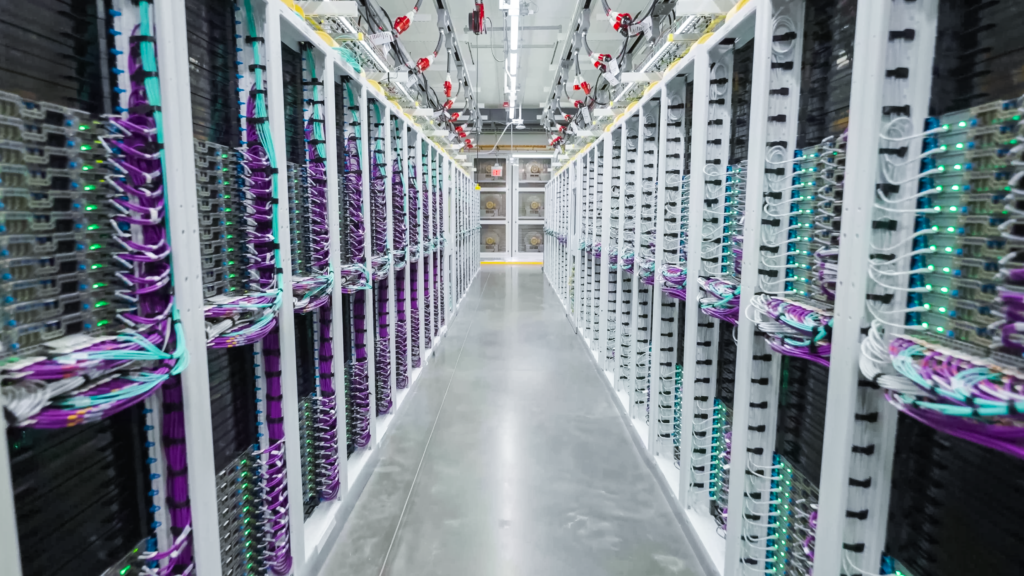
The announcement also included a photo of a data center rack deployment for the Cobalt 200 server. The image underscores the company’s view that data centers must be optimized not only for GPUs, but also for CPUs, network chips, and on-premises OS.
In the global cloud industry, there has recently been a growing trend toward adopting in-house chips to reduce dependence on Nvidia GPUs and maximize performance per watt. Amazon Web Services (AWS) is advancing Graviton and Trainium, while Google Cloud is internalizing its infrastructure around Axion and TPU.
Against that backdrop, MS fully unveiled its hardware strategy of co-designing silicon, servers, and infrastructure at this event. As AWS and Google Cloud each strengthen chip-based infrastructure, MS has also positioned integrated design across silicon and infrastructure as a core strategy.
Satya Nadella, MS CEO, said in his keynote that the company is co-designing data centers, servers, and silicon to fit workloads. Nadella said the token throughput per watt of its in-house AI accelerator, Maia 300, improved by 40%.
As part of that strategy, MS officially launched the next-generation Arm-based server processor, Azure Cobalt 200, as a virtual machine (VM). Cobalt 200 uses TSMC’s 3nm process and includes 132 Arm Neoverse V3 cores. MS also said it delivers up to 50% better performance than Cobalt 100.
MS said the core of AI agent workloads lies not only in GPU inference, but also in reducing latency in CPU-adjacent tasks such as Agent Sandbox, code compilation, tool execution, and in-memory DB processing. Cobalt 200 was presented as a server processor optimized for general-purpose and data-intensive workloads suited to those uses.
The solution will be offered first in 14 regions, including the Central Korea region. It is also expected to account for a significant share of new Azure computing capacity next year.
MS offers Azure Boost. Azure Boost is a DPU-like solution that handles network and storage processing offload and acceleration from the host CPU.
MS also offers Azure Integrated HSM, a dedicated security chip. Azure Integrated HSM performs functions that prevent hardware intrusion and protect encryption keys. MS has built Azure Boost and Azure Integrated HSM into Cobalt 200 servers as standard components. Through this, MS is strengthening an infrastructure architecture based on purpose-built silicon. The photo of Cobalt 200 is credited to Microsoft.
MS also fleshed out a hybrid strategy for internal data centers outside the cloud. The direction of the strategy is to turn enterprise on-premises systems into AI inference hubs. The company also unveiled a preview of Windows Server 2028, its next-generation server OS.
Windows Server 2028 is designed to let companies use their in-house servers as a local token factory for AI inference. The move targets companies that find it difficult to move sensitive business data to the public cloud. Factors cited as making cloud migration difficult include data sovereignty, regulatory compliance, latency, and cost.
Microsoft (MS) said that MS CEO Satya Nadella announced support for external AI accelerators in Windows Server 2028 at Ignite 2026. AMD Instinct MI350P was cited as an example of supported hardware, and a preview of AMD Instinct MI350P is scheduled for the first half of next year.
Windows Server 2028 incorporates local foundry integration, vLLM integration, Llama.cpp integration, and open runtime integration. This points to a direction in which AI models can be run in on-premises infrastructure in a manner consistent with the cloud.
Windows Server 2028 also strengthened core enterprise infrastructure functions. It enables native NVMe storage by default and supports booting from the ReFS file system to improve large-scale data input and output speeds.
It also incorporates PQC for protection against quantum computing threats, automatic certificate management, and hardware-based memory encryption. The focus is thus on strengthening the readiness required to operate core infrastructure, along with performance.
As AI agents autonomously write and run code and control cloud resources, security concerns and operational complexity have come to the fore, and MS has offered an infrastructure-level solution. MS introduced a preview of the Agent Sandbox extension for Azure Kubernetes Service (AKS). Agent Sandbox is the environment where code generated by AI agents is executed. The goal is to address the risk of unpredictable behavior in code generated by AI agents.
Agent Sandbox provides a session-based lightweight virtual machine (VM)-level isolation environment that is stronger than traditional containers. The purpose of this enhanced isolation environment is to block the possibility of compromising host infrastructure. MS also unveiled a preview of Agent Grid. Agent Grid provides encrypted communication between multiple agents and access control functions.
On the cloud operations side, Azure Resource Manager has been expanded with server functionality for the Model Context Protocol (MCP). Azure Resource Manager is the infrastructure control plane, and external AI agents can use MCP to query more than 3,500 Azure resources. Based on this, autonomous operations have become possible, including direct creation and modification of resources within company-defined security and governance policies, root-cause analysis of failures, and remediation.
Satya Nadella, MS CEO, said that the world has entered an era in which intelligence is becoming ubiquitous, and presented as key tasks for companies in this changing environment securing control over their own intelligence and broadly spreading the benefits of technology. He added that, as a way to support those tasks, MS will continue expanding options to include sovereign cloud, on-premises, and in-house silicon, explaining that this would preserve customer control over infrastructure and data without hindering innovation.
Source: IT DAILY · Kim Yeong-seok
Original: https://www.itdaily.kr/news/articleView.html?idxno=243035
References
This article was produced with the help of an automated content generation algorithm.
Source: IT DAILY
View originalThis article was summarized and organized by BizCrush based on the original article from IT DAILY. For exact quotations and full details, please refer to the original article.
Keep reading
BizCrush