Physical AI Training Hubs to Expand Nationwide Through Hands-On Education
AI TIMES ·
✦ AI Summary
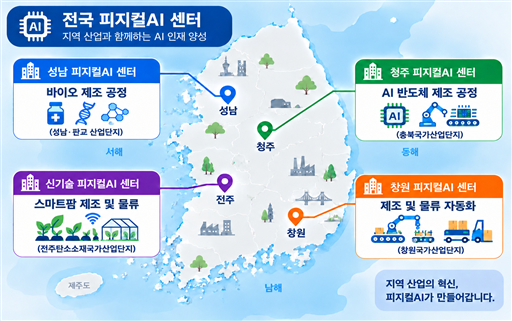
According to AI TIMES, the government said on November 18 that it plans to establish four testbeds, starting with Jeonju, to train practical…
According to AI TIMES, the government said on November 18 that it plans to establish four testbeds, starting with Jeonju, to train practical Physical AI workers that combine robots and AI, and then expand them to 12 hubs nationwide. The focus is on teaching hands-on skills such as robot operation, process control, and equipment maintenance in factory-like facilities that replicate real manufacturing processes, rather than limiting training to theory. Each region will be linked to its core industries, with Jeonju centered on smart farms, Cheongju on AI and semiconductors, Seongnam on biotech, and Changwon on manufacturing and logistics. The Jeonju facility will connect the flow from agricultural production to manufacturing and logistics into a single automated process, showing how Physical AI works in industrial settings. The training will not be limited to current students, but will also be open to specialized high school students, incumbent workers, universities, and vocational training institutions, allowing local companies to review the technology and receive practical training. The government and Korea Polytechnics expect this foundation to help local small and medium-sized enterprises with their AI transformation and serve as a hub for nurturing and supplying the technical talent needed within the region.
Perspective
The significance of this project lies in shifting the AI discussion from software development to hands-on capabilities for operating real equipment. If education, demonstration, and corporate support are bundled in one place, regional industries that have been hesitant to adopt the technology may have more room to move forward while reducing trial and error. In particular, as hubs linked to local flagship industries expand, workforce training and technology diffusion are more likely to spread closer to the field rather than staying concentrated in the Seoul metropolitan area or at large corporations. In the end, Physical AI competitiveness depends not only on model performance, but also on how steadily companies can secure the people needed for installation, operation, and maintenance.
This perspective is BizCrush's own commentary and is not part of the reporting by AI TIMES.
This article was produced with the help of an automated content generation algorithm.
Source: AI TIMES
View originalThis article was summarized and organized by BizCrush based on the original article from AI TIMES. For exact quotations and full details, please refer to the original article.