Intel GPU 'D270' Targets the HPC Market Beyond AI Inference
IT DAILY ·
✦ AI Summary
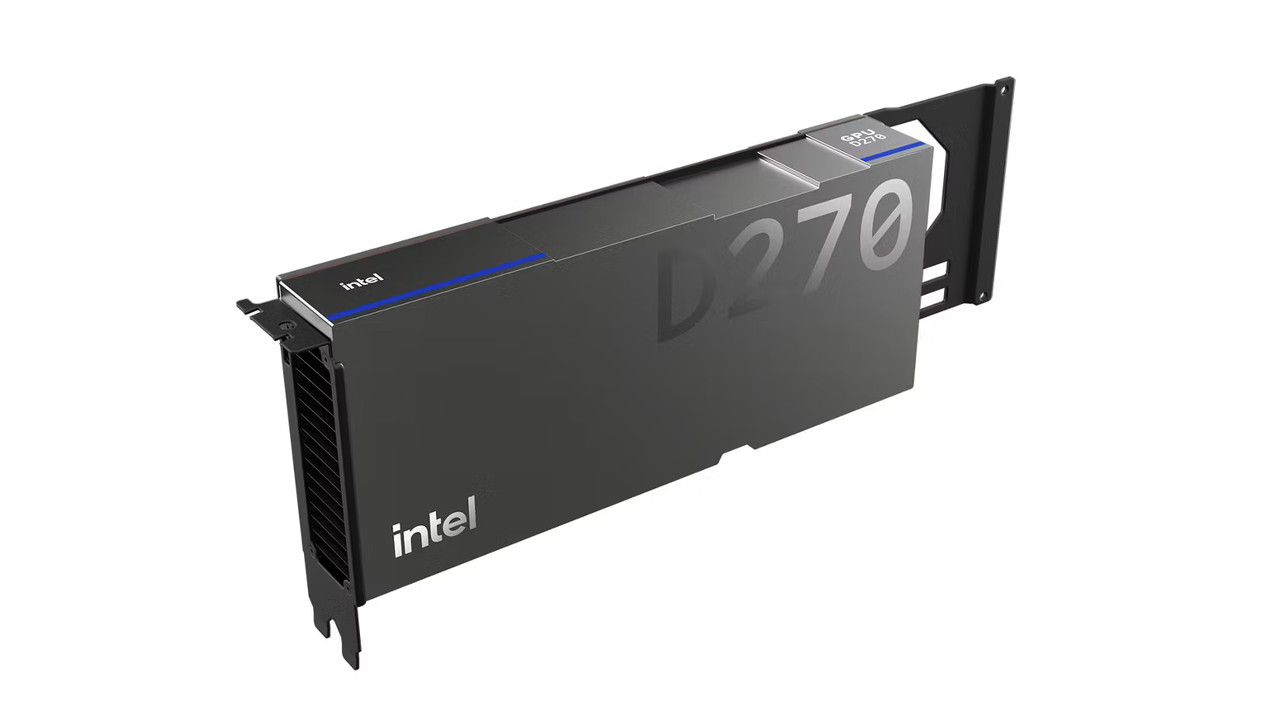
Intel announced on the 17th that it will expand the use cases for its data center GPU, the Intel GPU D270, from AI inference to HPC.
Built on Intel Xe 3P architecture, the D270 features 32 Xe cores, 256 XMX engines, 160GB LPDDR5X, and 1.5TB per second of memory bandwidth.
Intel plans to demonstrate seismic exploration simulations and a disaggregated heterogeneous inference architecture in real time at SC26.
BizCrushWant to follow Korean talks and live streams in real time?Try CapCrush on the web
Intel announced on the 17th that it will expand the use cases for its data center GPU, the Intel GPU D270. The scope now extends from AI inference to HPC.
Behind this expansion lies a recent trend in scientific research and industry. The movement to combine traditional numerical modeling and simulation with data analysis and AI inference into a single workflow is accelerating, and agentic AI autonomously links data with specialized tools in a closed loop while adjusting simulation parameters in real time.
As a result of these changes, demand is also growing for heterogeneous infrastructure that combines the optimal processors for each computational stage. The Intel GPU D270 was developed to address these converged HPC and AI workloads.
The Intel GPU D270 is based on Intel Xe 3P architecture. It is equipped with 32 Xe cores and 256 Xe Matrix Extensions (XMX) engines, and each core supports 64 FP64 fused multiply-add (FMA) operations.
The product is designed to cover everything from low-precision FP4 to FP8 inference to FP64 native double-precision scientific and financial simulations. Its memory and platform design is geared toward large-scale data processing.
The Intel-branded card comes standard with 160GB LPDDR5X and supports 1.5TB per second of memory bandwidth. In partner-designed configurations, maximum memory capacity can reach 480GB. This is intended to keep massive datasets and wavefield arrays resident in GPU memory and reduce bottlenecks from data movement across the host bus.
Its power design is 350W, and the form factor is standard air-cooled PCIe 5.0. The target environments are existing enterprise servers and racks. In pre-production silicon-based application benchmarks, it was presented as delivering high processing efficiency relative to power consumption.
In tests for financial services options pricing, the comparison target was Nvidia's RTX PRO 6000 Blackwell Server Edition (600W). In those tests, the D270 (350W) delivered 5.9 times higher European Monte Carlo throughput, 5.6 times higher European Black-Scholes throughput, 4.6 times higher Binomial throughput, and 1.92 times higher U.S. Black-Scholes throughput.
In performance comparisons, based on agentic AI and LLM inference tests, the latency of the Drex 2.0 decision-making model was reduced by up to 29% versus the same competing product. In addition, throughput improved 1.12 times for the Qwen 3 30B-A3B model.
On the software side, Intel said the product ensures portability for existing HPC codebases based on an open ecosystem. Supported items include Intel MPI, Fortran, a C++ compiler, standard AI frameworks, and the open SYCL programming model. As a result, developers do not need to rewrite code in proprietary languages, it said.
Intel plans to stage live demonstrations at SC26, the Supercomputing conference in Chicago. The demonstrations will cover seismic exploration simulations and a disaggregated heterogeneous inference architecture. In the seismic wave modeling segment, it will unveil cache-aware stencil optimizations and large-capacity memory integration, which it says will accelerate massive 3D acoustic wave propagation calculations.
A turnkey disaggregated inference infrastructure was unveiled. The infrastructure is intended to split the inference process according to the characteristics of each stage and remove bottlenecks at each computational step. The prefill stage, which is computationally intensive and handles high-dimensional simulation data and large contexts, is handled by the Intel GPU D270. The decode stage, which depends heavily on memory bandwidth, is handled by SambaNova's SN50 reconfigurable dataflow unit. Intel Xeon 6 and Xeon 6+ processors oversee overall workflow orchestration and tool execution.
Source: IT DAILY · Kwon Young-seok
Original: https://www.itdaily.kr/news/articleView.html?idxno=242994
References
This article was produced with the help of an automated content generation algorithm.
Source: IT DAILY
View originalThis article was summarized and organized by BizCrush based on the original article from IT DAILY. For exact quotations and full details, please refer to the original article.
Keep reading
BizCrush