Dell Technologies Expands Dell AI Factory Portfolio, Accelerating Agentic AI Operations
IT DAILY ·
✦ AI Summary
Dell Technologies said on the 17th that it has strengthened the portfolio and core capabilities of 'Dell AI Factory with NVIDIA.'
New capabilities and 'Agentic Data Gateway' were added to the 'Dell AI Data Platform' to convert enterprise data into trusted context for AI agents regardless of where it is stored.
It also expanded storage, management software, networking, and the validation ecosystem, while strengthening support for Dell Exascale, PowerScale, Dell OpenManage Rack Scale, and Dell Fabric Manager.
BizCrushWant to follow Korean talks and live streams in real time?Try CapCrush on the web
On the 17th, Dell Technologies announced that it is significantly strengthening the portfolio and core capabilities of 'Dell AI Factory with NVIDIA.' The goal of the expansion is to support the deployment of enterprise agentic AI into real-world operational environments.
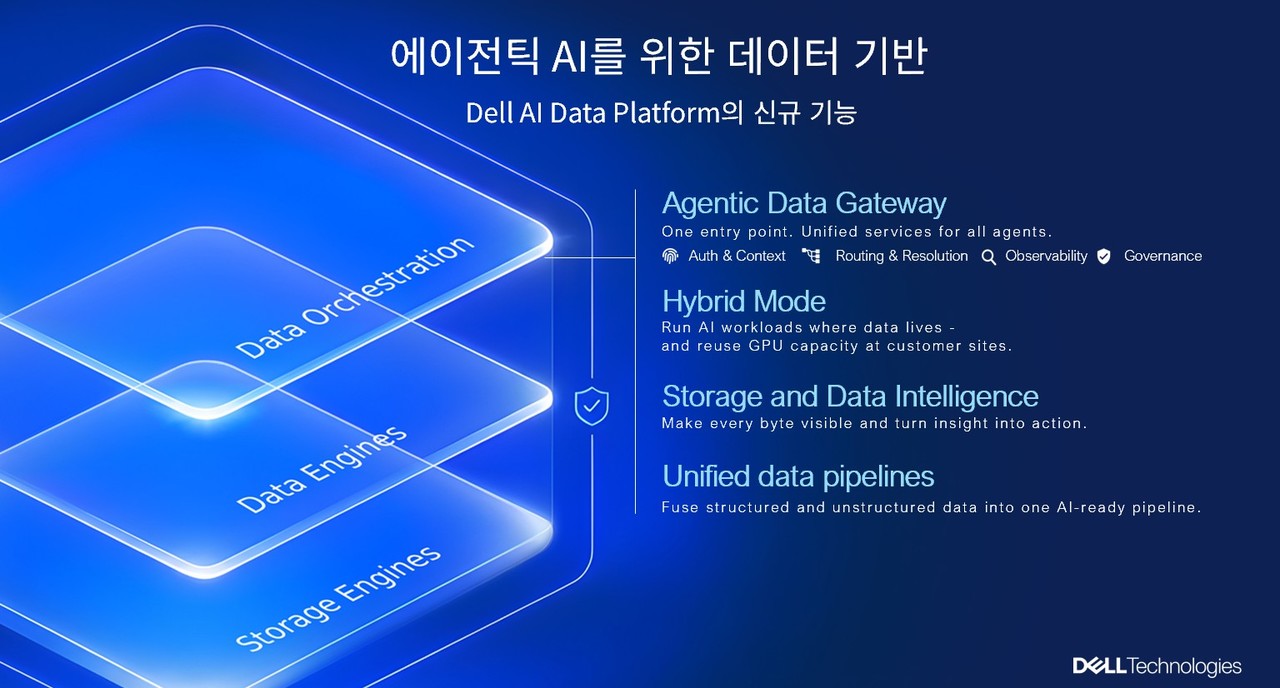
As part of this effort, Dell Technologies added new capabilities to the 'Dell AI Data Platform.' The added functionality converts enterprise data into trusted context for AI agents, regardless of where it is stored.
The new capabilities consist of data orchestration and a storage engine. Dell Technologies also introduced the new 'Agentic Data Gateway,' which provides a single governance path for all AI agents to access enterprise data and context. This eliminates the need for individual integration work.
Dell Technologies also presented results from internal testing. In internal tests that reused existing context, token consumption fell by up to 76%, while answer accuracy improved from 60% to 94%.
The initiative focuses on expanding integration between data pipelines and the development ecosystem so that data scattered across multiple environments can be used without being moved. To that end, it provides 'hybrid data pipeline orchestration,' making it applicable to on-premises private clouds, Dell AI Factory with NVIDIA, third-party infrastructure, and public cloud environments. It also supports running pipelines directly at the storage location, allowing massive unstructured datasets to be used without separate data movement.
At the same time, it provides 'storage intelligence' and 'data intelligence' to help users identify data provenance, quality, and usage across heterogeneous environments containing several billion files. This is designed to support the reliability of training and inference data, while also supporting storage lifecycle management.
It also offers 'open integrated data access,' enabling tables, images, video, and documents to be processed through a single pipeline. In addition, it allows vector data to be passed into existing databases, with indexing speeds improved by up to 12x. It also supports integrations with LangChain, OpenAI Codex, and Unstructured.io, while enabling integration with existing development tools without data leaving the environment.
Dell Technologies also showcased its storage products. In storage, it expanded the software-defined storage 'Dell Exascale' lineup. 'Dell Exascale' supports block, file, object, and parallel file systems.
The lineup includes a 4-in-1 direct liquid cooling (DLC) storage model. The model applies the Open Rack AI infrastructure standard 2-OU height, uses 100% direct liquid cooling, and supports up to 32 NVMe drives. It also offers a 1U platform for rack-space-constrained environments. The 1U platform increases drive density per rack by 67%, reduces footprint, and lowers power and cooling burdens.
It also includes software-defined 'PowerScale' equipped with Dell Exascale. 'PowerScale' received Foundation-level NVIDIA-Certified Storage validation.
To improve the operational efficiency of large-scale infrastructure, Dell upgraded its management software and networking capabilities. 'Dell OpenManage Rack Scale' supports build, management, monitoring, and automation for physical infrastructure from individual servers to full racks, and its management scale has expanded by up to 12x from the previous generation, allowing it to handle up to 100,000 devices. It also includes natural-language capabilities that let users investigate and resolve system status, alerts, firmware, inventory, power, and performance issues.
As a network integration management platform, Dell presented 'Dell Fabric Manager.' The platform provides Intent-based Automation, digital-twin-based design, zero-touch provisioning, and configuration change verification. Through these capabilities, it reduces Day-2 operational burden by up to 80% and provides value by securing 100% accurate device inventory.
Dell is expanding the support platforms for its network software to reduce dependence on specific vendors and help standardize different equipment environments. To that end, it added support for Z9964F-ON to 'Enterprise SONiC Distribution by Dell Technologies,' and also added support for NVIDIA SN4700 Spectrum platform to 'Enterprise SONiC Distribution by Dell Technologies.' This expanded support is aimed at easing vendor lock-in and supporting standardization across heterogeneous networks.
Dell has also expanded its validation ecosystem to minimize risk when moving from PoC to production, and presented the 'Dell AI Ecosystem Program' as its specific framework. The program includes AI security from F5 and JFrog, DataRobot's agentic AI platform, Dynatrace's full-stack visibility for AI workloads, Ipsotek's computer vision and video analytics, AI data solutions from Eternal Technologies and Teradata, knowledge assistants from Able, Atolio, and Maven AGI, OpenAI's code assistant, and AI governance and orchestration solutions from ClearML, Clik, and JFrog.
For modular architecture integration solutions, Dell PowerStore, Dell PowerEdge XE9785 with NVIDIA HGX B300 GPU, and NVIDIA AI Enterprise were newly added. Dell AI Factory Engineer was also introduced as a service model, with a dedicated engineering organization providing integrated support for platform buildout, workload buildout, data buildout, governance buildout, security buildout, and technology transfer.
Yoo Sang-mo, president of Dell Technologies Korea, said that enterprise AI implementation requires more than AI models alone. He added that Dell AI Factory with NVIDIA and the Dell AI Data Platform provide a full-stack foundation that enterprises can own and control directly, along with the specialized capabilities needed to integrate each element organically and the proven results that underpin them.
Source: IT DAILY · Kwon Young-seok
Original: https://www.itdaily.kr/news/articleView.html?idxno=242971
References
This article was produced with the help of an automated content generation algorithm.
Source: IT DAILY
View originalThis article was summarized and organized by BizCrush based on the original article from IT DAILY. For exact quotations and full details, please refer to the original article.
Keep reading
BizCrush