AI Competition Shifts From Semiconductors to System Integration
AI TIMES ·
✦ AI Summary
According to AI TIMES, Molex said on the 10th that over the next 12 to 18 months, the electronics industry and connectivity technologies wil…
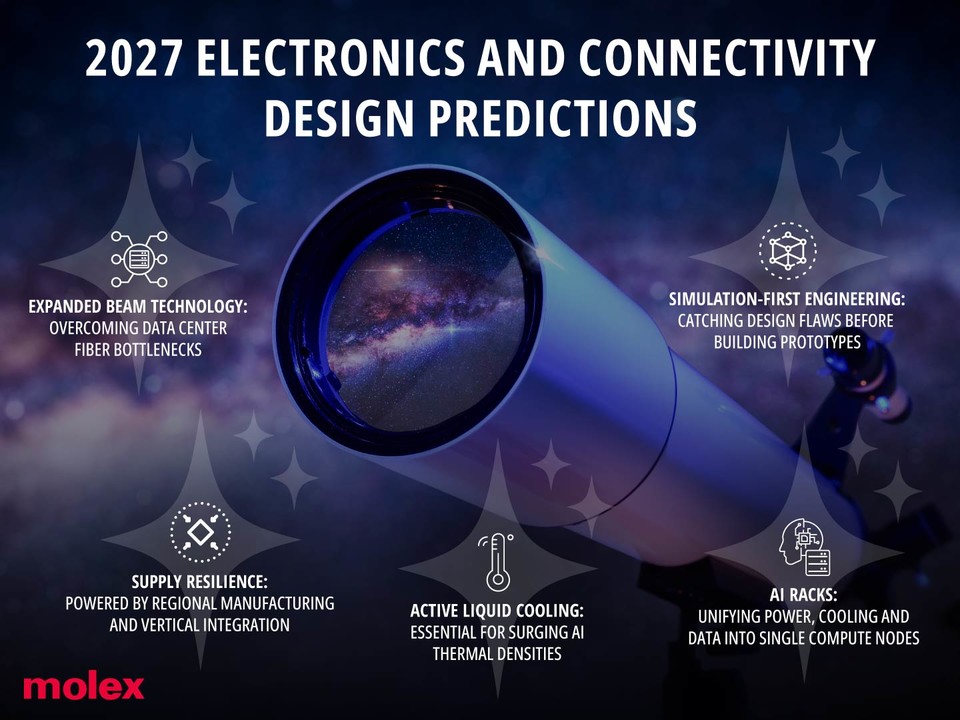
According to AI TIMES, Molex said on the 10th that over the next 12 to 18 months, the electronics industry and connectivity technologies will be shaped by a shift in the center of AI competition from the performance of individual semiconductors to integrated design capabilities that tie together data centers, robotics, and manufacturing. It said the key for AI data centers is a structural transition from treating servers as the unit of computing to treating the entire rack as a single computing unit. As a result, it expects approaches that optimize power delivery, cooling, and data connectivity together, rather than separately, to become increasingly important. Liquid cooling to address the limits of air cooling and rising demand for optical interconnects extending from chip-to-chip links to campus-level networks were also described as part of this shift. In design, it said the pace will accelerate toward finding problems first through simulation and digital engineering rather than building prototypes and then making corrections. It also said humanoids, robotic-assisted surgery, and automation equipment will move beyond the R&D stage and into mass production, increasing the importance of connectivity technologies that can handle power and data together in tight spaces.
Perspective
The core of this outlook is that the decisive factor in AI is no longer the performance of a single component. If infrastructure, design, and manufacturing are all being reshaped at once, companies will stand out less by one specific technology than by their ability to integrate those technologies and run them reliably. In the end, the market's competitive standard is likely to shift away from raw processing speed alone and toward operating stably for longer with the same resources and bringing products to market faster with fewer trial-and-error cycles.
This perspective is BizCrush's own commentary and is not part of the reporting by AI TIMES.
This article was produced with the help of an automated content generation algorithm.
Source: AI TIMES
View originalThis article was summarized and organized by BizCrush based on the original article from AI TIMES. For exact quotations and full details, please refer to the original article.