KONAN Technology Unveils Defense AI Platform "ARGO-X" for the First Time, Aims for Military Pilot Program Next Year
TECHWORLD ·
✦ AI Summary
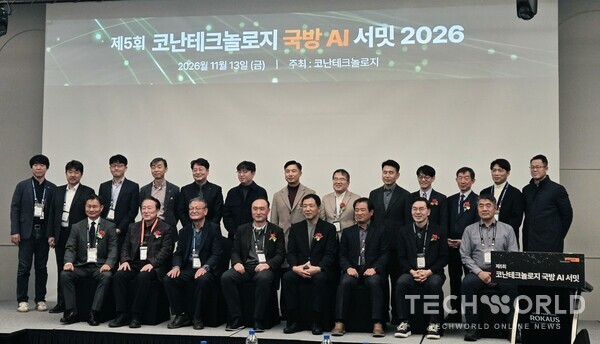
KONAN Technology held the "5th KONAN Technology Defense AI Summit 2026" on the 13th at Nine Tree ROKAUS in Yongsan, Seoul, and unveiled its defense AI platform "ARGO-X" for the first time.
ARGO-X is a platform equipped with integrated military intelligence analysis and command decision support functions, and KONAN Technology plans an official launch in December and a military field pilot program next year.
The event drew more than 200 attendees from 27 military and defense-related organizations, including the Ministry of National Defense, major commands of each branch of the armed forces, and industry-academia-research participants such as SK Telecom (SKT) and Korea Aerospace Industries (KAI).
BizCrushWant to follow Korean talks and live streams in real time?Try CapCrush on the web
KONAN Technology held the "5th KONAN Technology Defense AI Summit 2026" on the 13th at Nine Tree ROKAUS in Yongsan, Seoul, and unveiled its defense AI platform "ARGO-X" for the first time. The event drew more than 200 attendees from 27 military and defense-related organizations, including the Ministry of National Defense, major commands of each branch of the armed forces, and industry-academia-research participants such as SK Telecom (SKT) and Korea Aerospace Industries (KAI).
"ARGO-X" is a platform equipped with integrated military intelligence analysis functions and decision support functions for command and leadership. KONAN Technology said it plans to officially launch "ARGO-X" in December.
KONAN Technology said it plans to pursue a military field pilot program next year. It also outlined plans to expand into autonomous flight, counter-drone response, and space edge AI.
Kim Young-seom, CEO of KONAN Technology, said warfare is changing with the emergence of drones and unmanned systems. He added that the importance of rapid decision-making is growing and emphasized that AI's practical operational capabilities have become critical.
Kim said that over the past 20 years, the company has pursued technologies that are not just demonstrations but are reliable in real-world environments and function even when communications are cut off. He added that the company aims to strengthen South Korea's military capabilities with advanced AI and contribute to the realization of self-reliant national defense.
Lee Seong-hwan, a professor in the Department of Artificial Intelligence at Korea University, delivered welcome remarks. He said that as the volume and complexity of military intelligence increase, intelligence fusion and analysis capabilities will determine competitiveness in defense AI.
Lee said AI model performance is one factor in judging defense AI competitiveness. He also cited securing high-quality data, intelligence fusion, and the effectiveness of AI use in actual operations and decision-making as additional criteria.
ARGO-X unveiled 54 types of analytical functions. It is targeting military pilot programs in 2027.
Yang Seung-hyun, COO of KONAN Technology, identified two pillars of the defense AI business: all-source intelligence AI and unmanned and autonomous device AI. KONAN Technology started by building an integrated search engine for the Ministry of National Defense in 2006 and has carried out about 110 defense informatization and intelligence projects.
Military AI technology is divided into all-source intelligence AI and unmanned and autonomous device AI. All-source intelligence AI connects dispersed military intelligence and handles battlefield situation analysis and command decision support. Unmanned and autonomous device AI focuses on autonomous flight, counter-drone response, and space edge AI, and plays a role in supporting equipment's autonomous judgment and mission execution.
Yang said it is difficult to respond to future battlefields using only information scattered across individual systems. Emphasizing the importance of connecting and fusing information, he said there is a need to understand battlefield situations through connected and fused data. He added that linking this to rapid response is important.
ARGO-X, unveiled that day, is a platform aligned with that direction. It integrates data from various sources such as video, signals, and OSINT. It also analyzes relationships among people, equipment, facilities, and incidents. ARGO-X is designed to structure information based on an ontology, and its design purpose is to help analysts understand incident context and verify the basis for judgments.
Cho In-ji, head of KONAN Technology's defense strategy business division, demonstrated the main functions of ARGO-X that day. The ARGO-X interface is composed of 23 collection and management functions, 34 intelligence analysis functions, 17 intelligence operations functions, and 20 evaluation and feedback functions, for a total of 94. Its intelligent analysis capabilities cover 54 types.
ARGO-X is a system equipped with security situation analysis, North Korean leadership movement tracking, video interpretation, threat-sign detection, and automatic report generation functions. The system allows users to check sentence-by-sentence evidence in AI-generated reports, and it also demonstrated a function that revises judgments by reflecting analysts' opinions. Its goal is to detect threat signs early and support proactive preparation.
The demonstration presented an analysis of the possibility of a ballistic missile launch, and was structured to compare the basis of heterogeneous information against one another while also showing uncertainty in the judgment. Through this, it explained an analysis support approach based on diverse information.
Cho said that as information increases, it becomes more important to clearly present the basis for judgments. He added that ARGO-X is not intended to replace analysts, but to serve as an AI aide that supports evidence-based judgments. Final alerts and decision-making are carried out in accordance with military authorization procedures.
KONAN Technology plans to officially launch ARGO-X in December. It also plans to pursue one or two small-scale military pilot programs (PoC) in 2027. ARGO-X is currently being developed around open information, and integration with actual military data is planned for future pilot programs. In the long term, the company intends to expand its application to military command decision systems and next-generation command and control systems.
Kim Tae-hyung, head of KONAN Technology's defense strategy business division, said the company will prioritize small-scale pilot programs rather than wait for large-scale deployments. He noted that cooperation between the military and companies is essential to use actual military data and operational doctrine.
Meanwhile, KAI is jointly developing an AI pilot in the autonomous flight sector. Cooperation in the autonomous flight sector is under way, and the two companies have been carrying out a defense innovation company 100 R&D project since 2024.
The target timeline for commercialization of this project is 2027. Joint development of the KAI AI pilot is also under way.
Lim Seong-shin, head of KAI's AI Development Office, introduced the development progress of the AI pilot "Karilet." Lim also presented the results of demonstrations involving manned-unmanned teaming (MUM-T). KAI conducted a collaborative flight test between the FA-50 and an unmanned aircraft on October 8, and also carried out autonomous flight technology tests, target identification technology tests, and simulated strike technology tests.
Lim said that if the autonomy level of unmanned aircraft is insufficient, it is difficult to implement a manned-unmanned collaboration system. He added that autonomy technology is important for reducing the workload of pilots.
KAI is developing navigation technology for environments with restricted GPS use and a backup system to prepare for AI malfunctions. While pursuing continuous model improvement based on real operational data, KAI is also pushing to secure MLOps and a high-fidelity simulation environment.
In the counter-drone area, KONAN Technology, Reflex, and Ninano Company presented an air-to-air drone defense system they are jointly developing. The system was explained as detecting enemy drones with AI surveillance and reconnaissance drones and responding with neutralization drones equipped with ultra-wideband high-power microwave (UWB HPM).
Jung Young-kyung, executive director at Reflex, said the core of the drone threat lies in swarming and intelligence, and proposed a new air-to-air drone defense system that moves away from the existing surface-to-air approach.
Kim Geon-hong, CEO of Ninano Company, introduced the unmanned aircraft autopilot technology the company is jointly developing with KONAN Technology. Ninano Company is conducting flight tests of vertical takeoff and landing aircraft and is also developing an interception drone with a speed of about 300 km/h.
In the edge AI discussion, Kim said that lowering prices is a far more important prerequisite. He added that it is necessary to secure a balance between edge AI computing performance and cost.
In the space sector, Professor Kim Tae-yeon of Myongji University presented the development direction of a satellite-based edge AI cloud. He proposed a concept in which surveillance and reconnaissance data collected by satellites are analyzed and refined on the satellites themselves.
One benefit of this approach was cited as reducing the burden of transmitting data to the ground. A plan to connect low Earth orbit and geostationary satellites was also mentioned.
Kim said that in the short term, there is a need to secure data refinement and learning infrastructure centered on geostationary satellites. He added that in the medium to long term, the system should evolve into a multi-layered space cloud that combines onboard edge AI on low Earth orbit satellites.
The discussion then turned to ways to improve defense-specific AI model development and acquisition systems, as well as institutions and infrastructure for applying defense AI in real operations. During this process, Shim Seung-bae, head of the defense and security subcommittee of the National Artificial Intelligence Strategy Committee, presented key tasks, citing a lack of military data utilization systems, a shortage of AI infrastructure, and a shortage of specialized personnel. He also pointed out that it takes a long time to improve weapon system software and stressed the need to introduce a rapid acquisition system.
Shim proposed a goal of shortening the software update cycle to 6 months or less by 2030 to advance defense AI systems. The original draft under review was 3 months, and he noted that depending on the pace of technological progress, it may be necessary to shorten it to 1 month or less.
Shim also mentioned as supporting tasks the opening of 5 defense AX support hubs and ongoing cataloging work for military data use. He also raised the need to develop defense-specific foundation models and to introduce AI services for service members.
As an alternative before building a military in-house AI data center, the use of private cloud and GPU resources was introduced.
Kang Min-joon, head of the G.AI Business Team at SKT, identified the ability to accurately carry out commanders' orders and standard operating procedures (SOP) as the key to a defense-specific large language model (LLM). Kang said it is more important to learn how to perform tasks than to memorize knowledge, and he cited the ability to carry out instructed tasks according to set procedures without omissions as a requirement for defense-specific AI.
SKT is including public defense data in the training of its third foundation model under development. SKT is pushing to improve coding capabilities, improve instruction-following capabilities, and improve model serving efficiency. It is also emphasizing technology for structuring battlefield information based on ontology, with the goal of improving the analytical accuracy of AI models.
KONAN Technology used its AI interpretation solution "Lingo-X" at the event. "Lingo-X" transcribed and translated the presentations in real time into 4 languages: Korean, English, Japanese, and Chinese. Based on this, KONAN Technology highlighted the potential for use in multinational military exercises and defense diplomacy, and said it plans to commercialize its defense AI business through the launch of ARGO-X and military pilot programs.
However, remaining challenges include connecting actual military data, operating in a closed network, and verifying the reliability of AI analysis results. The results of next year's pilot program are expected to determine future expansion of military adoption.
Source: TECHWORLD · Kim Seung-ki
Original: https://www.epnc.co.kr/news/articleView.html?idxno=409759
References
This article was produced with the help of an automated content generation algorithm.
Source: TECHWORLD
View originalThis article was summarized and organized by BizCrush based on the original article from TECHWORLD. For exact quotations and full details, please refer to the original article.
Keep reading
BizCrush