Intel Broadens AI Use From PCs to Industrial Sites
IT DAILY ·
✦ AI Summary
Intel said it is expanding AI use from PCs to a wider range of industrial sites.
Dan Rodriguez, executive vice president, outlined a plan to turn PCs into agentic operating platforms and described a vision in which agentic AI and physical AI combine to let industrial equipment perceive on-site conditions and respond autonomously.
Intel said it integrates CPU, GPU, and NPU into Core Ultra Series 3 to support real-time control and predictable operation, and also cited Samsung Medison's automated ultrasound diagnosis case.
BizCrushWant to follow Korean talks and live streams in real time?Try CapCrush on the web
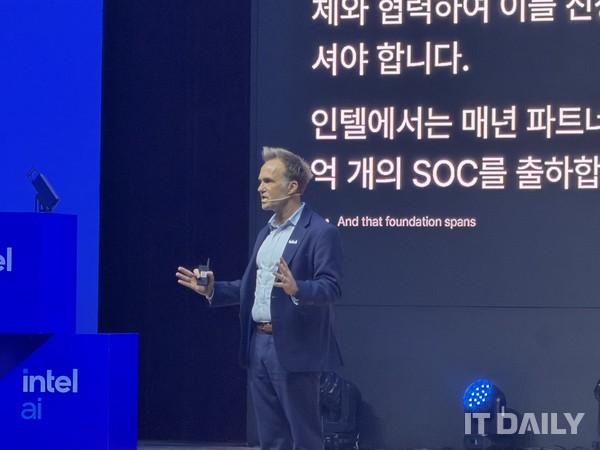
Intel is expanding the scope of AI adoption beyond PCs to a wider range of industrial sites. Dan Rodriguez, Intel executive vice president and general manager of the Edge Computing Group, introduced that direction at the '2026 Intel AI Summit Seoul' held on the 12th at COEX in Gangnam District, Seoul.
Rodriguez said Intel has the technology and performance needed to pursue this effort. He also said Intel supports a variety of models.
He said Intel is pursuing a plan to turn every PC into an agentic operating platform. He added that AI agents on PCs can perform tasks across multiple apps, and that such task delegation could reduce users' working time.
He described agent capabilities as a process in which a user enters a goal, the system creates a plan, and then completes the task. He added that for agents to function, they need continuous access to the data and business context required.
Rodriguez said combining the reasoning capabilities of agentic AI with physical AI would allow industrial equipment to perceive on-site conditions and respond autonomously. He cited factory industrial PCs that assess situations based on sensor data and control connected equipment.
He said that to implement these capabilities, reasoning and control must be performed in real time. He also explained that there is a challenge of securing the necessary computing performance while managing equipment size and power consumption.
As a response, he proposed heterogeneous computing, which distributes tasks across multiple types of computing resources. Intel has integrated CPU, GPU, and NPU into Core Ultra Series 3, and said Core Ultra Series 3 can use the computing resource best suited to each task.
Rodriguez explained that Core Ultra Series 3 supports real-time control, predictable operation, and physical AI in a single SoC. He also said that integrating work previously handled by two chips into one can reduce TCO and simplify design.
As an example of collaboration, Rodriguez highlighted Samsung Medison, saying it automated ultrasound diagnosis based on Core Ultra processors. He said AI performance improved 4.2 times in the process without a separate GPU.
Rodriguez then said AI is driving changes in computing from PCs to the edge. He explained that for these changes to be realized, an open ecosystem, trustworthy partnerships, and scalable platforms are needed.
He said Intel is building that foundation. He added that Intel is providing tools for developers' and partners' innovation, and that it is working with partners to turn AI's possibilities into tangible experiences and outcomes.
Source: IT DAILY · Yang Seung-gap
Original: https://www.itdaily.kr/news/articleView.html?idxno=242897
References
This article was produced with the help of an automated content generation algorithm.
Source: IT DAILY
View originalThis article was summarized and organized by BizCrush based on the original article from IT DAILY. For exact quotations and full details, please refer to the original article.
Keep reading
BizCrush