U.S., South Korea, and Japan Step Up Public-Private Cooperation for the 6G Era
IT DAILY ·
✦ AI Summary
South Korea, the United States, and Japan are pursuing technology demonstrations and market development through public-private cooperation ahead of the 6G era.
The United States is promoting 'Mission 6G' to demonstrate 6G technology at the 2028 Los Angeles (LA) Summer Olympics and Paralympics, while Japan is expanding support for overseas demonstrations and market entry.
South Korea is pursuing AI network demonstrations for industrial sites and physical AI support projects based on the 'Hyper AI Network Strategy.'
BizCrushWant to follow Korean talks and live streams in real time?Try CapCrush on the web
South Korea, the United States, and Japan are moving ahead with technology demonstrations and market development based on public-private cooperation ahead of the 6G era. The United States is working to verify the potential use of next-generation communications technology at the Olympics, while Japan is promoting support for overseas demonstrations and market entry by its companies. South Korea is pursuing AI network demonstrations that support physical AI, including robots, for industrial sites.
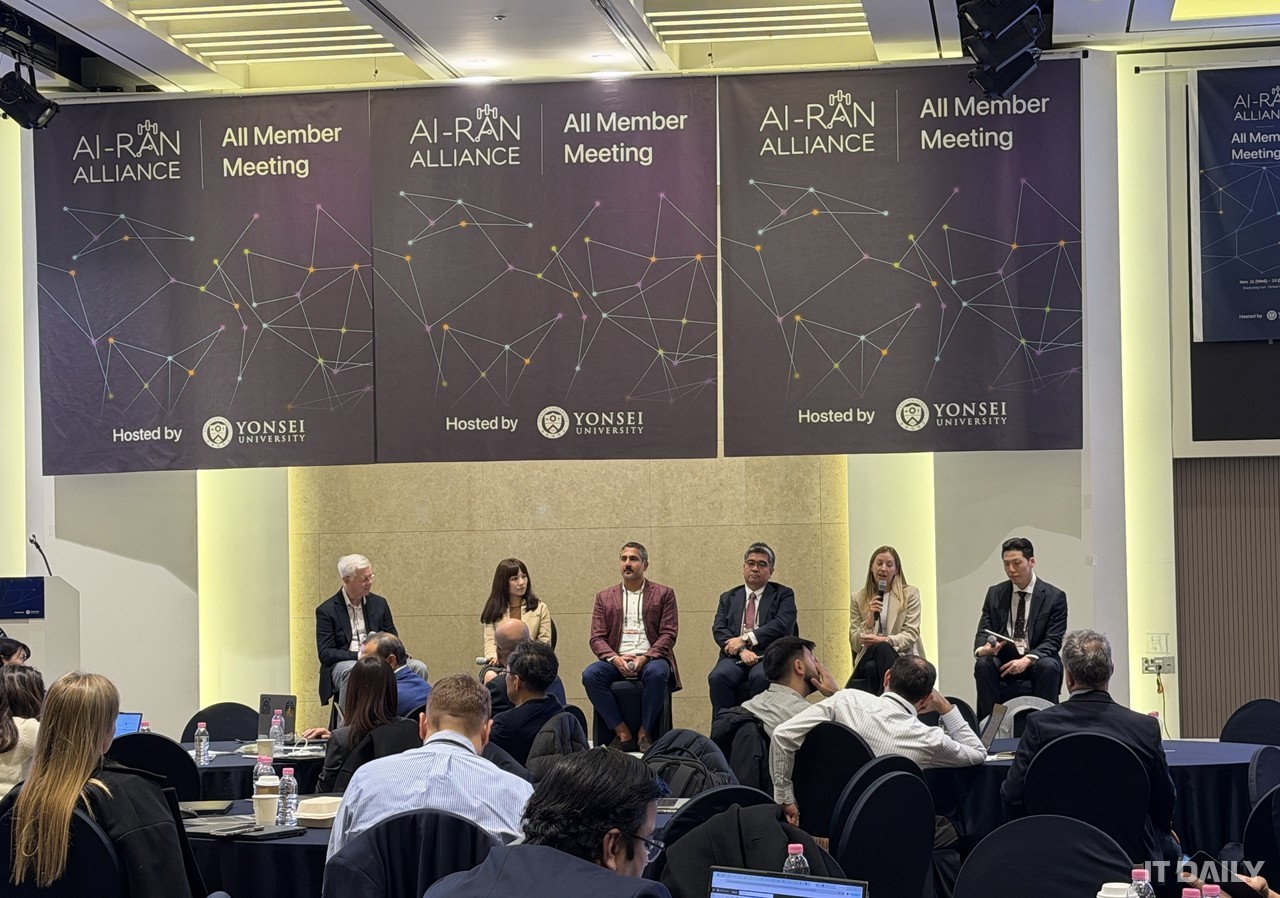
Against this backdrop, the 'AI-RAN Alliance November Member Meetings (AI-RAN Allicance 2026 November Member Meetings)' were held on the Yonsei University campus in Seoul on the 11th. Government officials from South Korea, the United States, and Japan attended the meeting.
At the meeting, presentations were given by government officials from South Korea, the United States, and Japan, and discussions were held on policy directions for AI networks and 6G, as well as on ways to cooperate internationally. The photo was taken by reporter Seong Won-young.
The United States is pursuing the 'Mission 6G' project. The project, which takes the form of a public-private cooperation initiative, includes a plan to demonstrate U.S. 6G technology at the 2028 Los Angeles (LA) Summer Olympics and Paralympics, ahead of the expected 2029-2030 commercialization of 6G. The United States is envisioning the Olympic venue before commercialization as a test bed for 6G.
To that end, the United States plans to set up a joint exhibition space during the Olympics. This joint exhibition space was conceived in the form of a 'mini MWC,' where multiple companies participate in one location.
Sarah Scaluba, who oversees 6G policy at the U.S. Department of Commerce (NTIA), said the current stage is one of reviewing what technologies could be demonstrated on-site. One of the technologies under review for demonstration was integrated sensing and communication (ISAC).
ISAC is a technology that combines wireless communications and sensing. It works by analyzing reflected signals from objects using existing wireless communications infrastructure such as antennas and base stations, and it can detect the location, speed, and presence of drones and vehicles. Sarah Scaluba said ISAC could be used to improve the spectator experience at games and make urban mobility easier for visitors.
Japan is supporting major target markets such as ASEAN, the United States, and Europe, and is pursuing demonstration projects with leading local telecom operators. The goal is to support overseas demonstrations and help Japanese companies expand abroad.
Shinya Shimada, Deputy Director-General for Emerging Technology Strategy at Japan's Ministry of Internal Affairs and Communications (MIC), said that as a result of such support, Japanese vendors have entered the Indonesian market. He also said that reference cases have been established in the Philippines.
Shimada said that, based on achievements in the Philippines, companies could expand into neighboring countries. He explained that such expansion is possible on the basis of prior demonstrations and secured references.
Shimada said it is practically almost impossible for individual private companies to break through barriers in overseas local markets on their own. He said that without government support, it is difficult for Japanese vendors to access those markets, and explained that successful cases were created as a result of government-level support for the challenges.
The South Korean government is carrying out a demonstration project to build a foundation for the 'Hyper AI Network' based on the 'Hyper AI Network Strategy.' The project is intended to lay the groundwork for AI to learn network conditions and traffic and automatically control network resources according to service needs.
Through this project, the government aims to comprehensively upgrade network infrastructure and strengthen industrial competitiveness. It also set as project goals the establishment of a foundation for automatic control of network resources by service demand, based on AI learning of network conditions and traffic.
The project involves the SK Telecom consortium and the KT consortium as participating entities. The SKT consortium includes Samsung Electronics, Ericsson, Nokia, HFR, Intellivix, Seoul Robotics, and Kleb.
Demand-side organizations participating include SK Incheon Petrochem and KG Mobility. These organizations will jointly verify the feasibility of applying the demonstration results on-site.
The target of verification is the leading network. SK Incheon Petrochem and KG Mobility will verify the applicability of the leading network in industrial settings by using a quadruped patrol robot for patrols in hazardous areas inside factories, an unmanned autonomous transport service, and a low-power-mode humanoid as verification tools.
The KT consortium includes Solid, Ariel Networks, WooriNet, the Telecommunications Technology Association (TTA), Yonsei University, and HD Hyundai Samho, and is pursuing physical AI demonstrations. The KT consortium plans to work with HD Hyundai Samho to develop a shipyard-specific 'AI-based autonomous system,' with the core focus on building an environment for real-time analysis and control of shipyard robot and equipment data.
Hwang Won-jun of the Network Policy Division at the Ministry of Science and ICT said the ministry is pursuing a total network investment of about USD 13 million (about KRW 17 billion). Hwang said that from next year, large-scale projects in the physical AI field will begin in earnest in South Korea, and that telecommunications infrastructure such as AI-RAN will be integrated and supported as a key element of physical AI projects.
Source: IT DAILY · Seong Won-young
Original: https://www.itdaily.kr/news/articleView.html?idxno=242884
References
This article was produced with the help of an automated content generation algorithm.
Source: IT DAILY
View originalThis article was summarized and organized by BizCrush based on the original article from IT DAILY. For exact quotations and full details, please refer to the original article.
Keep reading
BizCrush