KMS Lab Targets the 'Build-Type Enterprise AI' Market... Builds POSCO's Enterprise Portal
IT DAILY ·
✦ AI Summary
KMS Lab has begun stepping up its push into the on-premises AI market and is moving to expand the build-type enterprise AI market.
At a press briefing on the 13th, the company disclosed its contract win to build POSCO's enterprise-wide business portal and unveiled its knowledge management platform, 'K Portal BrainWeave (BrainWeave).'
CEO Bae Hee-jung cited legacy system integration and unstructured data refinement as challenges to adopting build-type AI, while KRG CEO Kim Chang-hoon said the enterprise AI market will move to a stage of proving investment returns in 2027.
BizCrushWant to follow Korean talks and live streams in real time?Try CapCrush on the web
KMS Lab has begun stepping up its push into the on-premises AI market. Based on 26 years of accumulated enterprise data processing technology and its own local LLM serving capabilities, the company has moved to expand the build-type enterprise AI market.
KMS Lab held a press briefing on the 13th. At the event, the company disclosed its contract win to build POSCO's enterprise-wide business portal and also unveiled its knowledge management platform, 'K Portal BrainWeave (BrainWeave).'
'K Portal BrainWeave (BrainWeave)' is the winner of the AI category innovation award at 'CES 2027.' At the event, Kim Chang-hoon, CEO of Knowledge Research Group (KRG), took the stage as a speaker and presented outlooks for the domestic and global AI markets.
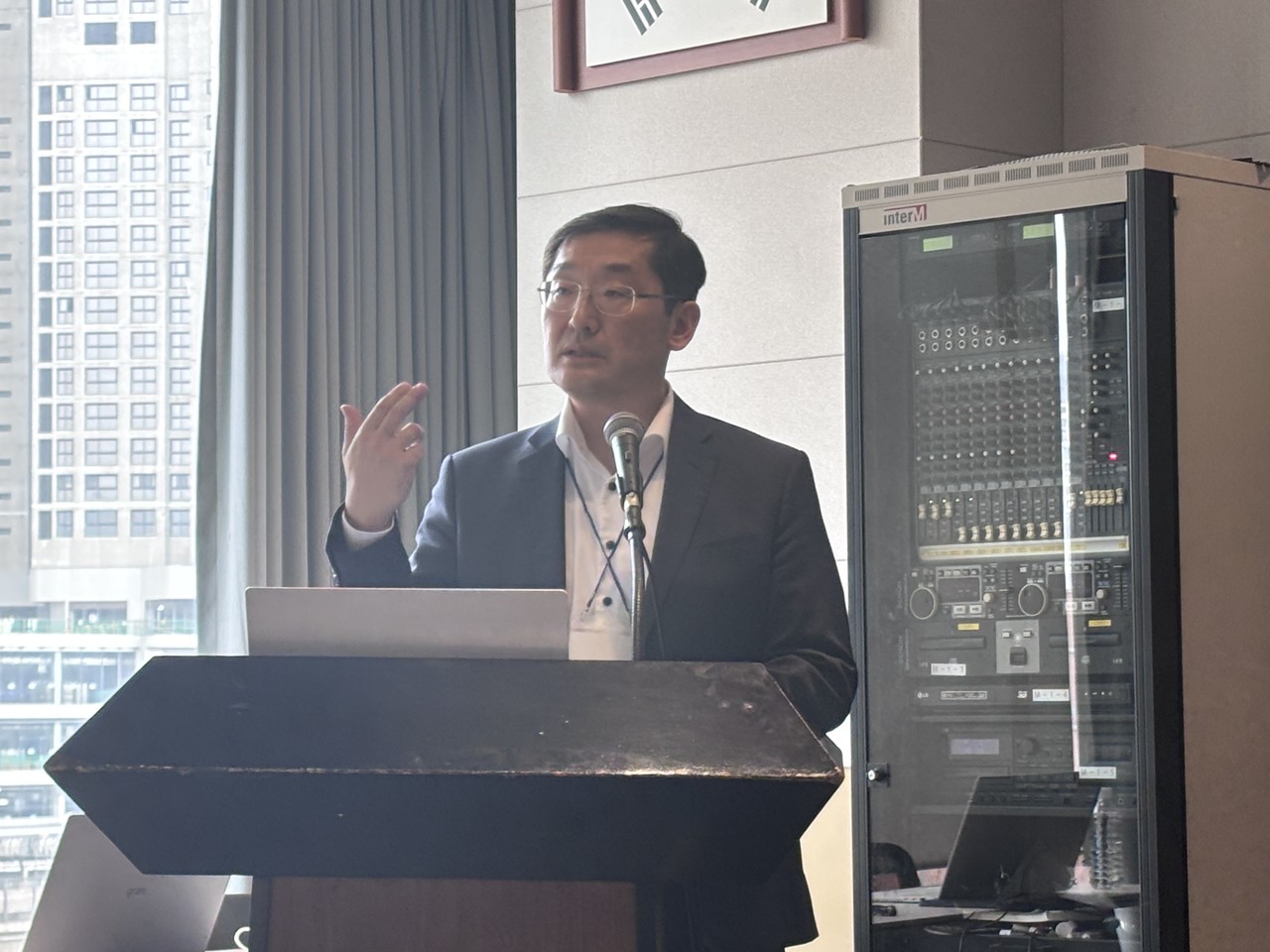
Bae Hee-jung, CEO of KMS Lab, also attended the event and gave a presentation. Bae said the biggest challenge in introducing build-type AI is the difficulty of integrating with in-house core legacy systems and the lack of capabilities to refine unstructured data.
Bae said many large companies prefer build-type AI because of security concerns. She added that simply introducing GPUs and models makes it difficult to secure the accuracy and response speed needed for practical use in the field.
After conducting about 7 months of prior validation (PoC), KMS Lab won in June a project to build POSCO's AI-based next-generation enterprise portal, 'Next EP.' It completed the first rollout in August, covering about 200 people, and completed the second rollout in November, covering about 1,000 people. KMS Lab plans to expand the deployment to all employees by next year.
The project applied the company's proprietary data processing technology, which received certification from the Telecommunications Technology Association (TTA). In TTA certification, the technology was presented as having a 73.6% compression rate for mixed data and 0.091-second search performance based on 100 million data records. The project also applied a 'hybrid multi-LLM' that combines specialized local LLMs by function, and the scope of application is the company's full-stack solution.
KMS Lab also unveiled 'K Portal BrainWeave.' The platform is equipped with a function that extracts business context based on employees' emails, messengers, and meeting records and generates a personalized 'second brain.' When an employee leaves the company or moves to another department, the 'second brain' can be transferred to colleagues or successors, and it can also be merged. Through this, the company aims to eliminate gaps in handovers and prevent the discontinuity of organizational knowledge.
At the event, Kim Chang-hoon, CEO of KRG, said 2027 will be a turning point for the enterprise AI market. He noted that the future benchmark for the enterprise AI market will shift away from technology performance itself and toward proving investment returns.
Kim presented a shift away from a model-performance competition as the substance of this transition. He added that the market will enter a stage of proving ROI.
According to a KRG survey, the global AI market is projected to reach USD 3.6 trillion next year. That would account for about 48% of the total ICT market of USD 7.6 trillion.
The domestic AI market, after growing 43% this year, is projected to grow more than 40% next year. As a result, the domestic AI market is expected to surpass KRW 10 trillion next year.
In addition, a KRG survey of 217 companies with sales of more than KRW 200 billion found that about 70% remained in the initial stages 1 to 2 of adoption. Accordingly, future investment reallocation is expected to proceed in the order of AI agents, infrastructure, platforms, and ready data.
Kim said that, given that manufacturing accounts for about 45% of the country's industrial structure, the domestic environment gives strong growth potential to multi-AI agents and also to physical AI, which controls production sites.
Source: IT DAILY · Kwon Young-seok
Original: https://www.itdaily.kr/news/articleView.html?idxno=242928
References
This article was produced with the help of an automated content generation algorithm.
Source: IT DAILY
View originalThis article was summarized and organized by BizCrush based on the original article from IT DAILY. For exact quotations and full details, please refer to the original article.
Keep reading
BizCrush