AMD Unveils Server CPU and Rack Strategy Aimed at AI Agents
AI TIMES ·
✦ AI Summary
According to AI TIMES, AMD on Nov. 10 introduced the 6th-generation EPYC server CPU aimed at running AI agents and operating data centers, a…
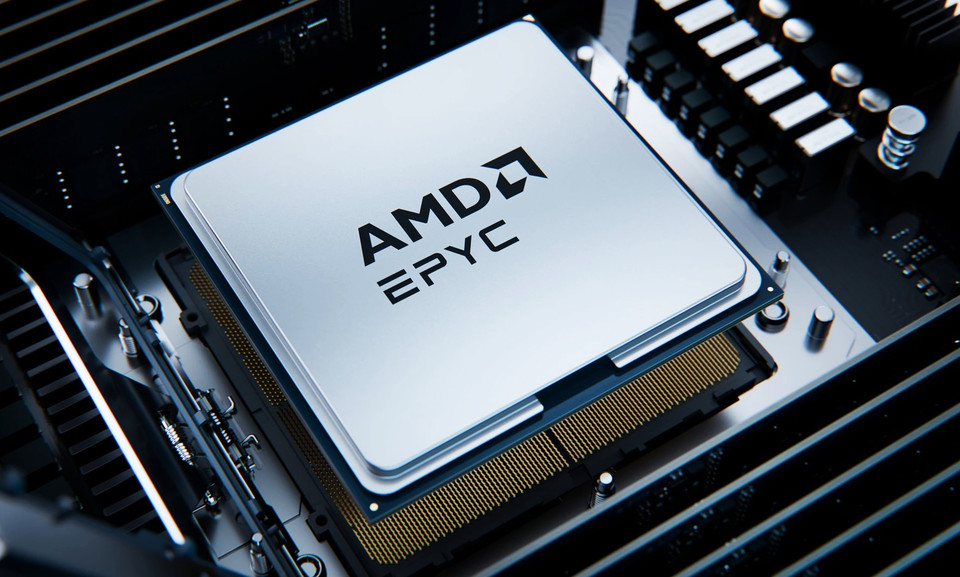
According to AI TIMES, AMD on Nov. 10 introduced the 6th-generation EPYC server CPU aimed at running AI agents and operating data centers, and said it delivers up to 3.7 times higher general-purpose server performance than Nvidia Vera-based systems, based on AMD's own benchmark. At the same time, it unveiled "Helios," an open infrastructure blueprint designed to support up to 73,728 threads in a single rack, positioning the CPU not as an individual chip but as the centerpiece of rack-level AI infrastructure. The focus of this announcement is AMD's view that the role of the CPU is regaining importance in an AI competition that had been centered on GPU. AMD said that as AI agents handle tasks such as data retrieval, code execution, and calling external tools, the CPU will take on execution coordination, maintaining isolated environments, and running enterprise applications. Its cooperation with Meta, Microsoft, and Oracle also sits within this strategy. However, the article noted that the performance and efficiency figures may vary depending on the actual deployment environment, as they reflect results based on specific configurations, conditions, and some estimation methods.
Perspective
The significance of this issue lies in the fact that the benchmark for competition in AI infrastructure is changing. The trend is now clearly moving beyond judging advantage solely by the raw compute performance of accelerators, and toward assessing how many agents can be run reliably and how much power and operating cost can be reduced. This shift also requires vendors to build capabilities that go beyond chip-level competition and extend to servers, racks, and cloud services. In the end, enterprise customers are likely to place greater emphasis on connectivity with existing environments, scaling methods, and operational efficiency than on the peak performance of any single device.
This perspective is BizCrush's own commentary and is not part of the reporting by AI TIMES.
This article was produced with the help of an automated content generation algorithm.
Source: AI TIMES
View originalThis article was summarized and organized by BizCrush based on the original article from AI TIMES. For exact quotations and full details, please refer to the original article.