Rebellions to Build Sovereign AI Infrastructure With Domestic NPUs in Partnership With NVIDIA and SKT
TECHWORLD ·
✦ AI Summary
Rebellions announced on the 9th at "NVIDIA AI Day" that it is collaborating with NVIDIA and SK Telecom to build sovereign AI infrastructure based on domestic NPUs.
The key is to connect Rebellions' next-generation NPU, "R200," with NVIDIA's "NVLink Fusion" and develop a rack-level inference system using the MGX rack architecture.
The three companies aim for a disaggregated inference architecture in which GPUs handle Prefill and NPUs handle Decode, expecting improved throughput and power efficiency.
BizCrushWant to follow Korean talks and live streams in real time?Try CapCrush on the web
Rebellions announced on the 9th at "NVIDIA AI Day" that it will pursue the establishment of sovereign AI infrastructure based on domestic NPUs in collaboration with NVIDIA and SK Telecom. The goal of the partnership is to advance South Korea's sovereign AI infrastructure.
The key task is to connect Rebellions' next-generation NPU, "R200," with NVIDIA's "NVLink Fusion" technology and develop a rack-level inference system using the MGX rack architecture. Rebellions, NVIDIA and SK Telecom will all take part in the process.
SK Telecom plans to leverage its experience in building and operating AI data centers, as well as its capabilities in proprietary AI models and services. It also plans to introduce the system it develops into an actual data center environment.
The three companies aim to implement a disaggregated inference architecture in which GPUs and NPUs efficiently divide computing tasks in AI inference. In this setup, NVIDIA GPUs handle the Prefill stage, which requires large-scale computation, while Rebellions' energy-efficient NPU handles the Decode stage, which generates answers sequentially.
AI inference is divided into the Prefill and Decode stages. The Prefill stage handles user question and context analysis, as well as processing the information needed to generate an answer, while the Decode stage sequentially generates actual tokens based on the preceding information. The plan is based on the premise that the two stages have different computational characteristics, and aims to deploy heterogeneous semiconductors tailored to each stage's needs.
If this approach is applied, the companies expect improvements in AI service throughput and power efficiency. As a result, it is expected to reduce power consumption in large-scale AI service operations and lower TCO, while pursuing the implementation of a Sovereign AI Token Factory.
This partnership is significant in that it connects domestic AI semiconductors with the global AI infrastructure ecosystem. Rebellions presented a direction in which it independently develops its own NPU and uses NVIDIA NVLink Fusion and the NVIDIA MGX platform to build a system compatible with global infrastructure. The aim is to lay the groundwork for expanded business opportunities for domestic AI chip companies within the global computing ecosystem.
Rebellions will accelerate the development and commercialization of R200 for frontier AI model inference. R200 is optimized for MoE models at the scale of several trillion parameters, and it is designed for low-latency, high-efficiency inference.
Through NVLink Fusion, Rebellions plans to directly connect the NPU inside the rack to NVIDIA's ultra-fast scale-up network. The goal is to maximize system performance, and the target for introducing the R200 system is 2028. It will also develop the system in the direction of an NVIDIA infrastructure-compatible rack system, and is expected to reduce system build risks and shorten the time to global market launch by leveraging the MGX ecosystem's proven partners and component supply chain.
Through this partnership, SK Telecom aims to strengthen the connectivity between its AI data centers, AI models and services. SK Telecom has its own AI model, "A.X K2," and its public AI service, "Everyone's AI," and plans to use them to verify the feasibility of applying domestic NPUs to real-world services. It also aims to expand the ecosystem for sovereign AI infrastructure that can be used by both the public and private sectors.
The Ministry of Science and ICT is supporting this partnership. The support direction is to foster a national sovereign AI infrastructure through open collaboration between domestic NPU companies and global technology companies. Rebellions was selected in March as the first direct investment company of the National Growth Fund, with its technological prowess and growth potential cited as the basis for the selection.
The three companies have set a partnership goal. The goal is to establish a foundation for large-scale operation of AI services optimized for Korea's language, data and industry-specific needs. Rebellions plans to secure large-scale proof-of-concept cases through SK Telecom's AI data centers and public AI services, while also seeking opportunities to supply domestic NPU-based systems to global customers using NVIDIA infrastructure.
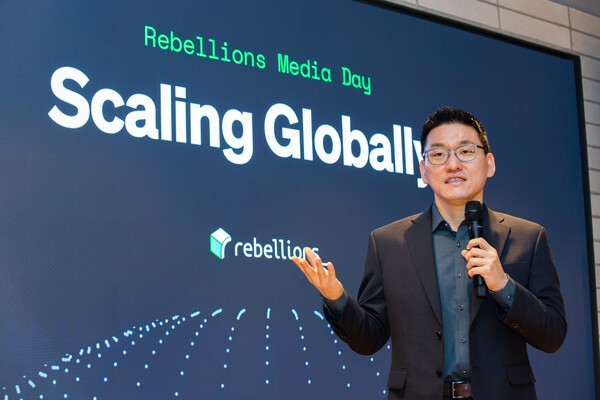
Rebellions CEO Park Sung-hyun said the combination of Korean AI semiconductors and models with global technology marks an important turning point in the expansion of South Korea's sovereign AI ecosystem. He added that the company will co-design next-generation AI infrastructure with NVIDIA and SKT, and will help Korean technology grow into a key pillar driving AI worldwide.
Jung Seok-geun, CTO and head of AI CIC at SK Telecom, said combining the strengths of NVIDIA GPUs and Rebellions NPUs increases the potential for improved inference performance and power efficiency, adding that this has significance in verifying the feasibility of a Korean-style sovereign AI infrastructure. He said SK Telecom has experience building and operating AI data centers, as well as capabilities in proprietary AI models and public-facing services, and that it plans to strengthen full-stack sovereign AI competitiveness based on those strengths.
Ashish Karandikar, vice president of NVLink Fusion at NVIDIA, said NVLink Fusion supports the combination of Korea's ASICs and NVIDIA AI Factory platform, thereby enabling high-performance AI infrastructure. He said he looks forward to working with the Ministry of Science and ICT, SK Telecom and Rebellions to contribute to strengthening Korea's sovereign AI capabilities and to building the next-generation AI computing ecosystem.
Source: TECHWORLD · Park Kyu-chan
Original: https://www.epnc.co.kr/news/articleView.html?idxno=409466
References
This article was produced with the help of an automated content generation algorithm.
Source: TECHWORLD
View originalThis article was summarized and organized by BizCrush based on the original article from TECHWORLD. For exact quotations and full details, please refer to the original article.
Keep reading
BizCrush