“Blocking OS Interoperability Creates Problems”: Pre-Opening Obligations Proposed for Google and Apple
IT DAILY ·
✦ AI Summary
As the first sanctions against Google and Apple over forced in-app payment practices were imposed, concerns were raised that choice of payment method alone is not enough to ensure competition in app marketplaces.
At the seminar, it was argued that control over app installation routes and device functions by incumbent platforms can restrict competition, and proposals were made for opening app installation routes and guaranteeing access to core mobile OS functions.
Sungkyunkwan University Professor Lee Seung-min proposed preemptively mandating OS function access and the opening of alternative app distribution routes for businesses meeting certain requirements, and related legislation was also submitted to the National Assembly.
BizCrushWant to follow Korean talks and live streams in real time?Try BizCrush Live
According to a report by IT Daily, as the first sanctions were imposed over Google and Apple’s forced in-app payment practices, concerns were raised that choice of payment method alone is not enough to ensure competition in app marketplaces. It was pointed out that competition can still be restricted even when developers are able to use other payment methods, with control over app installation routes by incumbent platforms and control over device functions by incumbent platforms cited as the factors. Accordingly, proposals were put forward calling for opening app installation routes to promote competition in app marketplaces and for guaranteeing access to core mobile operating system (OS) functions.
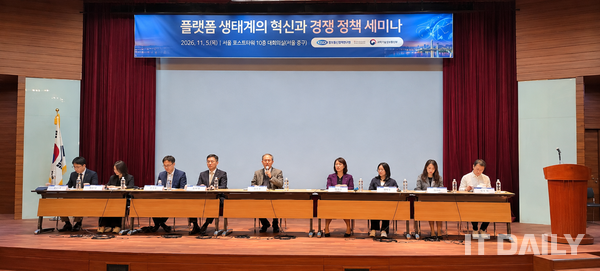
At the general discussion of the seminar “Innovation in the Platform Ecosystem and Competition Policy,” held on the 5th at Post Tower in Jung-gu, Seoul, attendees included Han Shin University Professor Yoo Young-kuk, Yonsei Law School Professor Choi Nan-seol-heon, University of Seoul Professor Park Se-hwan, Sungkyunkwan University Professor Lee Seung-min, moderator Hong Dae-sik of Sogang University, Kim Hyun-soo, head of the Korea Information Society Development Institute, Sejong University Professor Lee Hwa-ryeong, lawyer Cha Hyun-jung of Bae, Kim & Lee LLC, and Korea Mobile Game Association Chairman Hwang Seong-ik. The photo shows participants in the general discussion at the seminar “Innovation in the Platform Ecosystem and Competition Policy,” held on the 5th at Post Tower in Jung-gu, Seoul, and was taken by reporter Kim Byung-joo.
The Korea Information Society Development Institute, the Ministry of Science and ICT’s Digital Platform Policy Forum, and the Korean Association for Information Society Studies co-hosted the seminar “Innovation in the Platform Ecosystem and Competition Policy” on the 5th at Post Tower in Jung-gu, Seoul. The seminar was a venue to discuss legislative directions centered on mobile OS interoperability and app marketplace opening, with the question of how to define the scope of openness for mobile OSs and app marketplaces through legislation presented as the main topic.
Sungkyunkwan University Professor Lee Seung-min proposed a system that would preemptively mandate access to OS functions and the opening of alternative app distribution channels for businesses meeting certain requirements. The proposal was said to be intended to codify the legal requirements for market entry by competing businesses.
Ahead of these discussions, the Broadcasting and Media Communications Commission decided on the imposition of fines totaling KRW 63.71 billion on the 28th of last month, including KRW 42.9 billion against Google and KRW 20.81 billion against Apple. The sanctions targeted Google and Apple’s coercion of specific payment methods, Google and Apple’s undue delays in app review, and Apple’s discriminatory fees imposed on domestic and overseas developers. The commission ordered the provision of external payment routes through in-app links and adjustments to third-party payment fees, and this sanction was presented as the first case under the specific payment coercion prohibition introduced in the Telecommunications Business Act in 2021.
During the general discussion, Sungkyunkwan University Professor Lee Seung-min said that, among app marketplace issues, he was unusually in favor of introducing ex ante regulation. He explained that ex ante regulation tailored to the structural characteristics of app marketplaces is necessary.
Lee pointed out that the current Telecommunications Business Act continues to add prohibited acts, and noted that this approach could overlap with ex post regulation under the Monopoly Regulation and Fair Trade Act. Accordingly, he said that rather than repeatedly supplementing ex post regulation, a structure is needed in which openness obligations are set in advance and sanctions are imposed if those obligations are not fulfilled.
Lee stressed that creating a competitive environment among app marketplaces should take precedence over the government directly setting fee rates. Explaining that an environment in which costs are adjusted through competition is needed, he said alternative app marketplaces must be able to offer lower fees and developers and users must be able to choose those alternative app marketplaces. In such a case, he explained, incumbent operators would also face price competition pressure.
In line with these discussions, a seminar requested by the Ministry of Science and ICT covered mandatory technical access. In the National Assembly, a revision to the Telecommunications Business Act containing mobile OS operators’ technical access obligations was introduced.
Democratic Party lawmaker Lee Jung-heon co-sponsored the revision on May 21. The bill required mobile OS operators meeting certain criteria to ensure equal conditions for software of other telecommunications operators and their own software, and included an obligation to provide access to device hardware and software functions. However, minimal restrictions for personal data protection or OS security were allowed as exceptions. The bill was submitted to the National Assembly’s Science, ICT, Broadcasting and Communications Committee on September 8 and referred to a subcommittee.
The seminar was organized at the request of the Ministry of Science and ICT, and the focus of the discussion was on mobile OS interoperability and app marketplace opening. Related presentations and discussion materials were delivered to the National Assembly.
Kim Hyun-soo, head of the Korea Information Society Development Institute, explained that the Ministry of Science and ICT had sounded out Apple on whether it would voluntarily open up its technology. However, Apple is said not to have given a positive response.
Accordingly, it was raised that it would be difficult to expect technical openness through voluntary measures by operators alone, and that the need to consider legal obligations should be reviewed.
In his presentation, Han Shin University Professor Yoo Young-kuk said that restrictions on access to core OS functions could constrain competing operators’ service development and potentially limit market entry as well. As a representative example, Apple’s near-field communication (NFC) function was cited, which is used for smartphone-based contactless payments. He also explained that if an OS operator restricts access rights to related functions, it could affect the ability of competing mobile wallet operators to provide services.
The European Commission of the European Union (EU) gave legal force to Apple’s commitments in July 2024. The commitments were to allow third-party mobile wallet operators access to NFC for contactless payments, and EU competition law was applied to the measure. In the EU, the criteria for fulfilling openness obligations were also specified in greater detail.
The EU Commission then finalized interoperability measures for nine Apple iOS connectivity features in March 2025 based on the Digital Markets Act (DMA). The measures were designed to specify access to functions needed for notifications, connectivity, and data transfer for third-party devices such as smartwatches. The Commission separately established procedures for handling developers’ interoperability requests.
University of Seoul Professor Park Se-hwan cited these EU cases. He explained that, as a domestic option, one could consider both revising the Telecommunications Business Act and using the monopoly abuse provisions under the Monopoly Regulation and Fair Trade Act.
Kim said domestic legislation needs a detailed design covering which targets are subject to openness, access costs, and security exceptions. He explained that a distinction is needed between those who receive technical access free of charge and those from whom usage fees may be charged.
He also said that when fees are charged, an appropriate cost level must be set. If usage fees are excessive, even opened functions may be difficult for competing operators to use, he noted.
Kim said the issue of OS technical access rights is expanding into artificial intelligence (AI) services. Under a structure in which an OS operator provides its own AI services, the OS operator can decide whether competing AI services may access device functions, and this structure could become a new competition policy issue, he explained.
Yonsei Law School Professor Choi Nan-seol-heon distinguished between external payments and sideloading in her presentation. As payment methods that developers can choose, she cited using a third-party payment method within the app and paying on an external website after moving through an in-app link. Sideloading means installing without going through the official app marketplace, and third-party app marketplaces and developers’ websites were mentioned as routes.
It was pointed out that the competitive conditions of the app ecosystem need to be considered together as a combined issue of distribution, payment, and technical access. Sejong University Professor Lee Hwa-ryeong stressed in the general discussion that app distribution routes, access to core OS functions, and choice of payment method need to be reviewed together. Android allows installation from third-party app marketplaces and websites when user installation is permitted, but Korea was not included among the regions where Apple said alternative app distribution support is available.
Lee explained that opening app installation routes alone makes it difficult to properly implement competing services if there is no access to core OS functions. Conversely, even if technical access is allowed, if distribution and payments are restricted, it becomes difficult to turn developers’ innovative achievements into revenue, he said.
He said that even if another payment method is allowed, developers’ choices can still be constrained by fees and technical conditions imposed by incumbent app marketplaces. He noted that the fees and technical conditions of incumbent app marketplaces may reduce the practical effect of competition. He also explained that when alternative app distribution routes are limited, the structure in which developers depend on incumbent app marketplace policies is likely to continue.
Lee pointed out that platform operators have incentives both to open and to restrict access. He explained that the value of a platform can rise as third-party devices and services increase, but if the platform operator directly competes in adjacent markets, it may have an incentive to restrict competitors’ access to functions.
In the EU, not only whether alternative app distribution routes were opened, but also the actual conditions for use were treated as regulatory issues. In April 2025, the EU Commission announced a preliminary assessment of Apple’s additional fees for alternative app distribution and its strict eligibility requirements, saying those fees and requirements could restrict developers’ choices. Apple then changed its installation-count-based fee in the EU starting October 1 this year to a 5% fee on digital transactions for alternative app distribution routes, and also eased the eligibility requirements for operating alternative app marketplaces and for web distribution.
Along with this, cautious views over the scope of openness were also raised. Kim said there is a need to distinguish between installing third-party app marketplaces and direct installation from developers’ websites, and he expressed the view that, considering the conditions for managing security risks, one could consider a phased opening starting with third-party app marketplaces.
Bae, Kim & Lee LLC lawyer Cha Hyun-jung pointed out that when imposing technical access obligations, it is necessary to consider the criteria for determining equal access conditions. Cha said that when technical access obligations are imposed, technical and economic burdens should also be considered.
Cha explained that reasonable restrictions for personal data protection and prevention of security risks need to be recognized. In addition, the need to secure the effectiveness of openness obligations and establish predictable standards for operators and users was also raised.
Professor Yoo Young-kuk explained that the Telecommunications Business Act is advantageous for establishing standards that reflect the technical characteristics of mobile OSs. On the other hand, he said the Monopoly Regulation and Fair Trade Act has the advantage of being applicable across industries.
Yoo said it is necessary to distinguish between the issue of setting standards for fulfilling technical access obligations and the issue of determining abuse of market dominance. While comparing the strengths and weaknesses of each legal framework, he suggested that the two issues should be approached separately.
Hong Dae-sik, professor at Sogang University and chair of the general discussion, pointed out that regulatory authority over app marketplaces is dispersed across multiple government agencies. Hong noted that the EU Commission enforces competition policy and digital market regulation together, and emphasized the need for policy coordination among domestic agencies. It was also pointed out that it would be difficult to establish consistent policy by expanding different regulatory frameworks across individual agencies.
Hwang Seong-ik, chairman of the Korea Mobile Game Association, said that around 300 companies participated in Google’s previous collective arrangement on fee refunds. Hwang pointed out that while game development and operation costs have risen, centered on marketing, labor, and operating expenses, the burden of app marketplace fees has also remained high for a long time.
Hwang said he welcomed Google’s fee cuts, but argued that it still needs to be reviewed whether the scale of Google’s cuts is sufficient to ease developers’ burden. He then called for Apple as well to take steps that would ease fee burdens in a way that domestic game companies can feel.
Separate tasks for specifying access obligations were identified as setting the scope of target operators, defining the scope of functions for which openness is required, and determining the permitted level of fees. Legislative tasks were also identified in setting the minimum scope required when restricting access to functions for reasons of personal data protection or security.
Source: IT DAILY · Kim Byung-joo
Original: https://www.itdaily.kr/news/articleView.html?idxno=242739
References
This article was produced with the help of an automated content generation algorithm.
Source: IT DAILY
View originalThis article was summarized and organized by BizCrush based on the original article from IT DAILY. For exact quotations and full details, please refer to the original article.
Keep reading
BizCrush