Qualcomm Smartphone Chip Sales Fall 26% as It Diversifies Into AIDC
IT DAILY ·
✦ AI Summary
Qualcomm announced earnings on the 4th, and smartphone chip sales in fiscal 2026 fourth quarter fell 26% year on year to USD 5.137 billion.
During the same period, automotive sales rose 89% to USD 1.99 billion and IoT sales increased 4% to USD 1.888 billion, but total revenue fell 8% to USD 10.322 billion.
Qualcomm plans to start shipping custom chips to two large cloud customers from the first quarter of fiscal 2027 and highlighted expansion in non-smartphone businesses, including data centers and automotive and IoT.
BizCrushWant to follow Korean talks and live streams in real time?Try BizCrush Live
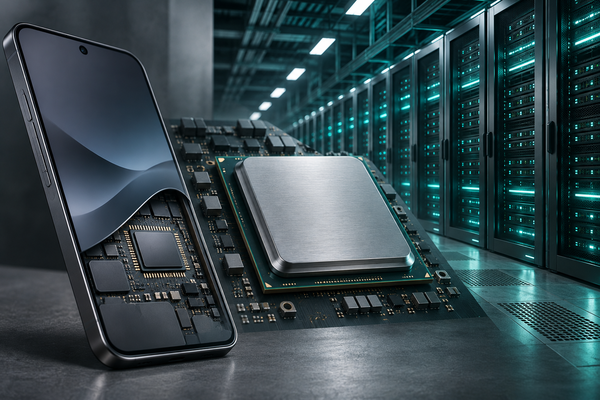
The image used in the report is AI-generated. Qualcomm announced earnings on the 4th (local time), and smartphone chip sales in fiscal 2026 fourth quarter (July-September) fell 26% year on year to USD 5.137 billion (about KRW 6.9 trillion). Qualcomm's semiconductor sales for smartphones fell by more than USD 1.8 billion from a year earlier in a single quarter.
By contrast, automotive sales during the same period rose 89% year on year to USD 1.99 billion (about KRW 2.7 trillion), while IoT sales increased 4% to USD 1.888 billion (about KRW 2.5 trillion). Although the automotive and IoT businesses grew, the combined increase in automotive and IoT sales came to only USD 1.018 billion (about KRW 1.3 trillion), covering just 56% of the USD 1.824 billion (about KRW 2.4 trillion) drop in smartphone chip sales. As a result, revenue for the semiconductor segment, QCT, fell 8% year on year to USD 9.015 billion (about KRW 12.2 trillion), and Qualcomm's total revenue fell 8% to USD 10.322 billion (about KRW 14 trillion).
Qualcomm plans to start shipping custom chips to two large cloud customers from the first quarter of fiscal 2027 (October-December 2026). The company plans to use this to begin expanding AIDC revenue in earnest.
After the earnings release, Qualcomm executives held a conference call and pointed to memory supply constraints, price increases, and lower revenue from Apple as headwinds for the smartphone business. Due to tight memory supply and demand, some smartphone makers adjusted production plans and inventory levels. Apple's shift to its own modem also affected Qualcomm chip shipments. Qualcomm said smartphone chip sales in the first quarter of fiscal 2027 will likely rise for Android chips, but the decline in revenue from Apple will offset that increase, leaving smartphone chip sales down by a mid-single-digit percentage sequentially. Meanwhile, Qualcomm renewed its long-term patent licensing agreement with Apple.
In contrast, Qualcomm highlighted expansion in non-smartphone businesses, including data centers and automotive and IoT. Qualcomm forecast that data center revenue in the first quarter of fiscal 2027 will exceed USD 650 million (about KRW 880 billion), reflecting shipments of custom chips to two large cloud customers. It also maintained its fiscal 2027 data center revenue target of USD 5 billion (about KRW 6.7 trillion), and said that in fiscal 2027, the combined automotive, IoT, and data center non-smartphone businesses will exceed half of semiconductor segment revenue.
Qualcomm pointed to Amazon as an example of its announced collaborations. In September, Qualcomm said it would co-develop custom semiconductors for AI inference with Amazon over multiple generations, and the two companies also announced cooperation on optical interconnect technology for high-speed data transfer inside data centers. Qualcomm also unveiled its own Dragonfly server CPU and its own AI inference accelerator. Qualcomm's strategy is to expand its in-house-designed server product line while also supplying chips tailored to the needs of each cloud provider.
Qualcomm said custom chip shipments will help improve operating margin at the semiconductor segment. However, it expects custom chip shipments to put downward pressure on gross margin. Its own AI accelerator and server CPU require upfront investment before revenue can scale. As smartphone revenue declines as a share of sales, the key question going forward is whether greater data center shipments will translate into higher profits for the semiconductor segment.
Source: IT DAILY · Lee Jae-young
Original: https://www.itdaily.kr/news/articleView.html?idxno=242735
References
This article was produced with the help of an automated content generation algorithm.
Source: IT DAILY
View originalThis article was summarized and organized by BizCrush based on the original article from IT DAILY. For exact quotations and full details, please refer to the original article.
Keep reading
BizCrushEvent interpretation
Korean talks like this one, captioned live in your language