National AI Strategy Committee Redraws AI Legislation Playbook, Launches 7 TFs for Superintelligence and Domestic AI
TECHWORLD ·
✦ AI Summary
The National AI Strategy Committee held its third plenary meeting on the 6th at Seoul Square and reviewed and approved the Republic of Korea AI Legislative Framework, the plan for establishing and operating national AI core task force groups, and the status of governmentwide data pipeline construction and plans for utilization.
The committee divided AI legislation into four areas — development, promotion of AX, securing safety and trust, and preventing misuse — and decided to prioritize revisions to the Framework Act on AI or existing individual laws.
The committee will operate 7 TFs, including 3 directly under the full-time vice chair and 4 division-linked TFs, while also advancing the pilot operation of the governmentwide data pipeline and public data joint-use tasks.
BizCrushWant to follow Korean talks and live streams in real time?Try BizCrush Live
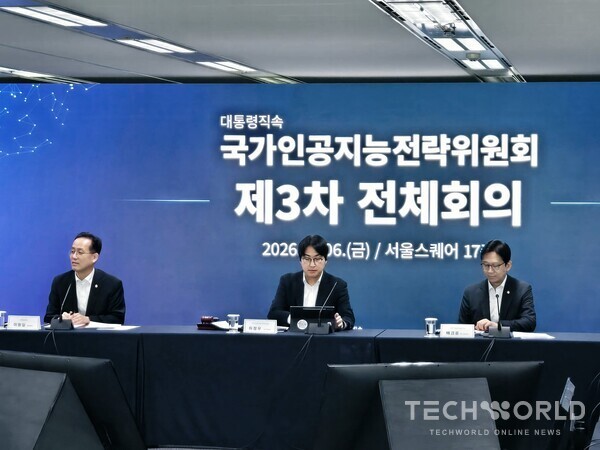
The National AI Strategy Committee is seeking to finalize governmentwide AI legislative standards and will form seven task force groups dedicated to seven key priorities, including responses to superintelligence and building a domestic AI ecosystem. The committee held its third plenary meeting on the 6th at Seoul Square, presided over by full-time Vice Chair Ha Jung-woo.
At the plenary meeting, three items were reviewed and approved: the “Republic of Korea AI Legislative Framework,” the “Plan for Establishing and Operating National AI Core Task Force Groups,” and the “Status of Governmentwide Data Pipeline Construction and Plans for Utilization.” The committee addressed AI legislative standards and the system for advancing key tasks at the plenary meeting.
In the process, major issues raised for discussion included responses to superintelligence, the domestic AI ecosystem, and the data utilization base, as well as responses to violations of fundamental rights caused by AI misuse, securing business budgets, and how to operate a public data-sharing system.
On the government side, Economy and Finance Deputy Prime Minister and Minister of Economy and Finance Lee Eok-won said technology development, infrastructure investment, realization of new market creation through demonstration results, and value-added expansion are necessary. He also said policies need to be refined to link overseas market expansion and export growth, and emphasized responses to economic and social risks such as AI safety, the impact on financial markets, and polarization, as well as interministerial cooperation.
Deputy Prime Minister for Science and ICT and Minister of Science and ICT Bae Kyung-hoon said securing GPU and pushing ahead with the development project for a proprietary AI foundation model would serve as the basis for taking on follow-up challenges such as frontier AI. As an extension of that trend, he said the government plans to launch “Everyone’s AI” for the entire public in mid-December.
Bae said “Everyone’s AI” is not simply a generative AI chatbot. He added that “Everyone’s AI” is the first starting point in preparing for the age of agentic AI.
Currently, each ministry is pushing ahead with about 30 public AX projects. The government plans to link public AX projects with specialized private-sector services, but Bae said there are difficulties in connecting individual services and using data.
Vice Chair Ha said the committee will shift its operations to a results-oriented project TF system during this process. He also proposed a policy of operating around projects with clear deliverables and generating results within a set period. In addition, legislation centered on the Framework Act on AI and discussions on responses to deepfake crimes will also be pursued.
The AI legislative framework has been finalized. The framework is designed to establish standards for reducing overlap and conflicts among laws by ministry at a time when AI-related legislation is surging. Since the opening of the 22nd National Assembly through October 19 this year, 477 AI-related bills and amendments have been introduced, exceeding the 170 introduced during the entire 21st National Assembly, which serves as the comparison period.
The committee divided AI legislation into four areas: AI development, promotion of AI convergence (AX), securing AI safety and trust, and preventing AI misuse. It also set its legislative priority to first review revisions to the Framework Act on AI or existing individual laws rather than enacting new standalone legislation. However, national defense and national security, which are excluded from the scope of the Framework Act on AI, were designated as exception areas, and separate legislation will be pursued for those fields.
The agenda also included discussion of the relationship between industrial promotion and the protection of fundamental rights. Women and Family Minister Won Min-kyung raised concerns that, in responding to deepfake sex crimes, an industrial promotion stance could constrain the introduction of necessary regulations. In response, the committee said it would focus on swift legislation if harm from AI misuse occurs.
Regarding efforts to overhaul the AI system, Senior Presidential Secretary for AI Future Planning Lee Hae-min stressed that legislative authority belongs to the National Assembly and that consistency with existing laws must be considered. Lee also said the role of the Framework Act on AI is to establish the basic framework.
Lee said revisions to individual laws such as the Network Act and the Personal Information Protection Act should be judged on a case-by-case basis.
Separately, the Intellectual Property Office raised the issue of unauthorized use of the images and voices of celebrities through AI. In response, the office announced plans to push ahead with revisions to the Unfair Competition Prevention Act.
The committee will operate 7 TFs. It will run 3 TFs directly under the full-time vice chair and 4 division-linked TFs. The 3 TFs directly under the full-time vice chair are youth advancement, national superintelligence response, and global strategic cooperation on AI. The 4 division-linked TFs are strengthening national cyber resilience, innovation in culture and content AI, building a data flywheel, and building a K-AI full-stack ecosystem.
The national superintelligence response TF aims to identify 10 or more tasks to supplement the AI action plan by June 2027. The data flywheel building TF aims to devise a plan to secure more than 1 trillion tokens of learning data in key fields by next March.
The K-AI full-stack ecosystem building TF plans to validate 10 or more combinations of domestic AI models and NPUs. It also plans to develop 3 AI services and apply them at 5 or more public and industrial sites. To this end, it will promote the launch of an alliance involving related companies by next March.
The national cyber resilience strengthening TF plans to prepare 3 or more scenarios for AI data center compound failures and recovery by next March. Lee Won-tae, head of the committee’s security subcommittee, emphasized that in addition to preventing cyber threats, rapid recovery after incidents is important. He also said the committee is preparing a national cyber resilience framework linked to AI infrastructure and data centers.
The youth advancement TF will promote on-site work experience support for 10,000 young people through the manufacturing AX support project. Cha Jeong-in, chair of the National Education Commission, requested that the use of education in national AI policy be actively reflected.
During the project rollout process, the issue of securing budgets for implementation was raised. Cho Joon-hee, head of the committee’s industrial AX and ecosystem subcommittee, pointed out the possibility that actual project execution could be difficult because of mismatches between the detailed TF plans and the timing of budget allocation. He also noted the need to link budgets by ministry and said additional funding measures are also necessary.
In response, Vice Chair Ha reportedly said he would discuss ways to link existing projects and budgets. He also reportedly said he would discuss ways to allocate new budgets. The committee plans to finalize detailed plans within this month.
After finalizing the detailed plans, the committee plans to launch the TFs sequentially starting at the end of November. Alongside that, tasks for joint utilization of public data across 848 institutions were proposed, and improvements to operating methods were also proposed.
Since last September, the government has been piloting a governmentwide data pipeline for 848 government ministries, local governments, and public institutions. As of October, there were 54,768 registered shared data entries and 2,442,269 metadata entries. The National Shared Data Platform, built last April, is also in operation.
On the National Shared Data Platform, users can find the data they need through AI-based search. They can also request data provision from the institutions that hold the data. The Ministry of the Interior and Safety plans to build multi-ministry datasets for joint use in areas such as welfare, employment, regional depopulation, disaster, and safety.
In discussions on data-sharing methods, Bae Eun-ok, head of the committee’s data subcommittee, pointed to management costs and delays in data updates as problems with the method of separately registering data on a central platform. She then proposed data sharing using institution-specific APIs and security gateways as an alternative.
The Ministry of the Interior and Safety said it will review the most suitable linkage method by data type and update cycle. Deputy Prime Minister Lee stressed that incentives are needed to encourage institutions to share data, citing budget and personnel support as examples.
Regarding the frontier AI project, Deputy Prime Minister Bae said securing actual model development capabilities is more important than the form of implementation. After previously explaining in the National Assembly that the government was reviewing a joint venture structure involving public and private investment, he again emphasized that technology development results matter more than the project structure.
In response to a question about introducing a cybersecurity czar, the answer was that governmentwide consultations are needed. Deputy Prime Minister Bae explained that AI models specialized in security are being developed to respond to cyberattacks using AI, and said cyber response should be jointly handled by the private sector, government, and military. He also said broad discussions including the National Intelligence Service and related ministries are necessary.
Although there are concerns that investment in global AI data centers could weaken, medium- to long-term investment is expected to continue, given demand for creating new industries through AI and for transforming existing industries. However, because expectations for the AI industry are high, attention should be paid to market volatility caused by shifts in the policy environment.
Source: TECHWORLD · Kim Seung-gi
Original: https://www.epnc.co.kr/news/articleView.html?idxno=409409
References
This article was produced with the help of an automated content generation algorithm.
Source: TECHWORLD
View originalThis article was summarized and organized by BizCrush based on the original article from TECHWORLD. For exact quotations and full details, please refer to the original article.
Keep reading
BizCrush