Tilion Unveils 3rd-Generation VDI Strategy, Says It Will Expand Its Territory Through Cloud Services
IT DAILY ·
✦ AI Summary
Tilion and its subsidiary Tilionsoft held their annual technology conference, "TheOtherDay 2026," in Jeju Special Self-Governing Province and unveiled three service-based product lines. The event introduced the next-generation VDI "Dstation X" and the cloud virtual desktop service "theOther.Space 2.0." Tilion said it will expand into cloud service businesses such as DaaS and SaaS based on VDI sales results in the Public Procurement Service's Digital Service Mall and 25 years of accumulated virtualization technology.
BizCrushWant to follow Korean talks and live streams in real time?Try BizCrush Live
Tilion unveiled its 3rd-generation VDI strategy and declared an expansion of its territory based on cloud services. The company said it has accumulated virtualization technology over the past 25 years and positioned itself as a "security gateway" that controls AI use inside and outside enterprises. Its target expansion areas are cloud service businesses such as DaaS and SaaS.
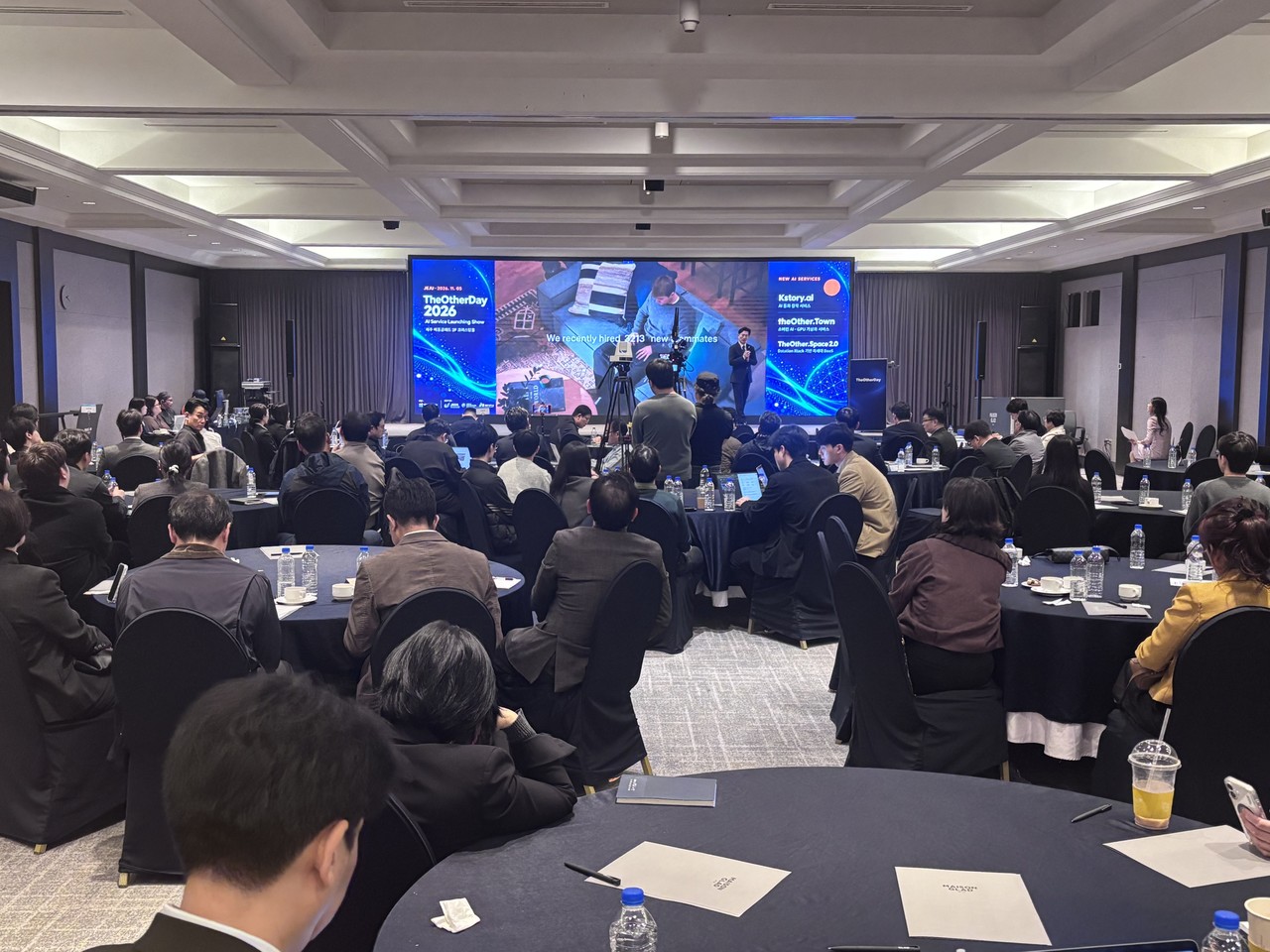
To that end, Tilion and its subsidiary Tilionsoft held their annual technology conference, "TheOtherDay 2026," on the 5th in Jeju Special Self-Governing Province. At the event, the companies unveiled three service-based product lines.
At the event, they introduced the next-generation VDI lineup, "Dstation X," which has completed registration in the Public Procurement Service's Digital Service Mall, and the cloud virtual desktop service "theOther.Space 2.0." They also unveiled three service-based product lines.
In the photo, Tilion Vice President Cha Jin-wook delivered the opening remarks at the event. In his presentation, he discussed the achievements of the virtualization market centered on the Public Procurement Service's Digital Service Mall.
In his opening remarks, Cha Jin-wook explained Tilion's advantage in the virtualization market, citing VDI sales results from the Public Procurement Service's Digital Service Mall. He said total VDI sales in the mall from 2021 to today amounted to KRW 14 billion, and that Tilion's supply volume over the same period was about KRW 12 billion. He also said the company had supplied more than 22,000 licenses over six years, and that the gap with the No. 2 company was more than 10 times.
The source of the disclosed data is Public Procurement Service KONEPS aggregate data, and the reference point for the data is October 2026. According to the data, Tilion ranked No. 1 with a 83.13% share based on sales, while the No. 2 company's sales-based share was 9.42%.
Cha Jin-wook went on to say that, beyond the Public Procurement Service and public institutions, the company is also operating for more than 30,000 users at major private-sector companies. He said it has on-site verification capabilities and added that, based on such verification, the company plans to provide clear answers to customers seeking data protection inside the company and flexible virtualization adoption.
The photo taken by reporter Kwon Young-seok shows Tilion Deputy General Manager Min Jeong-sik speaking at the event. Min Jeong-sik was in charge of the first presentation that morning.
In his presentation, Min Jeong-sik explained the evolution of virtual desktops by dividing it into three generations. He described the first generation of virtual PCs as centered on network separation and centralized management, and said the second generation was characterized by public DaaS expansion on the scale of tens of thousands of users.
Min introduced the newly unveiled Dstation X as a 3rd-generation product. He described its direction as a security gateway for safe access to AI environments.
He said Dstation X's security method has moved beyond simple blocking. He then presented a trace-based security system that identifies data leakage routes to the end, and explained features including automatic screen-capture blocking, screen watermarks, document watermarks, and printout watermarks.
He also said that Dstation X is linked with identity verification (DDS), access control (DAC), data encryption (DP), and a continuously audited monitoring module on the premise of use within a virtual desktop environment. In this environment, users can use the in-house LLM iStation, GPT, Claude, and Gemini, while external commercial AI can be used under control, he explained. As a connected portal function, Tokenizer-based external AI token cost management was introduced.
The product lineup consists of five products based on the same engine: "Dstation X," a general office model; "Dstation XE," a high-performance 3D graphics design model based on GPU partitioning; "Dstation XT," a model for integrated software development environments; "Dstation XI," a dedicated model for AI based on internal company documents; and "Dstation X-ABT," a model prepared for the 2028 transition to CBT for university nursing and health-related national exams.
On the sales and procurement side, the company completed registration of 10 products with the Public Procurement Service's Digital Service Mall, consisting of five perpetual-license products and five annual subscription-license products. Min said foreign vendors have raised subscription fees by up to 3 to 4 times over the past two years, and that Tilion is filling that gap. He also said the company has prepared an option for customers who face the cost burden of perpetual licenses or have a need for technical verification to operate on an annual-license basis first and then convert later.
The photo, taken by reporter Kwon Young-seok, shows Tilion Head of Division Ko Sang-hyun speaking at the event. Ko Sang-hyun, Tilion's second presenter, laid out a blueprint for an "AI agent-exclusive VDI."
In his second presentation, Ko Sang-hyun shared security improvements for the cloud DaaS "theOther.Space 2.0" and its 3.0 roadmap. He explained that theOther.Space 1.0 focused on establishing proof points through accessibility to DaaS in a multi-tenant environment, Linux VDI, high-performance EVDI, and no-install web access (WebLinker).
He then said theOther.Space 2.0 has changed through structural improvements based on the Dstation X architecture. On the security side, he explained that the company applied the TLS 1.3 standard to intermodule communications and removed the legacy RSA key exchange logic.
He also said support for virtualization host infrastructure has been expanded beyond the existing MS Hyper-V to include Xtack, Tilion's own OpenStack-based virtualization stack. He cited the benefits of using Xtack as reducing host server OS license costs, linking with open-source tools such as Grafana, Ansible, and Terraform, and securing greater freedom in infrastructure control.
Ko said the core feature of 2.0 is an internal and external dynamic security policy based on whether AGS is used. He explained that 2.0 applies different security policies to in-house and external or work-from-home environments depending on the access route and whether AGS is used: when connecting through the in-house IPsec VPN, clipboard use and screen capture are allowed and no watermark is applied. By contrast, when entering from outside or from home through H-AGS, the clipboard is restricted to one-way transfer from the device to the VDI, screen capture is blocked, and a screen watermark is applied. Based on these policies, he said the company is presenting a path to safely expand DaaS into internal business networks and secure work-from-home environments.
The next-generation theOther.Space 3.0 was then defined as an AI-agent-exclusive VDI. Ko explained that if a virtual desktop dedicated to AI agents is operated in isolation, any malfunction can be prevented from affecting the user's PC. He also said data is processed only inside the data center, and if settings are damaged, they can be immediately restored using snapshots. Through this, he said, a safe 24-hour agent work environment can be realized.
The photo taken by reporter Kwon Young-seok shows Tilion Head of Division Lee Chun-seong speaking at the event. With the ecosystem's first proof established in Jeju, Lee Chun-seong presented the company's business strategy in the final morning session. He proposed fully opening up the service-based business of its accumulated infrastructure technology as the company's strategy.
Lee mentioned Tilion's 83.1% share in the procurement market and defined the meaning of that figure as a monopolistic experience accumulated through solving issues raised at customer touchpoints. He compared this to a combination of Tesla car technology and SpaceX rocket technology. He then said the company would expand into service-based offerings by combining the virtualization, cloud, GPU partitioning, and security technologies it has accumulated over 25 years.
Lee presented three core Tilion services. "TheOther.Space 2.0" is a cloud deployment service for preconfigured work environments, which shortens the time needed to prepare PCs and complete security settings. "TheOther.Town" consists of "iStation" and "Tstation"; "iStation" provides multi-LLM selection, token budget management, and document access control based on roles and attributes, while "Tstation" provides GPU resources and a development environment.
Another core service, "Kstory.ai," is a generative AI creation platform. The service takes as input examples things like a child's doodles and an elderly person's spoken voice to create AI picture-storybooks. Through this, it aims to support intergenerational communication.
Lee defined Kstory.ai's role not as an AI that reads books aloud for users, but as an AI that encourages them to start reading voluntarily. Based on this view, he outlined plans to connect with libraries, schools, and lifelong education institutions.
Lee then presented essay, novel, poetry, and music creation as future expansion areas. He also said that 83% of institutions have chosen Tilion, and expressed the hope that the share of Jeju residents who start work, classes, and creative activities through Tilion services will exceed 83%.
Source: IT DAILY · Kwon Young-seok
Original: https://www.itdaily.kr/news/articleView.html?idxno=242719
References
This article was produced with the help of an automated content generation algorithm.
Source: IT DAILY
View originalThis article was summarized and organized by BizCrush based on the original article from IT DAILY. For exact quotations and full details, please refer to the original article.
Keep reading
BizCrush