Nexv Conducts Field Pilot of AI Workplace Injury Prevention Solution 'JIQ'... Early Detection of Worker Risk Signals
TECHWORLD ·
✦ AI Summary
Nexv is conducting a field pilot of its AI workplace injury prevention solution, 'JIQ,' at workplaces employing workers with disabilities, together with the Korea Employment Agency for Persons with Disabilities.
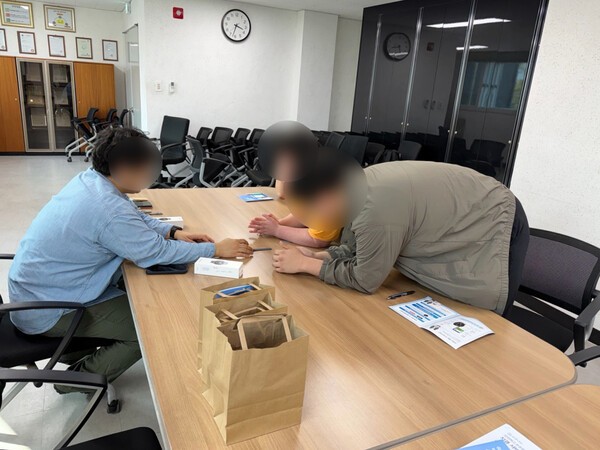
The pilot is part of the 'Public AX Project' promoted by the Ministry of Science and ICT and the National IT Industry Promotion Agency (NIPA), and targets 102 workers with disabilities at 26 workplaces nationwide.
JIQ analyzes biometric, behavioral, and location data collected by a smartwatch with AI to detect risks early, while also providing manager and guardian alerts and an SOS request function.
BizCrushWant to follow Korean talks and live streams in real time?Try BizCrush Live
Nexv is conducting a field pilot of its AI workplace injury prevention solution, 'JIQ,' at workplaces employing workers with disabilities. Nexv is an AI solutions specialist, and this field pilot is being carried out jointly with the Korea Employment Agency for Persons with Disabilities.
'JIQ' is a wearable-based AI workplace injury prevention solution. The solution uses its proprietary AI algorithm to analyze biometric signals and behavioral data collected by a smartwatch, as well as biometric information and movement data, to detect industrial accident risks early and determine dangerous situations.
'JIQ' is also configured to provide alerts to managers and guardians when necessary. Through this, it is being applied on a trial basis to test its function for determining whether there is a risk on site.
This pilot is part of the 'Public AX Project' promoted by the Ministry of Science and ICT and the National IT Industry Promotion Agency (NIPA). The pilot covers 102 workers with disabilities at 26 workplaces nationwide.
JIQ's core technology is a personalized AI analysis function for risk assessment that reflects each worker's physical condition and behavioral characteristics.
General sensor-based detection methods judge abnormalities based on preset threshold values. Even the same changes in heart rate and movements can have different meanings depending on a worker's usual physical condition and type of task.
To reduce such limitations, Nexv applies AI analysis technology that learns each individual's biometric signals and activity patterns. It sets a normal-state benchmark, Baseline, based on the worker's usual biometric signals and activity patterns.
It then calibrates the risk assessment criterion, Calibration, by reflecting the collected data.
The aim of this structure is to reduce false positives and false negatives arising from individual differences. Another goal is to improve the reliability of detecting dangerous situations.
JIQ is designed to capture signs of danger by using physical condition information, movement data, and location information together. The design purpose of JIQ is to combine biometric signal analysis, behavioral detection, and location-based safety management to identify workers' risk situations from multiple angles.
JIQ uses a smartwatch to collect health information such as heart rate and oxygen saturation (SpO2). It also analyzes motion sensor data such as acceleration and tilt to detect signs of danger, including falls, abnormal movements, and changes in activity status.
Location-based safety management functions have also been applied to JIQ. It links workplace hazardous areas and the vicinity of moving equipment with location awareness technologies such as BLE beacons, and uses GPS geofencing to determine whether workers are entering dangerous areas.
When a risk signal is detected, warnings and location information are delivered to a manager-only application to support rapid on-site response. Workers can also make an SOS emergency request directly from the smartwatch.
A three-layer safety management system connecting workers, managers, and guardians is added here. This is one of JIQ's key features that expands the scope of safety management.
Under this system, workers can check risk alerts on the smartwatch during work and also report emergencies. Workplace managers can monitor risky situations during work hours. Outside of work hours, guardians are given permission to check related risk signals and status. Through this role separation, the system is designed to enhance the continuity of safety management.
In developing JIQ, Nexv is not separately manufacturing dedicated smartwatch hardware, but rather developing AI-based risk detection technology using existing wearable devices. It is improving development efficiency by combining existing wearable devices with its proprietary AI software. It also plans to pursue registration as an assistive technology device in the future based on the results of the field pilot.
The technology is intended to support the prevention of industrial accidents among workers with disabilities. In addition, the company plans to advance the technology so that it can be used in a variety of work environments. This pilot aims to secure biometric signals and behavioral data from actual work settings.
Based on the data secured through the pilot, Nexv is advancing its AI analysis technology with the goal of achieving more than 90% accuracy in detecting dangerous situations. At the same time, it is also pursuing more than 90% accuracy in its model for predicting regional industrial accident risks.
Song Hwan-gu, head of Nexv, said that JIQ is a solution that analyzes each worker's differing physical condition and work environment with AI, and that it was developed to enable a more flexible response to dangerous situations. He added that the field pilot is intended to verify the reliability of the technology, and said the company aims to further advance safety management functions and expand use to a broader range of industrial sites, including those employing workers with disabilities.
Source: TECHWORLD · Kim Gyeong-ju
Original: https://www.epnc.co.kr/news/articleView.html?idxno=409388
References
This article was produced with the help of an automated content generation algorithm.
Source: TECHWORLD
View originalThis article was summarized and organized by BizCrush based on the original article from TECHWORLD. For exact quotations and full details, please refer to the original article.
Keep reading
BizCrush