Kakao Sees AI Business Breaking Even in 2028 on Ad Monetization, Cost Efficiency
IT DAILY ·
✦ AI Summary
Kakao said it expects to reach break-even in its AI business in 2028 by pursuing monetization and cost reductions in AI-based advertising and commerce.
CEO Shina Chung and CFO Shin Jong-hwan said they are pushing model operation optimization and cloud use to ease the cost burden from expanding AI services.
Kakao plans to start a closed beta of "AI Crew" in December and a pilot operation of its integrated AI service "Kanana Space," while aiming to officially launch its PC-based AI agents "Kanvas" and "Mudeoui AI" by the end of the year.
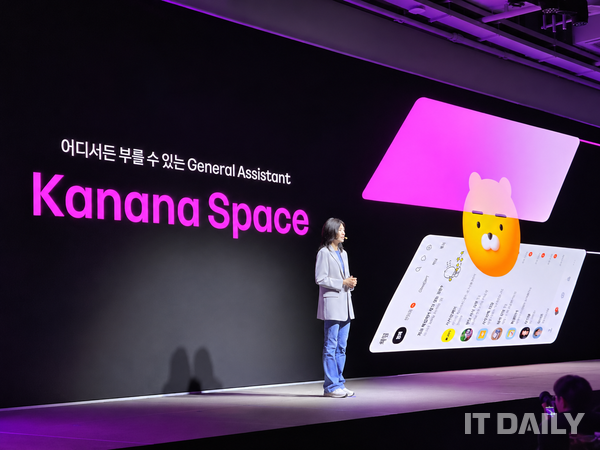
Kakao sees its AI business breaking even in 2028 on ad monetization and cost efficiency. Kakao CEO Shina Chung attended the if(kakao)26 event at Kakao AI Campus in Yongin, Gyeonggi Province, on Oct. 13 and introduced the AI service "Kanana Space." The photo was taken by reporter Kim Byung-joo.
Kakao said it expects to reach AI business break-even in 2028 by monetizing its AI-based advertising and commerce businesses while also cutting operating costs. To that end, the company plans to build an ad recommendation system that can identify purchase intent without users having to search, and it also plans to offer an AI agent that helps advertisers manage ad operations.
Kakao CEO Shina Chung and CFO Shin Jong-hwan attended the 2026 third-quarter earnings conference call on the 5th and explained the company’s AI monetization strategy and cost management plans. Kakao said it sees a cost burden from expanding AI services and plans to manage costs through model operation optimization and cloud usage.
CFO Shin said profitability in the AI business is expected to improve to around break-even in 2028 through expanded new revenue from AI use and cost efficiency. He also reaffirmed the company’s previous outlook that new AI-generated revenue in 2028 would account for a double-digit share of Talk Biz revenue.
Kakao identified AI-driven user intent detection as the key focus of its advertising business. The company said that while its existing search ads recommend products and services based on users’ search terms, AI can identify users’ interests and purchase intent without separate search activity.
CEO Chung said the company can identify intent without direct searches and recommend products and services at the right time. She added that Kakao expects to create new demand similar to search ads, which it previously did not have.
Kakao plans to build a "common memory infrastructure" by the first quarter of 2027. The purpose of the "common memory infrastructure" is to allow AI to understand and use user behavior, preferences, and experiences. Kakao’s plan is to improve recommendation accuracy by advancing ad recommendations so that, in addition to existing click and purchase histories, user interests and purchase intent are also comprehensively reflected.
Kakao will introduce an AI agent for advertisers. In December, it plans to begin a closed beta test of "AI Crew," a service that supports ad placement and operations. AI Crew will propose suitable ad products and operating strategies when advertisers enter their business goals in a conversational interface. It will also support everything from ad setup to performance analysis.
AI Crew is focused on lowering barriers to entry for small and mid-sized advertisers. It also aims to improve operating efficiency for existing advertisers. Through its advertiser support system, Kakao aims to help with the process from goal input to product and strategy recommendations and performance analysis.
CEO Chung said the company will also expand existing ad placements starting next year. She said Kakao will push ahead with improving ad efficiency using AI and seek new monetization opportunities. She also said the company aims to connect those results to tangible revenue growth.
Alongside those efforts, Kakao’s existing ad business continued to grow. Third-quarter Talk Biz advertising and subscription revenue rose 11% year over year to KRW 391.5 billion. Talk display ad revenue increased 35%, driven by an influx of new advertisers centered on feed-based ads and stronger product competitiveness.
Kakao is expanding AI services for users. In December, it will begin a pilot operation of its integrated AI service "Kanana Space" for preregistered users. "Kanana Space" is an AI invocation service within KakaoTalk.
The service plans to expand by executing KakaoTalk functions based on user requests and linking with external services. For external service connections, it will use both API-based direct integration and a computer use agent (CUA) approach. Direct integration is intended to reduce the cost of handling repetitive tasks, while the CUA approach, in which AI operates a browser, is intended to broaden the scope of service integration.
At the same time, Kakao is aiming to officially launch its PC-based AI agent "Kanvas" and "Mudeoui AI" by the end of the year. "Kanvas" is a productivity tool that controls a browser on a user’s PC. "Kanvas" handles information searches, document organization, and repetitive tasks.
Kakao expects to reach 10 million monthly active AI users this year. It also plans to lay the groundwork to secure more than 20 million daily active AI users by 2030. However, the company also raised concerns about cost burdens from the expansion of AI services and challenges in the monetization process.
Kakao’s separate-basis operating loss in its AI services division for the third quarter came to about KRW 64 billion. That operating loss widened by KRW 7 billion from about KRW 57 billion in the previous quarter. Over the same period, outsourced and infrastructure costs on a consolidated basis rose from KRW 223 billion to KRW 241 billion, an increase of 8%.
Kakao said the main reason was rising infrastructure demand for AI model training and service operations. It cited increased infrastructure demand stemming from the expansion of AI services as the background for the cost increase.
Accordingly, Kakao plans to reduce AI operating costs by choosing between in-house models and external models depending on request complexity. CEO Chung said that when AI operates a browser and then completes payment, model invocation costs amount to about KRW 800 to KRW 900 per case. By contrast, she said direct service integration can lower that cost to about KRW 5.
As an alternative to directly purchasing large-scale GPUs, Kakao is pursuing a strategy of using cloud services, saying the purpose of cloud use is to reduce the burden of initial investment. At the same time, Kakao plans to expand AI service users, secure new revenue in its advertising and commerce businesses, and improve infrastructure operating efficiency, thereby enhancing the profitability of its AI business.
Source: IT DAILY · Kim Byung-joo
Original: https://www.itdaily.kr/news/articleView.html?idxno=242711
References
This article was produced with the help of an automated content generation algorithm.
Source: IT DAILY
View originalThis article was summarized and organized by BizCrush based on the original article from IT DAILY. For exact quotations and full details, please refer to the original article.