Infineon Expands Bid for AI Data Center Power Market, Targets the “From Grid to Core” Chain
TECHWORLD ·
✦ AI Summary
Infineon Technologies has launched a push into the AI data center power market with semiconductor solutions spanning power grids, server racks, and AI processors in response to surging demand for AI data center power.
At a press briefing at its Gangnam headquarters in Seoul, Infineon outlined its “From Grid to Core” strategy and related technologies and business direction, including grid protection, internal server power supply, and ESS.
Infineon also signed an MOU with SoluM to strengthen cooperation on HVDC power solutions for AI data centers, and agreed to expand collaboration on key power applications such as IBC, BBU, and PSU.
Infineon Technologies is pushing to expand into the AI data center power market. The goal is to respond to surging demand for AI data center power. Infineon has entered the market with semiconductor solutions spanning power grids, server racks, and AI processors.
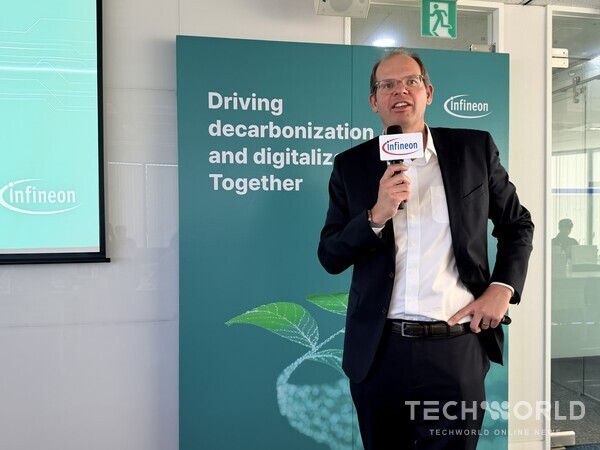
Infineon held a press briefing titled “Power Innovation in the AI Era” at its Gangnam headquarters in Seoul on the 5th. Adam White, president of Infineon’s Power Systems business division, attended the briefing. White introduced the power challenges facing AI data centers and explained Infineon’s related technologies and business strategy.
Infineon’s core strategy is “From Grid to Core.” The strategy covers everything from the data center power grid, or Grid, to power conversion and distribution inside server racks, and all the way to AI processors, or Core. Through “From Grid to Core,” Infineon provides semiconductor solutions that span the entire power supply process.
White said Infineon has the key semiconductor technologies needed across energy generation, transmission, power supply, and power management inside data centers. He added that Infineon is positioned to deliver power from the grid to the core and even to physical AI, and that it has all the solutions for the full power flow, enabling it to supply the broader ecosystem.
As AI data center power demand surges, the stability and efficiency of power supply are emerging as core competitive factors. Accordingly, data center power infrastructure must deliver stable power management, energy storage, and efficient power conversion at the same time, beyond simply supplying power.
In that context, White highlighted the role of ESS connected between the grid and the data center. He said ESS helps respond to fluctuations in data center power loads and also contributes to improving power supply stability.
White identified battery management systems (BMS), security, power conversion, and ESS thermal management as core areas of the technologies Infineon provides.
The company introduced its Solid-State Circuit Breaker technology and presented a semiconductor-based protection concept aimed at strengthening grid safety and protection functions. The technology is designed to support the stable operation of data center power infrastructure. The company also described internal server power supply solutions as a major business area.
The company said it has 8-30 kW PSU systems, battery backup systems, and a wide range of product lines. It also said it plans to support customers’ various power architectures based on its broad product portfolio. By presenting both grid protection technologies and server internal power supply products, the company described its ability to support power infrastructure for data centers and AI servers.
The company said the growing power demands of AI servers are increasing the importance of power supplies and power conversion systems. White mentioned Agentic AI as a direction for the AI industry, saying AI is evolving beyond information processing to actually carrying out actions and tasks. He said this is creating new technical requirements for computing and power infrastructure.
The speaker said that responding to power semiconductors requires a broad technology portfolio that is not limited to a single semiconductor technology. He also stressed the importance of collaboration across industries.
In this regard, Infineon said it provides Si and SiC and supports customers in selecting technologies suited to their system characteristics and power requirements. It also said it has a range of microcontroller products for implementing various power architectures.
Infineon said it sees AI data centers, physical AI, and robotics as the areas for expanding its power semiconductor business. It also said it has secured a semiconductor product lineup for humanoid robots, which supports motor control and sensing functions. Infineon added that it is seeking business opportunities in related markets as the robotics industry grows.
As part of that trend, Infineon signed an MOU with SoluM to strengthen cooperation on HVDC power solutions for AI data centers.
The two companies plan to expand their cooperation based on their existing technology partnership. The areas for expanded cooperation are three key power applications: intermediate bus converters (IBC), battery backup units (BBU), and server PSUs.
To that end, the two companies will jointly explore high-efficiency HVDC solutions by combining Infineon’s expertise in power semiconductors and systems with SoluM’s capabilities in server power solutions and power module design and manufacturing. Infineon plans to work with SoluM from the early stages of related projects, reviewing suitable technologies and products and providing reference designs and technical support.
For this cooperation, Infineon will use its CoolMOS, OptiMOS, CoolSiC, and CoolGaN product lines. It will also leverage a broad range of products, including Si-, SiC-, and GaN-based power semiconductors, as well as PSOC microcontrollers and sensors.
Both sides shared the view that the spread of AI is raising performance demands on data center power infrastructure and requiring structural changes. White said the rising requirements for AI data center power infrastructure call for greater efficiency, reliability, and power density, and said Korea is leading technological innovation and driving AI development. Seong Ho-young, CEO of SoluM, also said that AI expansion requires fundamental changes not only in computing performance but also in power infrastructure.
White said SoluM’s server power solution capabilities and Infineon’s semiconductor expertise are complementary, and conveyed his intention to advance next-generation AI infrastructure HVDC power solutions through the partnership. Seong Ho-young, CEO of SoluM, said Infineon has world-class power semiconductor technology and that the cooperation will help strengthen SoluM’s high-voltage, high-efficiency power design capabilities. Based on this, the two companies set a goal of accelerating the development of HVDC power systems for AI data centers.
Seong Ho-young, CEO of SoluM, also said he plans to expand new business opportunities in the next-generation AI data center power market. The two companies will continue regular technical exchanges related to next-generation technology development and will also strengthen their long-term partnership.
White emphasized that collaboration across the industry ecosystem is important in the process of technological advancement. He said that advancing to the next-generation power architecture requires more advanced technologies and products, but that alone is not enough, and close collaboration with customers and related companies is also necessary.
White said the company will provide differentiated technologies and products to help customers succeed in the market. He also expressed a positive view of cooperation with Korea’s industrial ecosystem and said the company continues to work on a range of collaborations with major domestic customers.
Infineon said it plans to strengthen cooperation with domestic partners following the MOU with SoluM. It also said it has technical expertise and systems understanding related to AI data center power architecture and plans to expand business opportunities in Korea’s AI infrastructure market based on that.
Source: TECHWORLD · Park Gyu-chan
Original: https://www.epnc.co.kr/news/articleView.html?idxno=409334
References
This article was produced with the help of an automated content generation algorithm.
Source: TECHWORLD
View originalThis article was summarized and organized by BizCrush based on the original article from TECHWORLD. For exact quotations and full details, please refer to the original article.