“From CPU to Domestic NPU and DPU”... AMD Sets Out to Prove Heterogeneous AI Computing
IT DAILY ·
✦ AI Summary
AMD said it will work with the Korean government, FuriosaAI, and MangoBoost to establish an open, heterogeneous AI computing coalition.
AMD plans to build the first reference deployment cluster in Seoul next spring and establish a "Korea Center of Excellence (CoE)" in Korea.
The Ministry of Science and ICT said it will promote the "K-AI semiconductor full-stack reference support project" starting next year to foster success cases that connect domestic chips, software, models, and services.
AMD is joining forces with the Korean government and leading domestic fabless companies to establish an open, heterogeneous AI computing coalition. The partners are FuriosaAI (NPU) and MangoBoost (DPU). AMD plans to build a large-scale demonstration infrastructure in Seoul. Through this effort, it aims to secure control over data and computing and accelerate the realization of Sovereign AI.
AMD held the "Advancing AI World Tour & AI DevDaySeoul 2026" on the 4th at the Westin Seoul Parnas in Gangnam-gu, Seoul. At the event, AMD unveiled its strategy for expanding the domestic AI ecosystem and its specific cooperation plans.
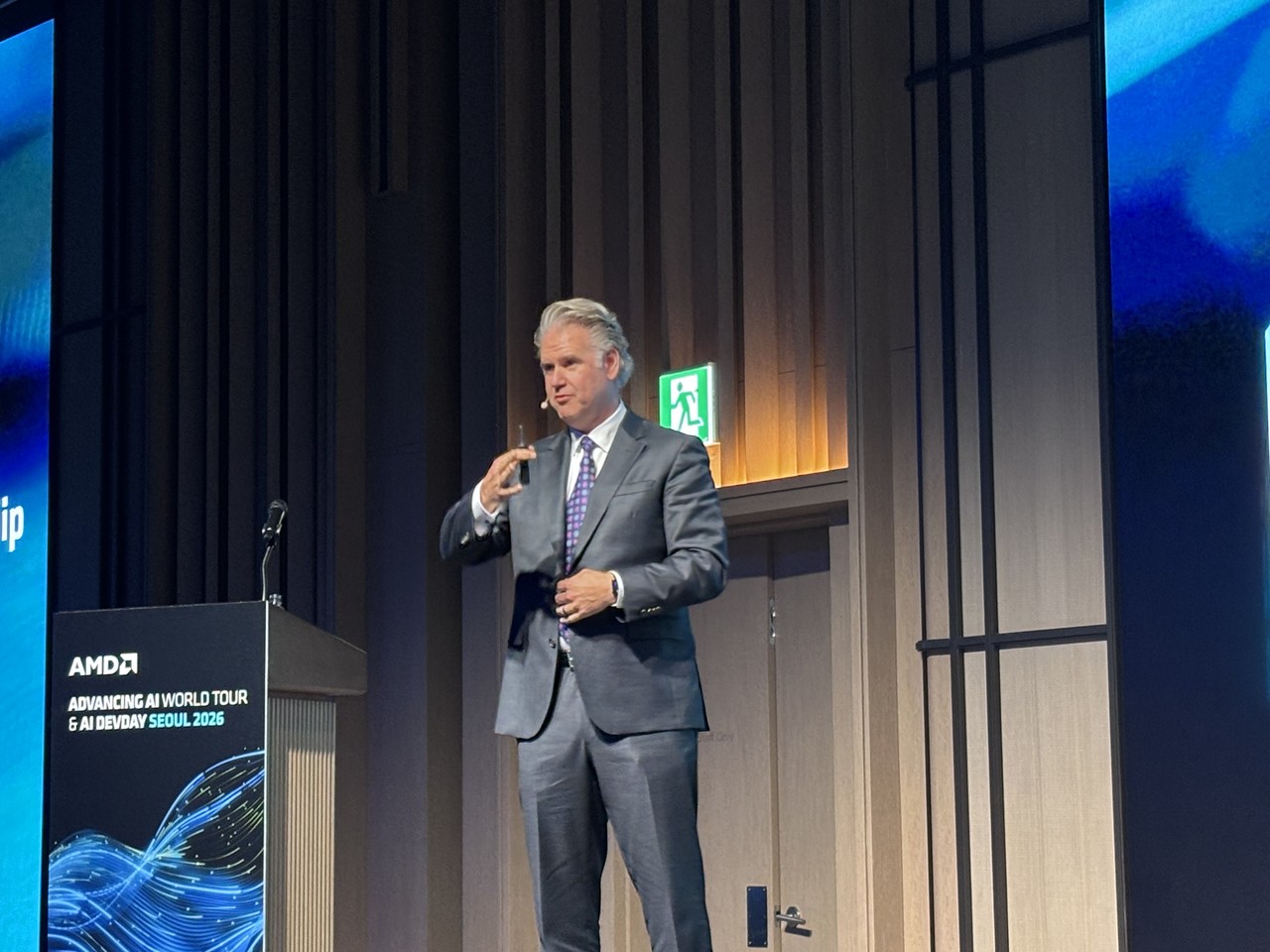
At the morning keynote session, Keith Strier, senior vice president at AMD, took the stage to deliver a presentation. The photo shows Keith Strier during his presentation and was taken by reporter Kwon Young-seok.
Keith Strier said AI is moving beyond answer-centric systems into an Agentic era in which it performs work and actions. He explained that, as a result, demand for inference computing and the power burden are surging. He added that a single company, a single chip, and a closed platform alone cannot respond to complex workloads.
AMD presented open hardware- and software-based collaboration as its response, and Strier, the senior vice president, announced immediately after his presentation that AMD would sign a memorandum of understanding (MOU) with FuriosaAI and MangoBoost and build the first reference deployment cluster in Seoul next spring. The cluster will consist of the AMD EPYC CPU, AMD GPU, FuriosaAI NPU, and MangoBoost DPU, and will be based on the organic integration of these components.
This move is tied to the government’s AI policy direction. It is an extension of the MOU signed with the Ministry of Science and ICT during the president’s U.S. visit in July, and Vice Minister Ryu Je-myung of the Ministry of Science and ICT attended the event.
Ryu Je-myung, second vice minister of the Ministry of Science and ICT, said that in the Agentic AI era, combining strengths with partners will determine future competitiveness. He said the government plans to promote the "K-AI semiconductor full-stack reference support project" starting next year, with the goal of actively fostering success cases that connect domestic chips, software, models, and services.
AMD unveiled plans to expand the foundation for R&D and talent development in Korea, and fully activated its domestic R&D hub and talent-development base. To this end, AMD said it will establish a "Korea Center of Excellence (CoE)" in Korea, pursue technical cooperation with domestic universities, pursue technical cooperation with domestic startups, and accelerate talent development. In a video message, Lisa Su, AMD CEO, said Korea is a key pillar of the global AI ecosystem, with strengths in memory semiconductors, infrastructure, and startups.
On the day, Jang Jeong-hee, head of commercial sales at AMD Korea, delivered the welcoming remarks. Jang said that connecting expertise in computing, infrastructure, software, and partners is a prerequisite for creating customer value. AMD Korea reaffirmed its commitment to expanding domestic partnerships.
AMD also offered its own definition of Sovereign AI. Strier said Sovereign AI does not mean isolation through the localization of all technologies. He added that it means a state in which a country and companies exercise choice and control over data, computing, models, and talent without dependency, and said only an open architecture can guarantee true sovereignty.
Source: IT DAILY · Kwon Young-seok
Original: https://www.itdaily.kr/news/articleView.html?idxno=242685
References
This article was produced with the help of an automated content generation algorithm.
Source: IT DAILY
View originalThis article was summarized and organized by BizCrush based on the original article from IT DAILY. For exact quotations and full details, please refer to the original article.