Schneider Electric Strengthens AI Data Center Reliability, Connecting Power to Cooling
TECHWORLD ·
✦ AI Summary
Schneider Electric participated in Data Center Korea 2026, which opened on the 4th at the aT Center in Yangjae, Seoul.
At the event, it unveiled an integrated infrastructure solution for AI data centers covering power supply, cooling, and digital operations.
It also introduced power distribution, UPS, cooling, EPMS and BMS-linked management, and condition-based maintenance measures.
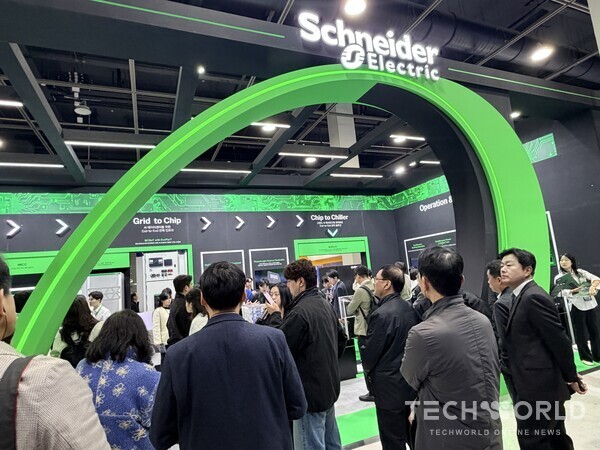
Schneider Electric has begun targeting Korea's AI data center market. Against a backdrop of rising data center power demand and cooling loads driven by the expansion of AI workloads, the company participated in Data Center Korea 2026, which opened on the 4th at the aT Center in Yangjae, Seoul. At the event, Schneider Electric unveiled an integrated infrastructure solution for AI data centers.
The solution unveiled this time spans power supply, cooling, and digital operations. It was released to improve AI data center reliability, energy efficiency, and operational flexibility. The exhibition theme was “Powering Every Layer of AI Datacenters — From Grid to Chip, Chip to Chiller.”
Schneider Electric introduced an infrastructure portfolio that connects the power grid, IT equipment, and cooling facilities. Through this, the company sought to enhance the reliability of AI data centers and present ways to ensure stable operations and efficient expansion across the data center.
To respond to high-density AI infrastructure, facilities and solutions covering both power supply and cooling were presented together. On the power side, the company introduced a stable supply system for data center power infrastructure and management methods for that infrastructure.
In power distribution, the company displayed the high-voltage switchgear MCSeT, the intelligent power distribution and motor control solution IPCC/IMCC, and solutions for power control and rack power distribution. Through these, it presented response measures spanning distribution and power control.
In the UPS segment, the modular Galaxy VXL was unveiled. Galaxy VXL delivers up to 99% efficiency in eConversion mode and supports Live Swap, which allows power modules to be added or replaced while online. This makes it possible to expand power capacity or perform maintenance without stopping data center operations, with a focus on securing operational continuity for high-density AI infrastructure.
On the cooling side, the company unveiled a thermal management solution for AI data centers. It showcased the MCDU-25 coolant distribution unit (CDU) from Motivair, a liquid cooling specialist acquired by Schneider Electric, and the product regulates coolant flow and temperature. It also supports stable operation of liquid cooling systems through a dual-pump configuration and dew point management function.
At the exhibition, the company first presented an AI POD miniature of EcoStruxure Pod Data Center. This modular infrastructure solution uses a preassembled structure and is designed to integrate power, cooling, and network infrastructure. The solution was designed to shorten data center build times and to secure consistent construction quality.
It was also presented as a solution that responds to rising AI demand and to market needs for flexible data center capacity expansion. At the exhibition, the preassembled data center infrastructure solution was introduced in connection with the need for expansion stemming from growing AI demand.
The company then introduced its digital operations offering. Here, it presented an integrated management approach linking the EPMS and BMS, supporting comprehensive monitoring of power quality, energy consumption, and facility operations information, and offering a framework for managing operational conditions across the data center infrastructure.
It also unveiled a temperature and humidity sensor demo and a condition-based maintenance solution. The company introduced methods for using operational data to identify signs of equipment abnormalities and to determine the right time for inspection and maintenance, focusing on reducing the risk of unexpected equipment failures, reducing downtime risk, and improving maintenance efficiency.
Kwon Ji-woong, CEO of Schneider Electric Korea, said that in high-density AI environments, organically connecting power and cooling facilities, using operational data, and managing performance and efficiency across the infrastructure are important. He added that, based on the solutions unveiled this time, the company will support improved operational stability for domestic customers and partners according to their infrastructure conditions, and will work to support flexibility in responding to rising AI demand.
Kwon will participate in the conference Strategy Track on the second day of the exhibition, on the 5th. His presentation topic is digital twins for AI data centers and integrated engineering, and the session will focus on changes in the data center industry in the AI era and future business strategies, while sharing directions for data center design and engineering using digital technologies.
Source: TECHWORLD · Park Kyu-chan
Original: https://www.epnc.co.kr/news/articleView.html?idxno=409265
References
This article was produced with the help of an automated content generation algorithm.
Source: TECHWORLD
View originalThis article was summarized and organized by BizCrush based on the original article from TECHWORLD. For exact quotations and full details, please refer to the original article.