[Conference Call] SKT: “Some Building Permits Approved for Ulsan AIDC... In Talks With Global Clients”
IT DAILY ·
✦ AI Summary
SK Telecom is pursuing the AI data center business through SK Hyper.
Park Jong-seok CFO said the company obtained building permits for some of SK Hyper's Ulsan capacity and is in talks over business terms with 3 to 4 global operators.
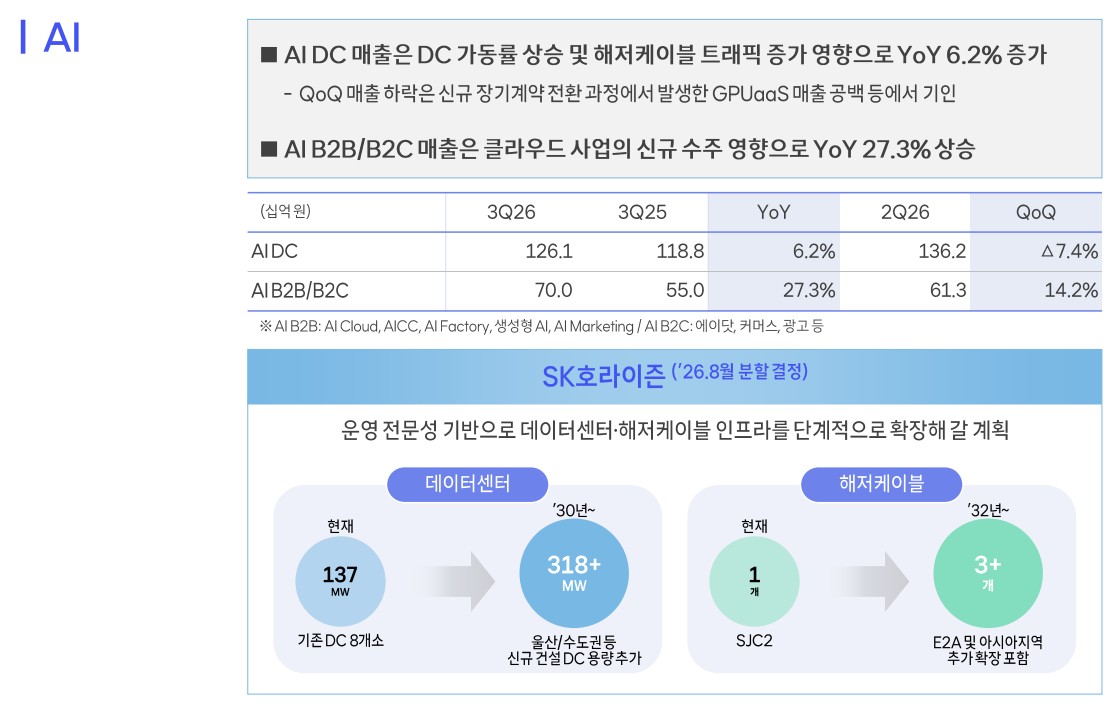
Revenue from the AIDC business in the third quarter of this year was KRW 126.1 billion, up 6.2% from the same period last year but down 7.4% from the previous quarter.
SK Telecom is pursuing the AI data center business through SK Hyper. At a conference call for its third-quarter earnings release on the 4th, SKT CFO Park Jong-seok said the company had obtained building permits for some of SK Hyper's Ulsan capacity. Park said it is discussing specific business terms with 3 to 4 global operators.
Park Jong-seok CFO said the company is working to secure sites and attract customers at multiple candidate locations outside Ulsan as well. SK Telecom aims to secure customer demand for initial operating capacity by the first half of next year. It also aims to begin phased data center operations from the second half of 2029.
SKT's AIDC business revenue for the third quarter of this year came to KRW 126.1 billion. That revenue increased 6.2% from the same period last year. However, it fell 7.4% from the previous quarter.
Park CFO said talks with customers are under way and declined to disclose specific details such as contract size and timing. He said the goal is to secure customer demand related to initial operating capacity by no later than the first half of next year, proceed with permitting and construction, and begin phased data center openings from the second half of 2029.
Revenue from the AI data center (AIDC) business in the third quarter of this year was KRW 126.1 billion, up 6.2% from the same period last year. The revenue increase came from higher data center utilization and increased submarine cable traffic. By contrast, third-quarter AIDC revenue fell 7.4% from the previous quarter. SKT said the revenue gap from GPU as a service (GPUaaS) during the transition to new long-term contracts affected the quarter-on-quarter decline.
In terms of role division, SK Hyper will be responsible for large-scale business development, while SK Horizon will handle construction and operations of existing businesses.
SKT will split its AI infrastructure business between SK Hyper and SK Horizon according to the stage of development. In the early stage, SK Hyper will be responsible for refining customer requirements and establishing a financing structure based on long-term contracts. In the later stage, SK Horizon will handle the construction and expansion of businesses with contracts and financing structures in place.
SK Hyper was established in July and is responsible for developing gigawatt (GW)-scale AI data center projects. It is refining terms with potential customers, centering on Ulsan, while also carrying out customer attraction activities at multiple candidate sites. Its goal is to establish an execution framework for large-scale investment financing based on long-term customer contracts.
SK Horizon is scheduled to be established in the first quarter of next year. It will handle infrastructure projects with commercial contracts and financing structures that are largely in place, and based on its data center operations capabilities, it is pushing ahead with the construction of about 180MW of new data centers in Ulsan and Seoul. It also plans to expand its submarine cable business in phases and will focus on securing business stability and profitability based on a relatively stable commercial contract and financing framework.
SKT plans to actively use external funding for AI data center investments. However, it intends to first verify customer demand and business viability before investing. The company plans to execute investments after securing customer demand in advance and sufficiently validating business viability.
Park CFO said the company plans to actively raise external funding for SK Hyper's AI data center construction. He cited the project’s business viability, rather than market variables such as interest rates, as the key criterion for attracting investment.
This criterion is also connected to the SK Horizon case. SK Horizon secured business stability and profitability based on long-term customer acquisition. Based on that, the company explained that it was able to attract large-scale external investment.
Park CFO said the company plans to raise external capital, focusing on projects with strong investment appeal despite market uncertainty while taking financing conditions into account.
Source: IT DAILY · Seong Won-young
Original: https://www.itdaily.kr/news/articleView.html?idxno=242699
References
This article was produced with the help of an automated content generation algorithm.
Source: IT DAILY
View originalThis article was summarized and organized by BizCrush based on the original article from IT DAILY. For exact quotations and full details, please refer to the original article.