[Market Trends] Finding Products to Delivery... E-commerce Moves Beyond Brokerage
IT DAILY · · 1 views
✦ AI Summary
E-commerce platforms are widening their roles beyond product sales and brokerage into AI recommendations, logistics, advertising, overseas expansion, and C2C transaction support.
Naver, Coupang, Kurly, Danggeun, and Bungaejangter are each expanding discovery, delivery, advertising, overseas sales, and safe payment functions while operating the pre- and post-transaction stages.
Platform expansion is progressing alongside transaction activation and monetization, but some services still focus more on user acquisition and operating metrics than on revenue and profitability.
E-commerce platforms have grown on the back of product sales and brokerage, but they are now expanding their role into the pre- and post-transaction stages. Using AI, they are helping consumers discover and compare products, while also broadening seller support to include storage, shipping, and returns. They are also extending their functions by using purchase data to select ad audiences and measure ad performance.
At the same time, the direction of business expansion for e-commerce platforms is centered on increasing transaction customers and expanding product offerings. In overseas businesses, they are connecting domestic brands with local buyers. They are also strengthening C2C functions around payments, shipping, and price offers, while targeting secondhand and collectible goods transactions as areas of support.
The background to this shift is a change in the pace of market growth. According to data from the National Data Service in the 'August 2026 Online Shopping Trends,' annual domestic transaction value rose from KRW 242.2068 trillion in 2023 to KRW 262.4256 trillion in 2024 and KRW 274.9442 trillion in 2025. However, the year-on-year growth rate fell from 8.3% in 2024 to 4.8% in 2025. As the market expands, securing additional revenue from the existing customer and seller base has emerged as a task for platforms.
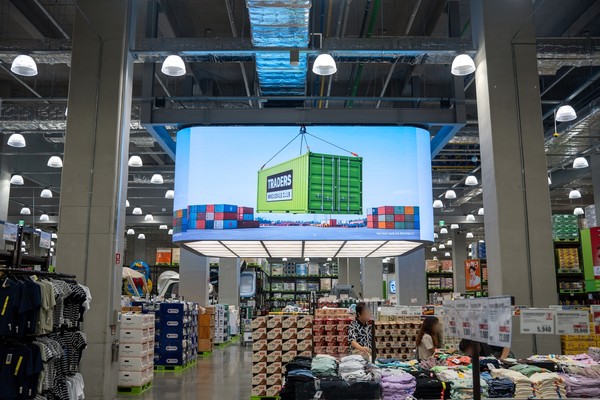
This photo of the media cube at E-Mart Traders Wholesale Club's Hanam branch is courtesy of E-Mart.
The expansion of the platform's role starts even before consumers make a purchase. E-commerce companies are introducing AI recommendations, conversational search, and product comparison features into the shopping process. Their scope of involvement is widening into product discovery and narrowing purchase conditions.
However, the starting point for consumer product discovery remains existing commerce platforms. Criteo surveyed 6,379 consumers across 6 countries, including 1,107 Korean consumers, for its '2026 Commerce and AI Trends Report.' In Korea, the share of consumers who begin product discovery on marketplaces was 59%, while 20% started with search engines. The share who said they use AI shopping assistants as a primary shopping tool was 7%.
Against this backdrop, commerce platforms are applying AI to product recommendations and discovery functions. Their influence is expanding beyond the payment stage into the early shopping process, where customers search for products and narrow down conditions.
On the Naver Plus Store app, the share of transaction value routed through AI recommendations exceeded 50% of total transaction value in May for the first time. The click-through rate on products in the AI recommendation area of the Naver Plus Store app was more than 50% higher than that of general shopping search results.
AI-based conversational shopping features are translating into actual transactions. Naver launched its AI shopping agent at the end of February and said transactions are occurring during the conversational discovery stage. The daily average number of conversations on Naver's AI shopping agent in August was about 5 times higher than in March, and the daily average transaction value generated through the AI shopping agent in August was about 4 times higher than in March. Digital and home appliance products accounted for about 40% of transaction value generated through the AI shopping agent, and the company said conversational discovery is being used for products that require comparison across multiple conditions, such as specifications, features, and intended use.
Coupang also operates similar discovery and comparison features. Coupang provides summaries of product descriptions and key user reviews, and for home appliances and digital products it also presents comparison items and product-specific features based on users' search history. However, Coupang does not disclose quantitative results such as transaction value by feature or purchase conversion rates.
User surveys show both demand for AI assistance and a tendency to make the final judgment directly. Embrain Trend Monitor surveyed 1,000 men and women aged 19 to 69 nationwide, and 78.4% of respondents said they would be willing to use an AI shopping agent in the future. On the other hand, 74.0% said they believe a person should make the final payment regardless of how convenient the service may be. There was demand for AI use in price comparisons, product specifications, and review summaries, but there was also demand to retain direct control over final purchase decisions.
Along with a photo of Naver's AI shopping agent, e-commerce platforms are expanding their role beyond sales brokerage into sellers' logistics operations. The scope of platform responsibility is also widening from inbound storage before sale to outbound shipping, delivery, and returns after orders are placed. E-commerce platforms are providing these entire processes as services.
Accordingly, the point of contact between platforms and sellers is also expanding beyond product sales brokerage. Logistics services are linked to the way products are sold on the platform, and whether logistics services are used is also connected to how consumers are exposed to products on the platform.
Coupang's Rocket Growth handles order processing, delivery, customer service, and returns after a seller's product is brought into a logistics center. In addition to the sales commission charged on product transactions, the seller also bears the cost of logistics services.
The entity that charges the sales commission is Coupang. The entity that charges Rocket Growth logistics processing fees is Coupang Fulfillment Services (CFS). The logistics fee items include inbound and outbound processing, delivery, storage, return pickups, restocking, and outbound removal.
Coupang grants the Seller Rocket badge to Rocket Growth products that meet certain standards. It also gives those products exposure opportunities in Rocket Filter. In this way, use of logistics services is tied to exposure benefits within the platform.
Naver began the open beta of 'Fulfillment by Naver (FBN)' in July. Under the existing N Delivery-centered structure, sellers and logistics companies contracted directly, but under the FBN structure, the contract shifted to a seller-Naver arrangement. As a result, Naver has become directly involved in the contractual relationship between sellers and logistics companies.
Under the FBN structure, Naver manages the service as a whole, while affiliated logistics companies handle physical storage, outbound processing, and delivery. The FBN fee consists of logistics costs plus the fee for using the N Delivery solution. Of this, the solution fee is 1.5% of the order amount.
Naver continues to withhold FBN revenue, FBN profitability, the number of sellers using FBN, and FBN volume. A Naver official said it is still in the early stage of the business, making it difficult to provide detailed explanations of revenue and profitability. The official also said that because delivery's importance in commerce is growing, the company sees value in handling related areas directly. Naver places importance on securing delivery experience for consumers and securing logistics data.
As cases emerge in which changes in sales methods affect profit-and-loss structures, Kurly is expanding its third-party seller business in a structure where direct procurement accounts for a large share. Kurly operates Fulfillment by Kurly (FBK), which handles storage and delivery on behalf of sellers' products. In a direct-purchase structure, Kurly buys inventory in advance, incurring acquisition costs and bearing inventory and disposal burdens, but in a 3P structure, an outside seller becomes the seller of record and Kurly receives transaction fees without directly purchasing the goods.
In connection with this shift, Kurly's gross profit margin for the second quarter was 35.3%, up 1.5 percentage points from a year earlier. The company said the increase in revenue share from fee-based businesses such as 3P, along with improvements in cost of goods sold, drove profitability improvement. Transaction value for 3P, including FBK, rose 32.1% from a year earlier in the same period.
Kurly is also handling outside sellers' volume through its own logistics network. The volume processed by Kurly through the Naver Fulfillment Alliance (NFA) has increased 21-fold from the launch stage. Kurly said it has built cold-chain logistics infrastructure for fresh food delivery and is increasing center utilization and generating additional revenue by attracting outside volume.
While a photo of Kurly's Purple Box for delivery is shown, the data accumulated on the platform includes searches, product views, and purchases. Retail and e-commerce companies use this data as the basis for ad operations, linking it to audience selection and performance measurement.
The ad businesses of retail and e-commerce companies are expanding. At the same time, data-driven advertising is expanding beyond online into offline retail as well.
E-Mart is using store visits and actual purchase data in RMN. Revenue related to RMN in 2025 increased about 20% from a year earlier.
The number of stores operating RMN is 127 E-Mart stores and 24 Traders stores, for a total of 151 stores. The number of customers visiting online and offline channels is about 30 million per month.
The data items used for advertising are actual purchase history, visit frequency, items of interest, and shopping routes. This makes it possible to segment ad audiences and measure whether customers exposed to ads actually purchased the relevant products. It also makes it possible to verify whether customers who saw an online ad purchased the product at an offline store.
Naver secures data starting before the purchase stage. The data items it secures include search history, product views, saved items, purchase history, and brands of interest. Naver combines search, purchase history, and interest data with AI to deliver ads tailored to each user, and it also applies AI to ad material creation and operations.
The effect of this AI application is being confirmed in ad performance. Naver officially launched AI Briefing Ads at the end of July. The click conversion rate for AI Briefing Ads is more than 30% higher than that of existing search ads, and the purchase conversion rate is more than 3 times higher than that of existing search ads. Revenue from Naver's overall ad business in the second quarter of this year was KRW 1.4472 trillion, up 7.5% from a year earlier. Naver said AI contributed more than 60% of the increase in ad revenue in the second quarter.
Sales performance is also affecting how advertisers allocate budgets. An industry source said the basic principle of the recent performance marketing market is to optimize ad spending allocation and operations based on performance by revenue channel. The source also said that among advertisers with a large share of revenue from Naver and Coupang, some allocate more than 90% of their ad budgets to those media.
In overseas markets, advertising is growing into an independent business pillar for retail and e-commerce companies. Amazon's ad services revenue in the second quarter of this year was USD 19.809 billion, up 26% from a year earlier.
Walmart showed the same trend. Walmart's global ad business growth rate in the second quarter of fiscal 2027 (May-July 2026) was 38% from a year earlier, and Walmart Connect growth was 43% from a year earlier excluding Vizio. Walmart classifies advertising as a high-margin area.
Along with this trend, domestic platforms are expanding their buyer base centered on Korea through overseas expansion. Platforms are using brand, product, and customer data accumulated in Korea, along with logistics operations experience, in overseas businesses.
From the perspective of participating brands, this has the effect of easing the burden of having to build overseas sales networks individually. It also expands opportunities to access new markets. A photo of a Musinsa pop-up store in Japan is included.
Against this backdrop, domestic online direct sales to overseas customers in the second quarter of this year came to KRW 1.2032 trillion, up 38.7% from a year earlier. By region, China accounted for KRW 449 billion, the U.S. for KRW 309.3 billion, and Japan for KRW 244.9 billion. Overseas direct sales of clothing and fashion-related products came to KRW 99.4 billion.
The way each platform secures overseas buyers differs. Some platforms introduce domestic brands locally to test demand, while others convert offline experiences into online purchases. Some also enter markets by acquiring platforms that already have local buyers and sellers.
Musinsa is directly checking market response to domestic brands in Japan. Musinsa is running a large pop-up store in Osaka through the 8th, and more than 70 domestic fashion and beauty brands are participating in the event. Participating brands were selected based on accumulated customer data from online and offline channels in Japan, and Musinsa is using the pop-up as a test bed to check sales performance and consumer response by brand.
Since 2023, Musinsa has held three pop-ups in Tokyo for emerging brands. More than 200 brands have participated cumulatively in those pop-ups, and 38 of them entered Japan's offline market for the first time through the pop-ups.
A Musinsa official said that in Korea the company is responsible for platform listings and sales brokerage, while overseas it supports brands' initial market entry, localization strategy development, and securing stable distribution channels. Participating brands go through a process of linking domestic product codes and then sending products to the Musinsa logistics center. Musinsa supports overseas shipping and customer service. It also operates a structure that automatically translates domestic product reviews and exposes them in the global store.
Under this operation, Musinsa Global Store transaction value in the second quarter of this year increased by more than 143% from a year earlier.
W Concept is choosing a method that links local offline experiences to online purchases. Last month, it operated a Paris pop-up, and the space did not sell products directly. Instead, it provided visitors to the Paris pop-up with opportunities to try on and experience products from domestic fashion and beauty brands, and guided customers who wanted to buy to its global mall.
During the pop-up period, online transaction value in France on the global mall increased 103% from a year earlier. After the pop-up, the share of orders from new customers on the global mall rose 19 percentage points, from 29% to 48%.
A W Concept official said the Paris pop-up was operated as a space for customer experience and fitting rather than direct sales. The official also said customers who wanted to buy were guided to purchase through the global mall. Plans to support participating brands' entry into local distribution networks have not been decided, and follow-up pop-up plans in Paris have also not been decided.
Naver, by contrast, chose to secure an existing local C2C transaction base rather than building a new foundation directly in Europe. Naver has acquired Poshmark in North America, Kream in Korea, SODA in Japan, and Wallapop, a C2C platform in Spain, Europe. Naver's purpose in acquiring Wallapop is to secure a strategic platform and user base for its European business.
Naver is planning to combine search, advertising, payments, AI technology, and business know-how with Wallapop. Wallapop's revenue streams are payment and delivery fees, advertising, and subscription products for professional sellers. The effect of acquiring a local platform is that there is no need to recruit initial buyers and sellers, and existing users, product information, and transaction history can be leveraged.
The photo shows the screen of Carrot Market's direct secondhand transaction service.
If the nature of an overseas expansion strategy is the expansion of the transaction region, the focus of C2C platforms' feature expansion is making it easier to complete transactions for personally held goods. The items being traded are also expanding beyond new products supplied by corporate sellers to include personal wardrobes, collectibles, limited editions, and collectibles.
Buyers can also become sellers by reselling goods they own. Accordingly, the role of the platform is also expanding from connecting counterparties in transactions between individuals to payment, shipping, price negotiation, and linking to professional purchasing firms.
With this kind of platform involvement, transaction processes that individuals used to handle directly are being brought inside the platform. As a result, the range of transactions expands, and platforms also gain revenue points where fees can be charged.
Danggeun has introduced measures that combine payments and parcel delivery with face-to-face local transactions. These measures have broadened the range of trading counterparts on Danggeun. Danggeun's 'Direct Purchase' service is a method in which users pay in the app and then receive the product by parcel delivery, with safe payment applied by default. Safe payment is a method in which the purchase amount is held in escrow until the transaction is completed, and delivery is handled by CJ Logistics.
Danggeun expanded the nationwide scope of listings available for Direct Purchase in March this year. However, the criteria for exposure in the home feed continued to focus on local listings. Instead, the product search function was made available so users could search Direct Purchase listings registered nationwide.
According to Danggeun, the volume of Direct Purchase transactions in September increased by about 503% from March. However, the company said transaction count, transaction value, and the share of total secondhand transactions are undisclosed.
A Danggeun official said the purpose of introducing Direct Purchase was to improve user transaction convenience and safety rather than to increase short-term revenue. The official added that once the service becomes more active, the company expects business results such as improved profitability.
On the other hand, Bungaejangter has expanded its involvement in the transaction process. Bungaejangter linked its payment function to its revenue model. It also applied escrow-based safe payment to all transactions in August 2024. The escrow-based safe payment method holds the buyer's funds and then settles with the seller after confirming receipt of the product.
Bungaejangter said that safe payment transaction value in March this year was KRW 91.5 billion. That figure represents about a 10% increase from the same month last year and was the monthly high. Over the same period, payment fee revenue also rose by more than 70%. Bungaejangter said this means that about 1 year and 6 months after the full rollout of safe payment, payment fees have become established as a major revenue model.
Bungaejangter has also added a feature to help complete transactions. 'Secret Price Offer,' introduced in September, allows sellers to proactively offer a discounted price to users who have saved the product. The offer is valid for 48 hours and is a method of concluding a transaction with a user who prepays. Bungaejangter is using purchase-intent information accumulated on the platform in sellers' price offers.
Based on Bungaejangter's measurement period of September 29 to October 5, the average time it took for an offer to lead to an actual sale was 7.4 hours. The time was measured from sending the offer to completion of payment.
Bungaejangter also operates 'Bungae Estimate,' a service that connects individual sellers with professional purchasing firms. 'Bungae Estimate' works by having sellers register product information and then receiving quotations from purchasing firms. The number of quotations a seller can compare is up to 10. Through this, Bungaejangter is adding a business seller channel for individuals in addition to person-to-person transactions.
As goods that have moved into C2C are connected with overseas buyers, overseas demand for goods held by domestic individuals is expanding. In some transactions, C2C is also combining with global trends. Bungaejangter announced that the number of transactions on 'Bungae Global' in the first half of this year increased 56% from a year earlier. Among all overseas transactions, photo cards accounted for 35%.
This trend shows that domestic person-to-person transactions and global transactions are expanding together. However, the expansion of a platform's transaction role and transaction base does not immediately lead to revenue generation in the same way. Transaction expansion and revenue structure are not the same.
Some businesses have already become established as separate revenue sources. In advertising, ads using purchase data have become a revenue source. Coupang collects logistics service fees in addition to sales commissions. Bungaejangter's payment function, introduced to ensure transaction safety, is translating into fee revenue.
By contrast, some services still remain at the stage of activating transactions, expanding user touchpoints, and securing data rather than generating visible revenue. As a result, the pace of transaction expansion and monetization is not moving at the same speed.
Platforms are still emphasizing operating and activation metrics over revenue or profitability. Naver has not disclosed FBN revenue or profitability, and is currently emphasizing securing delivery experience and logistics data. Danggeun is positioning Direct Purchase around improved transaction convenience and safety rather than short-term revenue growth. AI recommendations are also currently showing public performance indicators centered on transaction activation, such as the share of transactions through recommendations, click rates, and agent usage.
As revenue points expand, the scope of platform operations also expands. Logistics operations require product storage infrastructure, outbound processing, delivery processing, and return handling. Maintaining trust in C2C requires safe payment, product inspection, and dispute response. Overseas businesses also require localization, delivery, and customer service.
In the advertising business, performance verification is emerging as a challenge. In an April assessment, the Interactive Advertising Bureau (IAB) said that sustainable business models and measurable performance are needed for the long-term growth of commerce media. Then, on October 20, the Interactive Advertising Bureau (IAB) released a draft decision guide for cross-channel measurement, and the draft included linking the results of marketing mix modeling (MMM), incrementality measurement, and attribution analysis to investment decisions. The Interactive Advertising Bureau (IAB) has also begun gathering opinions on the draft guide.
To judge the results of platform expansion, different metrics must be considered by area. In logistics and payments, fee income and operating costs should be examined; in overseas businesses, repeat purchases after initial acquisition should be checked; and in evaluating AI recommendations, the effect of changing existing transaction paths and the effect of generating additional purchases should be assessed separately.
Source: IT DAILY · Kim Byeong-ju
Original: https://www.itdaily.kr/news/articleView.html?idxno=242588
References
This article was produced with the help of an automated content generation algorithm.
Source: IT DAILY
View originalThis article was summarized and organized by BizCrush based on the original article from IT DAILY. For exact quotations and full details, please refer to the original article.