AI Revenue Rises, but Investment Costs Surge as Global AI Firms Face Profitability Test
TECHWORLD ·
✦ AI Summary
Global AI companies increased revenue in the third quarter as demand for cloud and AI services grew.
MS posted revenue of USD 92.3 billion and operating income of USD 45.9 billion, while Google Cloud reported revenue of USD 30.7 billion, up 103%.
OpenAI delayed its IPO and lowered its target fundraising size to USD 20 billion, while Anthropic filed an IPO registration statement with the SEC.
Summarizing corporate earnings releases and foreign media reports as of November 2, global AI companies expanded revenue in the third quarter this year on rising demand for cloud and AI services. However, as investment in infrastructure such as data centers also increased, recouping those costs and securing funding emerged as key challenges.
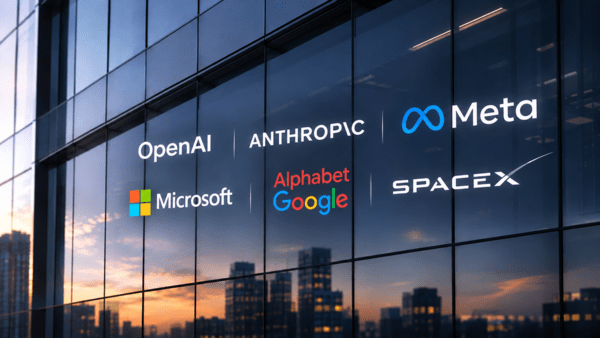
Microsoft (MS) and Google posted strong growth in their cloud businesses. Meta and SpaceX expanded their AI infrastructure investments. OpenAI and Anthropic took different paths in fundraising and initial public offerings (IPOs).
Against this backdrop, profitability management emerged as the key issue. Demand for cloud and AI services lifted results, but investment in infrastructure such as data centers was also proceeding at the same time.
MS announced its fiscal 2027 first-quarter results on October 28, covering July-September 2026. MS revenue came in at USD 92.3 billion, up 19% from a year earlier, while operating income rose 21% to USD 45.9 billion.
MS recorded cloud revenue of USD 63.9 billion, up 30%, as demand for enterprise AI services increased, and Azure revenue also rose 48%. At the same time, commercial remaining performance obligations climbed 73% to USD 677 billion.
Over the same period, MS spent about USD 45.2 billion on capital expenditures, including finance leases, while free cash flow came to about USD 18.6 billion.
Alphabet reported third-quarter revenue of USD 127.6 billion and third-quarter operating income of USD 40.6 billion. Revenue was up 25% from a year earlier, while operating income rose 30%.
Google Cloud revenue jumped 103% to USD 30.7 billion, helped by rising demand for enterprise AI infrastructure, growing demand for enterprise AI solutions, and sales growth of its proprietary AI accelerator TPU systems. However, expanded data center investment pushed third-quarter free cash flow into an approximately USD 9.1 billion deficit.
Meta and SpaceX expanded their AI infrastructure investments. Meta reported third-quarter revenue of USD 64.6 billion, up 26% from a year earlier, with ad business growth driving the increase. However, after reflecting about USD 9.9 billion in costs related to legal settlements, Meta's operating income came to USD 13 billion, down 37%.
Cash outflow widened as AI infrastructure investment increased. Third-quarter capital expenditures, including principal repayments on finance leases, totaled USD 34.9 billion, and third-quarter free cash flow showed a deficit of USD 2.1 billion. The full-year capital expenditure outlook was set at USD 135-145 billion.
Such large-scale investment plans affected credit ratings. S&P Global Ratings changed Meta's outlook from 'stable' to 'negative' on October 30. The change reflected uncertainty in cash flow stemming from expanded AI capital expenditures, while Meta's credit rating itself was maintained.
Meanwhile, SpaceX generated third-quarter revenue of USD 14.6 billion, supported by growth in its satellite communications and AI businesses. That was up 161% from a year earlier. Third-quarter net income was USD 4.4 billion.
Revenue in the AI-related superintelligence (SI) segment increased to about USD 7.6 billion. Solution and infrastructure revenue within the SI segment, including cloud services and AI software, was about USD 7 billion. As of the end of September, computing infrastructure capacity stood at 1.7 GW, and third-quarter SI segment capital expenditures were about USD 16.4 billion.
AI model developers are seeking funding and pursuing long-term supply contracts to secure financing for large-scale computing resources. However, they are reportedly facing growing funding pressure in the process. The Wall Street Journal (WSJ) reported these details.
In this environment, OpenAI had been pursuing fundraising with a target of USD 30 billion. However, with about USD 11 billion in investment commitments secured, OpenAI lowered its target to USD 20 billion.
OpenAI also revised its desired valuation from USD 1.4 trillion to USD 1.25 trillion. In addition, OpenAI decided not to pursue an IPO this year.
CEO Sam Altman said in an interview last September that, given AI safety concerns and other factors, now was not the right time to go public. OpenAI's decision not to pursue an IPO this year aligns with that view.
By contrast, Anthropic filed an IPO registration statement with the U.S. Securities and Exchange Commission (SEC) on October 26. Anthropic is currently pursuing a public listing, but the offering price has not yet been set and the final timetable remains undecided.
The Financial Times (FT) reported that concerns over credit risk have been raised around Anthropic's listing plans. Blackstone is said to have told investors that Anthropic could be rated at a 'BB' level, below investment grade, after going public.
In August, Anthropic signed a long-term computing resource lease agreement worth about USD 45 billion with British AI cloud company Nscale. Anthropic is also in discussions on additional supply contracts, and Nvidia is reportedly discussing financial guarantees aimed at supporting Nscale's data center construction financing.
With the U.S. midterm elections scheduled for the 3rd local time, the vote is being cited as a variable that could affect AI infrastructure investment. As rising power demand from data center expansion is drawing attention and electricity costs are emerging as an election issue, policy discussions after the election on power grid investment and cost sharing could shift.
Rising AI-related demand is translating into actual revenue growth. However, because investment scales differ by company and financing conditions also vary, future profitability will likely depend on the speed at which increased computing demand is converted into revenue and on the pace of data center investment cost recovery.
Source: TECHWORLD · Kim Seung-gi
Original: https://www.epnc.co.kr/news/articleView.html?idxno=409060
References
This article was produced with the help of an automated content generation algorithm.
Source: TECHWORLD
View originalThis article was summarized and organized by BizCrush based on the original article from TECHWORLD. For exact quotations and full details, please refer to the original article.