Incross: Monthly Spending on Generative AI Averaged KRW 36,000
TECHWORLD ·
✦ AI Summary
Incross conducted a digital media usage survey of 2,000 men and women aged 15 to 69 nationwide and released the "2026 IAM Report."
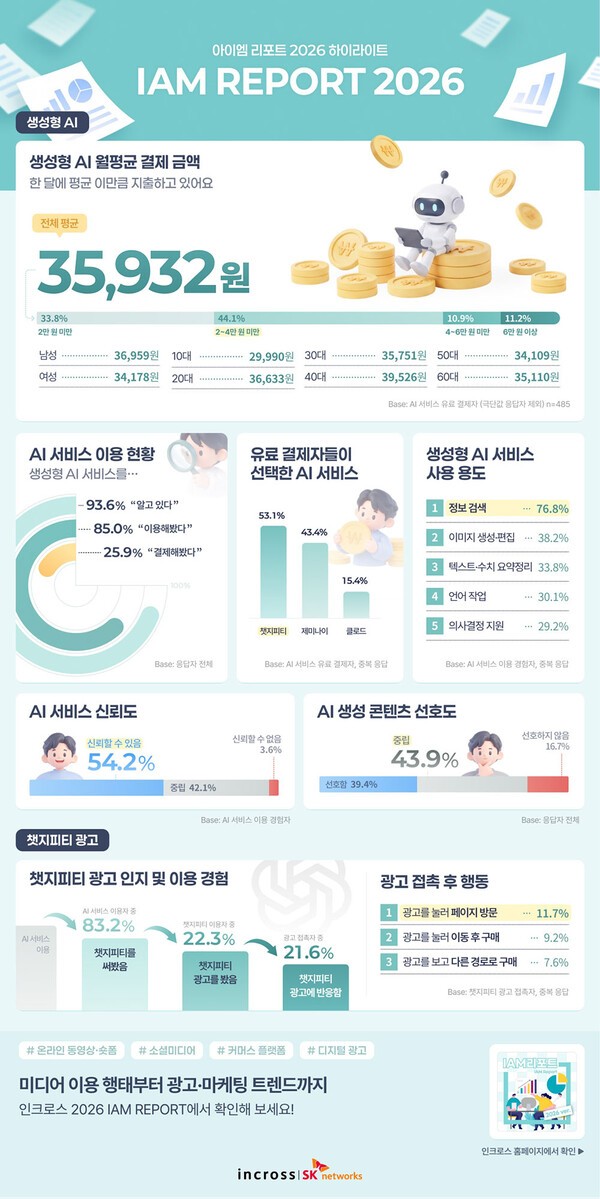
Response rates for generative AI service use were 85.0%, paid usage was 25.9%, and the average monthly spending among paid users was KRW 35,932.
Among paid services, ChatGPT accounted for 53.1%, Google Gemini for 43.4%, and Claude for 15.4%, while positive responses on trust in AI services stood at 54.2%.
Incross conducted a survey on digital media usage among 2,000 men and women aged 15 to 69 nationwide and released the "2026 IAM Report," which covers paid subscription practices for generative AI services and related perceptions. The survey found growing experience with AI services and an increase in paid users, while also examining actual spending on AI services and perceptions of AI technology and content.
The survey found that the average monthly payment among paid users of generative AI services was KRW 35,932. By spending bracket, 44.1% spent between KRW 20,000 and KRW 40,000 a month, the largest share, followed by 33.8% under KRW 20,000, 10.9% between KRW 40,000 and KRW 60,000, and 11.2% spending more than KRW 60,000.
By age group, the average monthly payment was highest among people in their 40s at KRW 39,526, while those in their teens had the lowest at KRW 29,990. Through this survey, Incross presented not only the average payment amount but also the distribution by payment bracket and differences by age group.
The survey showed that 85.0% of respondents said they had used generative AI services. That figure was up 11.6 percentage points from 73.4% the previous year. Meanwhile, 25.9% said they paid for AI services, up 4.6 percentage points from 21.3% the previous year.
Among paid services, ChatGPT ranked first with 53.1%. Google Gemini followed in second place at 43.4%, and Claude came in third at 15.4%.
The top purpose for using generative AI was information search at 76.8%. Image generation and editing followed at 38.2%, text and numerical summarization and organization at 33.8%, language tasks at 30.1%, and decision support at 29.2%.
Incross said the findings show that generative AI is being used not only for information searches but also across everyday life and work, including content creation, document work, and decision support.
As AI service use has become widespread, a trust survey of AI service users found that positive responses toward trust in AI services accounted for 54.2%, a majority. On the other hand, negative responses stood at 3.6%, while neutral responses came in at 42.1%.
By age group, positive responses toward trust in AI services were highest among people in their 50s at 62.6%. Trust in AI services among people in their 60s was also relatively high at 59.6%.
In a survey on preferences for AI-generated content, 39.4% said they preferred AI-generated content. Those who did not prefer AI-generated content accounted for 16.7%, while neutral responses on preference for AI-generated content made up 43.9%, a larger share than positive responses.
Consumer perceptions of ads within generative AI services were also examined. Among ChatGPT users, 22.3% said they had encountered ads on ChatGPT.
Among users who had encountered ads on ChatGPT, 11.7% said they had clicked a button or link and visited a product or service page. Among users who had seen ads on ChatGPT, 9.2% said they had purchased a product or service through an ad button or link.
Source: TECHWORLD · Lee Gwang-jae
Original: https://www.epnc.co.kr/news/articleView.html?idxno=409008
References
This article was produced with the help of an automated content generation algorithm.
Source: TECHWORLD
View originalThis article was summarized and organized by BizCrush based on the original article from TECHWORLD. For exact quotations and full details, please refer to the original article.