AI Customer Service Adoption Did Not Lead to Layoffs, but 18% Cut Staff and 29% Added Workers; Half of Customers Still Sought Human Agents
TECHWORLD ·
✦ AI Summary
Remember & Company unveiled the "AI Customer Experience Report" and surveyed customer service practitioners and decision-makers at major domestic companies.
While 36% of companies that had not adopted AI expected staff reductions if they did, among companies actually using AI, staffing additions at 29% and reassignments at 45% outpaced cuts at 18%.
At 50% of AI-adopting companies, requests to connect with a human agent were the most common customer reaction, and 78% were found to have criteria for AI response scope and agent handoff.
Remember & Company unveiled the findings of a survey titled "AI Customer Experience Report" on the 30th through its in-house "Remember Research," based on a survey of customer service practitioners and decision-makers at major domestic companies in South Korea. The survey examined staffing changes at companies that introduced AI customer service centers and customers' preference for human agents.
The survey contrasted companies' expected staffing reductions before AI adoption with the results at companies that actually adopted AI. Among companies that had not introduced AI, 36% expected staffing cuts if they were to adopt AI in the future.
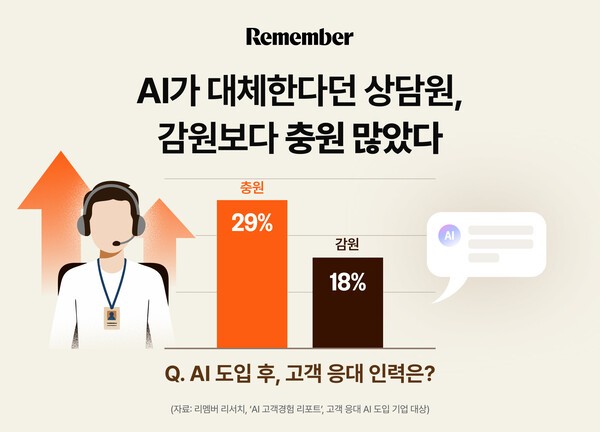
But among companies that actually used AI, staffing additions and reallocations were more common than cuts. Of companies actually using AI, 18% reduced staff, while 29% added staff. Another 45% kept existing staff and reassigned them to other tasks.
As a result, AI adoption appeared to be shifting agents' roles rather than immediately reducing headcount. At companies that adopted AI, staffing additions outpaced reductions, and the direction of AI use was seen more as supporting agents than replacing them.
The survey also found that even after AI-based responses, half of customers still requested connection to a human agent. With requests to speak with an agent reaching about half of customers, AI is being used more as a support tool than a replacement for agents.
Customer reactions showed many cases in which it was difficult to end consultations with AI alone. At AI-adopting companies, 50% cited "requests to connect with an agent" as the most frequent customer reaction. Cases of repeat inquiries for the same issue were also tallied at 45%.
The results were interpreted as showing that while AI-only responses contributed to faster response times and greater operational efficiency, there were many cases in which they fell short of resolving issues to the level customers wanted. Gaps also emerged between internal operating metrics and customer-perceived results.
The average share of respondents saying that company management metrics such as response time, waiting time and handling costs improved after AI adoption was 65%. By contrast, the average share saying that customer-related metrics such as customer satisfaction and brand image improved was 52%, a relatively smaller gain than the improvement in operational efficiency metrics.
A key factor shaping these AI adoption outcomes was identified as the criteria for handing off to human agents. Of companies that delivered better-than-expected results, 78% had rules defining the scope of AI responses and the situations in which agents should take over.
Among companies whose results fell short of expectations, only 32% had established such criteria. When comparing the reasons for underwhelming results, customer requests to connect with an agent were cited at 56%, far more than answer accuracy at 16%.
Only 8% of all AI-adopting companies had formally defined the roles of AI and human agents. Most companies were found to be shifting AI consultations to people based on the experience and judgment of the person in charge. As a result, establishing an organizational system for applying related criteria was presented as a task.
Among the capabilities that became more important after AI adoption, the ability to use AI tools ranked first at 53%. Data interpretation and analysis skills ranked second at 44%, while emotional response and empathy skills came in at 30%.
The adoption of AI customer service by companies was presented as likely to increase in the future. Among respondent companies, 74% had already introduced or piloted AI. However, only 6% had expanded it across the entire company or all channels.
Respondents were more likely to say they would expand AI investment over the next year, at 53%, than to say they would cut AI investment over the next year, at 4%, indicating a stronger tendency to increase rather than reduce investment over the coming year. As new AI application areas, consultation summarization and automated classification ranked first at 30%, voice bots and voice-based responses ranked second at 26%, and real-time support for agents ranked third at 24%. Nineteen percent said they would newly introduce customer-facing chatbots.
Ju Dae-woong, head of Remember's Market Data Business Division, said the factor that determines AI adoption results is not AI performance itself, but the advance setting of criteria for when human intervention is needed. He said that while AI can handle customer service, what matters is field judgment that clearly defines when a handoff to a person is necessary.
Source: TECHWORLD · Kim Seung-gi
Original: https://www.epnc.co.kr/news/articleView.html?idxno=409040
References
This article was produced with the help of an automated content generation algorithm.
Source: TECHWORLD
View originalThis article was summarized and organized by BizCrush based on the original article from TECHWORLD. For exact quotations and full details, please refer to the original article.