Kakao Unveils 2 'Kanana Embedding' Models to Boost Korean Search Performance
TECHWORLD ·
✦ AI Summary
Kakao unveiled 2 Kanana Embedding models as open source on Hugging Face.
The unveiled models are the 3 billion-parameter "Kanana-2-3b-embedding" and the 1.3 billion-parameter "Kanana-2-1.3b-embedding."
Kakao said it expanded embedding technology with Korean search performance and personal AI agent use in mind.
Kakao has released 2 "Kanana Embedding" models as open source on Hugging Face. Following the release of 4 Kanana small language models (SLMs) in July, Kakao has now made its embedding models, used for search and information linking, open source as well. With this release, the scope of its open-source offerings has expanded to include embedding technology for search and information linking.
The models released this time are the 3 billion-parameter "Kanana-2-3b-embedding" and the 1.3 billion-parameter "Kanana-2-1.3b-embedding." Their uses include personalized AI agents and semantic search.
Embedding is a technology that converts the meaning of text into numerical vectors. If a general language model handles understanding questions and generating answers, an embedding model calculates the semantic similarity between questions and documents and searches for the information needed to answer them.
Embedding-based search can find information with similar meaning even when a user does not remember the exact word or name. For example, if a user who has not identified the speaker asks about a quiet restaurant mentioned earlier without remembering the restaurant's name, the feature searches the conversation and related information at the time and handles the query by linking it to that information.
Kakao plans to apply this search function to personalized AI agents. These personalized AI agents are designed to connect a user's past conversations and information scattered across multiple services in semantic units, then search for relevant context when needed and reflect it in responses. Kakao introduced embedding technology as a foundational technology for building personalized AI agents at if(kakao)26.
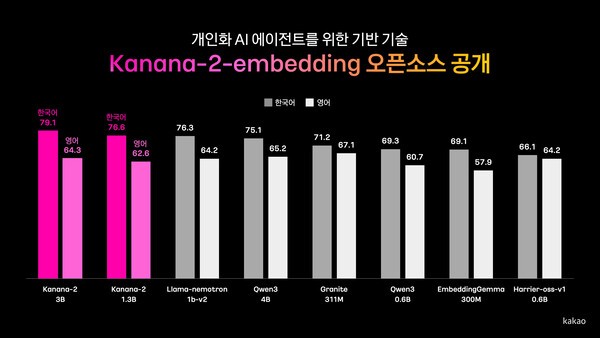
In terms of performance, the models focus on Korean search performance. In comparisons against publicly available models of similar scale, Kakao said the 2 Kanana Embedding models achieved top Korean performance, using "llama-nemotron-embed-1b-v2" and "Qwen3-Embedding-4B" as comparison targets. English performance was at a similar level, and the company said inference efficiency was also higher than with "Qwen3-Embedding-4B."
The company said the models improve search performance compared with its existing Kanana Embedding series while also improving memory usage and inference speed. According to the company's announcement, efficiency in memory usage and inference speed improved by dozens of times or more.
The company developed the 3 billion-parameter model by further training its in-house small language model, "Kanana-2-SLM," so that its language understanding capabilities could be used for information retrieval. It then developed the 1.3 billion-parameter model by applying knowledge distillation, a technique that transfers the 3B model's learning to a smaller model.
The company also said it applied Matryoshka Representation Learning (MRL), allowing it to adjust resources in real service environments in addition to model size. As a result, the number of dimensions used in embedding vectors can be adjusted, and developers can choose vector sizes for each service while considering search performance, storage space and processing speed.
The 2 models are governed by the Kanana Open License. Under this license, they can be used for research and development as well as commercial purposes. As a result, researchers and companies in Korea and overseas can use the 2 models to develop personalized AI agents and semantic search services.
Kakao plans to continue embedding training using larger language models. It also plans to continue research on knowledge distillation. Through this, the company aims to improve search accuracy, reduce memory usage and improve inference speed, while enhancing usability in real service environments.
Noh Byeong-seok, lead of Kakao's Unified Foundation Model performance team, said in connection with AI agents that, along with the ability to answer questions, technology that can accurately find the needed information in distributed data is important. He added that the company plans to support a wide range of services using Korean-strength embedding technology and continue research to improve search performance and efficiency at the same time.
Source: TECHWORLD · Kim Seung-gi
Original: https://www.epnc.co.kr/news/articleView.html?idxno=408985
References
This article was produced with the help of an automated content generation algorithm.
Source: TECHWORLD
View originalThis article was summarized and organized by BizCrush based on the original article from TECHWORLD. For exact quotations and full details, please refer to the original article.