Samsung SDS Sees Parallel Growth in AI, Cloud, and Logistics... Speeds Up AI Full-Stack Execution (Complete)
IT DAILY ·
✦ AI Summary
Samsung SDS said on the 29th that it posted preliminary third-quarter revenue of KRW 3.7725 trillion and operating profit of KRW 241 billion.
Revenue rose 11.2% year on year and operating profit increased 3.7%, with the gains attributed to the expansion of external cloud business and air and sea logistics businesses.
Samsung SDS unveiled plans to expand AI infrastructure, security, and DBO businesses, while also outlining ways to strengthen air logistics and expand AI services in the public sector.
Samsung SDS announced its preliminary third-quarter results on the 29th. Third-quarter revenue came to KRW 3.7725 trillion, while operating profit was KRW 241 billion. Revenue increased 11.2% from a year earlier, and operating profit rose 3.7% year on year. The company attributed the improvement to the expansion of its external cloud business and its air and sea logistics businesses.
During its third-quarter earnings conference call, CEO Lee Jun-hee said the company plans to speed up the execution of its AI infrastructure business roadmap based on its AI full-stack strategy. He also said Samsung SDS will support and accelerate customer AX by combining its AX and AI services with its AI platform and solution capabilities. In addition, he said the company plans to pursue Inorganic growth through strategic investments and M&A, and strengthen its mid- to long-term growth engine by pushing ahead with new businesses such as RX.
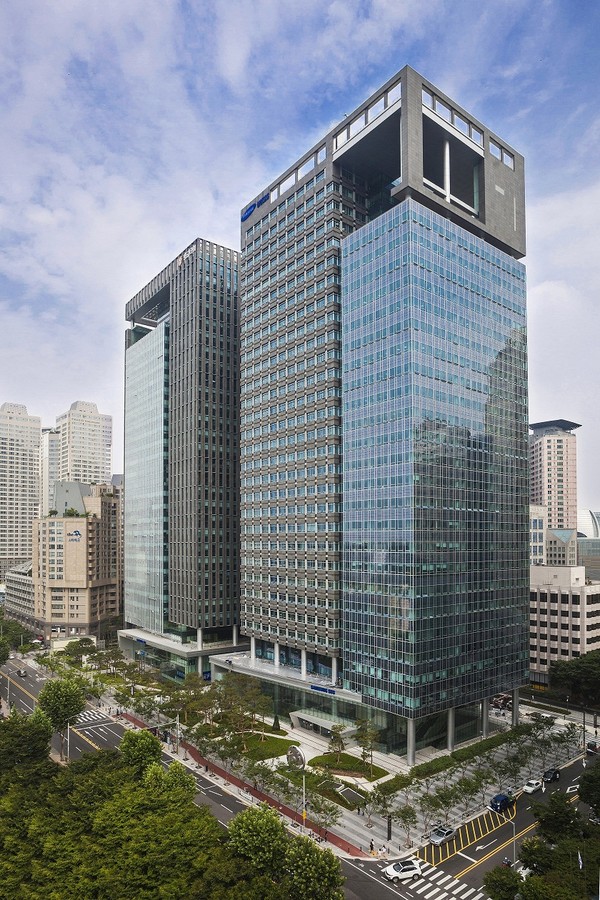
The photo shows the exterior of the Samsung SDS Tower, provided by Samsung SDS.
Samsung SDS said it is moving to expand its DBO business as part of efforts to respond to rising demand for AI infrastructure. The company set a goal of securing a cumulative 500 MW of DBO business by 2031. If it reaches that target, it expects annual revenue of more than KRW 1 trillion from 2031.
Lee Ho-jun, vice president and head of the Cloud Service Business Division at Samsung SDS, said it is difficult to secure new power supplies in the Seoul metropolitan area because of high electricity consumption. Accordingly, Samsung SDS plans to pursue DBO projects with asset management firms and other companies.
Lee said the company will pursue large-scale domestic expansion based on the power secured by its partners. He also said it will pursue the acquisition of successful project references.
Lee said a differentiator is that the company provides end-to-end service across the entire value chain, from conceptual design and construction to operation of data centers.
As demand for stronger corporate security has grown amid ongoing personal data leaks and repeated hacking incidents involving AI use, Samsung SDS shared its plans to expand its security business. Against that backdrop of rising demand, the company outlined plans to strengthen AI-based security inspection capabilities and incident response capabilities.
Samsung SDS also said it plans to expand the service area it covers in response to the spread of AI agents. The company plans to add AI agent authentication capabilities to its authentication and authorization management software, SingleID, and it also plans to release a solution that automatically classifies confidential and sensitive data.
Through these measures, the company plans to respond to demand for protecting corporate data. It will also expand related services while strengthening both security inspections and incident response.
CEO Lee Jun-hee emphasized that Samsung SDS is gaining new demand and expanding its business by providing security inspection services using Frontier AI and investment firm Crossbow Solutions, as well as incident response services that quickly address security incidents. He also said the company selects and combines AI models optimized for each customer's infrastructure and work environment.
Lee said its differentiator is the broad detection of vulnerabilities based on selected and combined AI models. He added that by using engineers deployed on-site, the company provides the full process from inspection and remediation to verification on an end-to-end basis, and connects the improvement of identified vulnerabilities to actual business opportunities.
Samsung SDS released performance and order outlooks for its major business segments and forecast that IT services revenue and external and internal order growth would continue. It cited AX demand in the financial and public sectors, as well as increased IT investment by affiliates, as the drivers of growth.
Revenue from Samsung SDS's IT services business segment came to KRW 1.681 trillion. IT services revenue increased 5.3% from a year earlier.
Cloud business revenue reached KRW 796.1 billion. Cloud business revenue rose 18% from a year earlier.
Kim Tae-ho, vice president in charge of management support at Samsung SDS, said AX business centered on the financial and public sectors is expanding in cloud managed services (MSP). He added that if growth in shipbuilding and energy ERP businesses and revenue from affiliates are reflected, the IT segment should be able to maintain double-digit growth in the fourth quarter.
He said that given the order backlog and the expected increase in corporate AX investment next year, the company should be able to pursue growth centered on external AI and cloud businesses.
On the other hand, he pointed to market uncertainty and foreign exchange issues in relation to the logistics business. Accordingly, he said it is difficult to expect a significant expansion in the logistics business.
He expected the logistics business to post slight growth or to remain at this year's performance level.
Samsung SDS explained plans to strengthen its air logistics business through the acquisition of Woojeong Air, a specialist in consolidated air cargo transport. Samsung SDS signed a stock purchase agreement on the 12th to acquire 100% of Woojeong Air's shares.
Samsung SDS plans to improve air logistics efficiency by combining Woojeong Air's transport and operations capabilities with its own customer base and global cargo volumes. To that end, it will integrate cargo originating in Korea with cargo from Asia transiting through Incheon, and it will seek to improve loading efficiency through integrated operations. It also plans to reduce processing time and costs by linking its own security screening with Cello Square.
Samsung SDS is broadening its air logistics operating base through cooperation and an MOU with China Southern Air Logistics. The company plans to expand its transport network and improve service convenience by linking transport information.
Through this, it plans to expand transport space for shipments from China and Vietnam to the Americas and Europe, and it will jointly identify new markets such as the Middle East and Southeast Asia. Samsung SDS said it will widen transport space on existing routes while also strengthening an efficient operating base.
Vice President Oh Gu-il, head of the logistics business division at Samsung SDS, said the acquisition and the MOU will strengthen cargo acquisition capabilities, efficient operating capabilities, and the global airline network. He added that the company plans to improve cost competitiveness for existing volumes, and expand both new customers and routes to enhance the growth potential and profitability of air logistics at the same time.
Separately, Brity Works is seeking to expand its public-sector customer base by highlighting its AI-based collaboration solution. Based on Samsung SDS's announcement, Brity Works is used by about 180,000 people across 14 central government ministries, and 11 additional ministries are expected to adopt it in the fourth quarter. Based on this, the company is targeting 250,000 users by the end of the year.
Samsung SDS said it is preparing AI services tailored to administrative document work in the public sector. Song Hae-gu, vice president and head of the solution business division at Samsung SDS, said the company will provide skills specialized for administrative tasks such as official documents, press releases, and materials for National Assembly and audit responses, and will unveil customized services based on fixed document formats and work procedures.
The service is being developed to handle the process from information retrieval to final document drafting. Song said the company will first expand the user base in central government ministries and focus on increasing the use of AI functions, then expand the business to local governments, education offices, and public institutions in 2027.
Samsung SDS also said it will support companies' use and management of AI through FabriX 2.0. As the adoption of various AI services makes work environments more complex and management burdens increase, the company plans to develop FabriX 2.0 into a platform that eases complex work environments and management burdens.
Vice President Kim Jong-pil, head of the AX Center at Samsung SDS, said companies have started using a range of AI services, but users still face difficulties in accelerating AX. He identified data, processes, and security as areas of difficulty, and noted that management teams also do not fully understand costs, security, and performance. He said the company will pursue a plan to position FabriX 2.0 as a new AX platform that solves these problems.
Source: IT DAILY · Yang Seung-gap
Original: https://www.itdaily.kr/news/articleView.html?idxno=242562
References
This article was produced with the help of an automated content generation algorithm.
Source: IT DAILY
View originalThis article was summarized and organized by BizCrush based on the original article from IT DAILY. For exact quotations and full details, please refer to the original article.