[C-TOUCH on Site 3] Commercial Displays Evolve Into AI Service Terminals, Expanding Into Hotels, Conference Rooms, and Stores
TECHWORLD ·
✦ AI Summary
Commercial displays are expanding their role from content display screens to terminals linked with AI and spatial services.
Skyworth exhibited commercial solutions for hotels, conference rooms, and stores, and applied AI voice, content search and recommendations, and room control functions to hotel TVs.
At this exhibition, smart glasses, transparent LED, and OLED were unveiled, and competitive factors expanded from panel performance to optics, materials, and software.
The role of commercial displays is expanding from content display screens to terminals linked with AI and spatial services. In hotels, they are used for room control and service requests, while in conference rooms and stores, they are being used for work management and content creation.
At the event held on the 28th, "C-TOUCH & DISPLAY SHENZHEN 2026," BOE, Skyworth, display companies, smart glass and XR companies, and optical glass, adhesive material, and manufacturing equipment companies participated and unveiled their technologies. On the exhibition floor, a trend emerged that product competitiveness could no longer be explained by image quality and screen size alone, and AI- and software-based spatial and service linkage functions were emphasized as competitive factors for commercial displays.
Along with this, smart glasses and transparent LED emerged as new product forms, further diversifying product types. In particular, weight, power consumption, and optical efficiency were presented as factors that determine the maturity of smart glasses.
As a result, the scope of competition in the display industry is also broadening from panel performance to optics, materials, and software. This change is continuing across panels, materials, and manufacturing processes as well.
In the commercial market, the role of displays is expanding from information display devices to terminals that connect spaces and services.
In line with this trend, Skyworth exhibited large displays and commercial solutions for hotels, conference rooms, and stores. Among them, a 135-inch-class product was equipped with a dedicated image-quality processing technology.
According to officials at the site, this product supports motion compensation through a dedicated image-quality processing chip. It also supports conventional improvements in video sharpness and color management.
However, Skyworth placed greater emphasis on the combination of AI and services than on image quality in the commercial market. AI voice was applied to hotel TVs, and they support content search and recommendations. Voice commands can also be used to control room lights, curtains, and air conditioning.
A Skyworth official explained that the role of hotel TVs is moving beyond content display devices to solutions for hotel spaces. The official added that, with the introduction of AI, they are evolving beyond screen display functions into intelligent terminals that serve as an entry point for AI interaction and service operations.
In hotels, the role of TVs is expanding beyond the room itself. Through a room TV, guests can check and request hotel services such as laundry and food and beverage. In addition, requests that are difficult to handle through AI voice alone can be directly connected to the front desk or restaurant through the IP phone function integrated into the room TV.
In stores, the role of displays is expanding to content creation as well. Skyworth applied an AI advertising image generation function and also applied a digital avatar conversion function for photos. The digital avatar conversion can be used for product descriptions.
The same trend continues in conference rooms. Skyworth provides wireless screen sharing and meeting management functions, and multiple conference room displays can be centrally managed. It can also be linked with corporate business systems, and when connected, it can control meeting reservations, device power, lighting, and HVAC management together.
However, AI use has not yet reached full automation. A Skyworth official explained that because current general-purpose large language models (LLMs) do not sufficiently understand some specialized areas, auxiliary requests and clear instructions are needed. The official said that as each industry becomes more specialized, human intervention will be reduced.
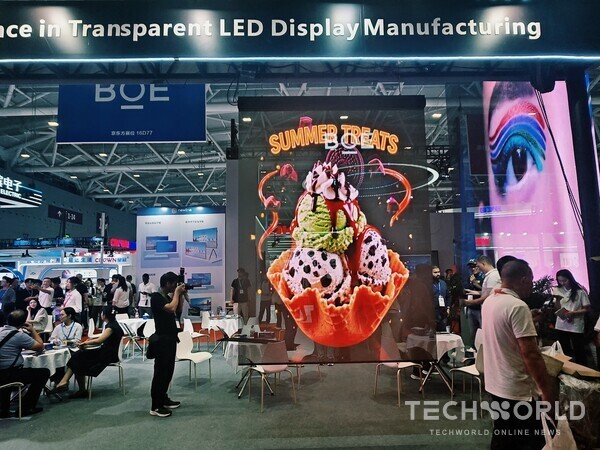
At this exhibition, commercial displays were shown moving toward form diversification beyond functionality. Shenzhen Guojia Optoelectronics exhibited a transparent LED display, which is intended to display advertising and information content while preserving visibility through the space behind the screen. The product is applied to store windows and commercial spaces, and its condition of use is that it must not block the field of view.
BOE also participated in the exhibition as a major display company. BOE unveiled next-generation display technologies such as OLED and is pursuing an "AI+" strategy that applies AI across manufacturing, product development, and corporate operations. At this exhibition, various panel technologies including OLED and micro OLED were featured, and the expansion of applications extended from smartphones and wearables to vehicles and commercial displays.
Accordingly, the competitive criteria for commercial displays are also changing. Competitive factors now include panel image quality, AI- and software-based spatial and service linkage functions, screen forms tailored to the installation environment, and panel technologies tailored to the installation environment. These elements are emerging as product differentiation factors.
The competitive axis in the smart glasses sector is taking shape around the combination of optics and AI. As the role of screens is changing in commercial displays, the screen form itself is also changing in smart glasses.
Smart glasses face structural constraints because they must simultaneously house the display, optical system, camera, and battery inside the frame. For this reason, smart glasses development requires not only higher resolution but also smaller, lighter, and lower-power modules.
In particular, AR glasses place great importance on the optical system when creating a screen in front of the eyes. In the process by which light travels from the display light source to the user's eyes, light loss occurs, so simply increasing panel brightness has its limits.
Accordingly, the necessary technologies include simultaneously securing brightness and optical efficiency while achieving a thinner and lighter optical module. In line with this trend, technologies across the smart glasses ecosystem, including finished products, optical modules, and related solutions, were exhibited at the venue.
The Seoul Business Agency (SBA), in connection with the Seoul XR Center, set up the Seoul joint pavilion. At the Seoul joint pavilion, technologies from domestic XR companies such as Nexil and Prazen were introduced.
Nexil unveiled "ControlXR." "ControlXR" is software that analyzes first-person video input from smart glasses and VR devices, using AI, vision, and language models (VLM) as analysis tools. The function is focused on evaluating whether a worker follows procedures, and it can be applied to XR devices in fields such as nursing practice, manufacturing, and defense by repeatedly checking prescribed work procedures.
Prazen exhibited an optical module for AR glasses. The optical module secured a 70-degree field of view on a monocular basis and features reduced weight and lower power consumption. As smart glasses are intended to be worn for long periods, securing a wide field of view, lighter weight, and power efficiency at the same time was presented as a product competitiveness factor.
VUMO unveiled smart glasses that combine AI with camera and voice functions. At the venue, AR-type glasses that display information in front of the eyes and AI glasses with minimized display functions were exhibited side by side, showing both product types and functional differences. The AR type focused on enhancing optical performance and field of view, while the AI glasses placed more weight on camera- and voice-centered AI services based on minimized display functions.
Smart glasses differ in product configuration and required components depending on what is given priority, such as wearing time, weight, or battery life. Accordingly, design directions and component selection are also determined differently.
To reduce the thickness and weight of smart glasses, not only the panel but also the optical components must be made thinner and lighter. Precision in glass processing and coating technology are considered factors that determine product completeness.
HONY Glass Technology exhibited precision glass, optical processing, and coating technologies at this exhibition. These were presented as areas that are becoming equally important in the process of making smart glasses lighter and thinner.
As the smart glasses market expands, the scope of competition is extending beyond the panel. Product maturity now requires integrated coordination of optical glass, coating, module design, and AI software.
This change in product form is driving changes in surrounding display materials and manufacturing processes. The shift in smart glasses form factors is leading to a trend that requires responses across the related industries beyond the display unit itself.
Think Top Technology (TTT) introduced high-performance adhesive materials for displays and electronic devices at this exhibition. The company showcased related technologies amid the trend of changes in surrounding materials and production processes driven by the spread of smart glasses.
TTT is responsible for designing the polymer structure of adhesive materials inside tapes. In particular, for products that are repeatedly folded, such as foldable smartphones, adjusting the properties of adhesive materials to prevent traces and deformation at the folding area is important. A TTT official explained that foldable smartphones undergo folding tests of about 200,000 cycles and that repeated folding can cause bends and fold lines in the tape. The official added that the company is working on adhesive polymer design to prevent creasing.
TTT was founded in 1988. Its initial business expansion was centered on the domestic market. Later, expansion of overseas exports began around 2010.
The company said overseas volume is steadily increasing. It also said that, in response to the slowdown in the domestic industrial economy, it has designated China as a key target market. It added that it is strengthening sales activities for China.
As product structure changes broaden, material requirements are becoming more advanced as well. Inside thinner products, multiple components must be combined. In addition, in repeated folding and moving structures, performance is required to maintain adhesion even after deformation.
Material changes are affecting manufacturing processes. Shenzhen Height-LED Technology unveiled curing technology using UV LED and also unveiled related automation equipment. As the thinning of parts that use adhesives and coating materials progresses, and as the structural complexity of parts that use adhesives and coating materials also progresses, the importance of process control that keeps application and curing conditions consistent is increasing along with the deepening thinning and structural complexity of parts.
In addition, Guangzhou Changqi Technology exhibited inspection equipment applied to LCD, OLED, and touch panel manufacturing processes, as well as reliability-related equipment applied to LCD, OLED, and touch panel manufacturing processes. New materials and new structures must be verified before being applied to mass production, and the verification items include whether the same quality can be maintained even in repeated production and whether the same performance can be maintained even in repeated production.
This exhibition also highlighted the trend of the display industry's competitive scope expanding beyond the panel. In the commercial market, AI and software are becoming screen service terminals. In the smart glasses sector, the compact and lightweight integration of the display and optical system is emerging as a competitive factor. In addition, as product forms and panel technologies diversify into transparent LED, OLED, and foldable products, corresponding responses from surrounding materials and manufacturing processes are also continuing.
The standards for judging product competitiveness are no longer limited to basic performance such as panel brightness and resolution. Going forward, in addition to the screen's own performance, the form in which the display is implemented, connected services, and the ability to ensure stable production are expected to be the factors that determine competition.
Source: TECHWORLD · Kim Seung-gi
Original: https://www.epnc.co.kr/news/articleView.html?idxno=408965
References
This article was produced with the help of an automated content generation algorithm.
Source: TECHWORLD
View originalThis article was summarized and organized by BizCrush based on the original article from TECHWORLD. For exact quotations and full details, please refer to the original article.