Dassault Systèmes Combines Industrial AI With CATIA to Boost Engineer Productivity
IT DAILY ·
✦ AI Summary
Dassault Systèmes is integrating industrial AI into CATIA to improve engineers’ design and development productivity.
It held the "CATIA User Symposium Korea" on the 27th at L Tower in Yangjae, Seoul, and shared CATIA’s technology evolution roadmap and trends in industrial AI applications.
Speakers said AI helps automate repetitive modeling, analyze design requirements, and explore design alternatives while expanding engineers’ expertise and creativity.
Dassault Systèmes is integrating industrial AI into its design solution, CATIA. The goal is to improve engineers’ design and development productivity. The company said combining industrial AI can drive design innovation and expand engineers’ expertise and creativity.
Dassault Systèmes Korea held the "CATIA User Symposium Korea" on the 27th at L Tower in Yangjae, Seoul. The event shared CATIA’s technology evolution roadmap and trends in industrial AI applications.
In his presentation, Lee Joo-sang, head of Dassault Systèmes Korea, said advanced AI is driving changes in manufacturing design and development methods. He explained that AI’s role in manufacturing design and development is expanding.
Lee said AI is being used to automate repetitive modeling tasks, directly analyze design requirements, and explore a variety of design alternatives. He also said the scope of AI applications is gradually widening.
Lee added that he expects AI applications to spread further in the future. In this context, combining industrial AI is leading to design innovation and also affecting the expansion of engineers’ expertise and creativity.
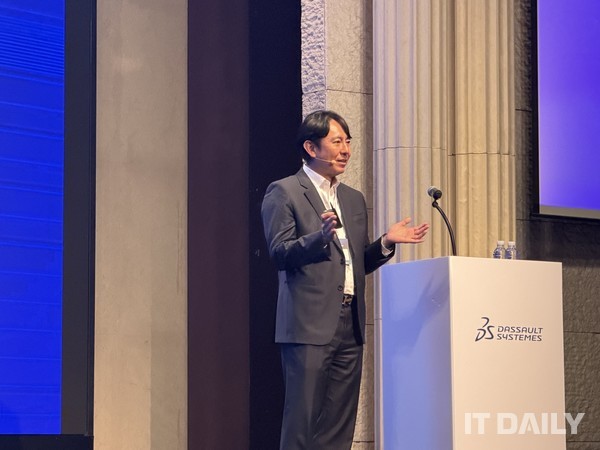
The photo shows Lee Joo-sang, head of Dassault Systèmes Korea, delivering a presentation at the "CATIA User Symposium Korea." The photo was taken by Yang Seung-gap.
As AI spreads, engineers’ work and product development methods are changing. The main changes are that engineers can focus on higher-value work and develop better products more efficiently. The focus is on how AI is changing engineers’ work and product development methods.
Dassault Systèmes has positioned industrial AI as a core element of design and engineering innovation. CATIA is a 3D design and engineering solution that connects design data and development processes on the 3DEXPERIENCE platform. It is also strengthening design and collaboration support functions through AI integration.
Based on accumulated industrial expertise and know-how, Lee said the company aims to combine virtual twins and AI to help solve complex challenges in industrial settings. He also explained that this approach supports engineers in reviewing multiple design alternatives, verifying product performance and behavior in virtual environments, and making more reliable decisions.
Lee said AI is not a replacement for engineers. He added that AI is a companion that expands engineers’ expertise and creativity.
As product functions and uses change, there is a growing need to change design and verification methods as well. There is also a recognition that design, verification, and automation must be connected and that the use of industrial knowledge must be increased.
The person in the photo is Xavier Melkonian, senior director of CATIA Virtual Experience at Dassault Systèmes. The photo was taken by Yang Seung-gap.
Xavier Melkonian said product complexity is increasing. He added that, as interdependence among electricity, software, and composites grows and sustainability and new manufacturing processes must be taken into account, the entire process needs to be completed more quickly.
In response, Dassault Systèmes is pursuing its vision of the "3D UNIV+RSES" with industrial AI integrated. This aligns with its direction of connecting design, verification, and automation while increasing the use of industrial knowledge to fit the changed product development environment.
CATIA is evolving in a direction that combines existing design applications with the "virtual twin," the "virtual companion," and "generative experience." The "virtual twin" serves to virtually reproduce products and processes, the "virtual companion" handles work support and execution, and "generative experience" takes care of task automation.
The structure described is a way of sharing product information centered on the virtual twin. In this process, experts from multiple fields participate in design and performance reviews.
Here, the virtual companion plays the role of guiding users and performing tasks by using corporate knowledge and know-how. Director Melkonian explained that the virtual companion supports and trains users with the platform’s knowledge and know-how and carries out tasks. Generative experience functions support rapid exploration of various design alternatives by reflecting design rules, automating repetitive work, and more. Melkonian said generative experience improves productivity through knowledge- and know-how-based task automation.
As the foundation for making this possible, Dassault Systèmes presented the "industry world model." The company described it as an industrial AI model that combines industrial knowledge and know-how, physical models and simulations, and reasoning and generation capabilities. Its purpose is to use a company’s proprietary design knowledge and secure the accuracy and reliability required of real products.
Director Melkonian said that if users have specific knowledge about work methods and essential internal regulations, that information can be reflected on the platform.
He especially explained that when working on products that require actual flight and are subject to flight certification, design requirements must be met precisely. He also stressed that scientific reliability is important for the platform.
Next, Kim Ki-hyun, head of the CATIA technical team at Dassault Systèmes Korea, introduced CATIA’s AI features and engineering use cases. The photo shows Kim Ki-hyun, head of the CATIA technical team at Dassault Systèmes Korea, during the introduction, and it was taken by Yang Seung-gap.
Kim said AI adoption within CATIA is reducing design errors and automating change work. He added that CATIA’s modeling functions are also being advanced.
In the bracket model case, adding fillets was presented. In that case, only 27 of 60 combinations of design variables could be updated without errors.
As a countermeasure, the fillet radius was automatically adjusted within the designer’s allowable range. As a result, the update success rate increased by 97%.
AI-based automation features included extracting shape and dimension information from drawing images, reconstructing 3D shapes without design history, and converting them into editable models. Functions for analyzing parameters and relationships in technical documents and generating rules for applying design changes were also explained.
Kim said these functions work by using AI algorithms and learning models internally to automate tasks during CATIA’s execution process.
He then introduced a conveyor design change case using "Leo." Leo is an AI in charge of design and engineering tasks among the virtual companions. When the user’s request changed the size and load conditions, it searched for and explained the relevant parameters and applied the changed values to the model. It then adjusted the number of rollers, spacing, and support structure based on existing template definition rules.
Kim said the direction of AI’s role is not to replace humans but to support engineers in reaching faster and more accurate results through interaction.
He emphasized that the basis for related work is connecting a company’s proprietary design knowledge with the platform.
Kim said there are some limitations to relying only on external AI training. He added that the company aims to provide AI in a form that can be used in industry based on interaction with AI within the platform. He also said the company is avoiding simply turning accumulated information into a database and instead wants to develop it into an ontology that can be used for AI training and application.
Source: IT DAILY · Yang Seung-gap
Original: https://www.itdaily.kr/news/articleView.html?idxno=242474
References
This article was produced with the help of an automated content generation algorithm.
Source: IT DAILY
View originalThis article was summarized and organized by BizCrush based on the original article from IT DAILY. For exact quotations and full details, please refer to the original article.