Red Hat Holds Summit Connect 2026, Shares Ways to Secure Sovereignty Over AI Infrastructure
IT DAILY ·
✦ AI Summary
Red Hat held 'Red Hat Summit: Connect 2026' on the 27th and presented security strategies and infrastructure modernization solutions in response to the accelerating adoption of AI.
Kim Kyung-sang, president of Red Hat Korea, said the AI era is the third major turning point in IT history, and that companies must move away from the monopoly of a single cloud, a single AI model, or a specific vendor.
Vincent Caldeira, CTO, proposed reducing dependence on external model APIs and shifting to a 'Token Producer' model that controls workloads in its own environment, as well as operating VM, containers, and AI on a single platform.
The discussion began with a sharp rise in AI operating costs and software supply chain security threats accelerating by the second. In this environment, it was pointed out that organizations need to break free from dependence on a specific vendor in order to respond to security threats and secure control over infrastructure.
Along with that, the need to shift to a single open source-based hybrid platform was raised as an alternative. It was described as a way to reduce vendor lock-in and secure infrastructure control.
Red Hat held 'Red Hat Summit: Connect 2026' on the 27th. The theme of the event was responding to the accelerating adoption of AI, and Red Hat presented strategies for countering security threats and solutions for infrastructure modernization.
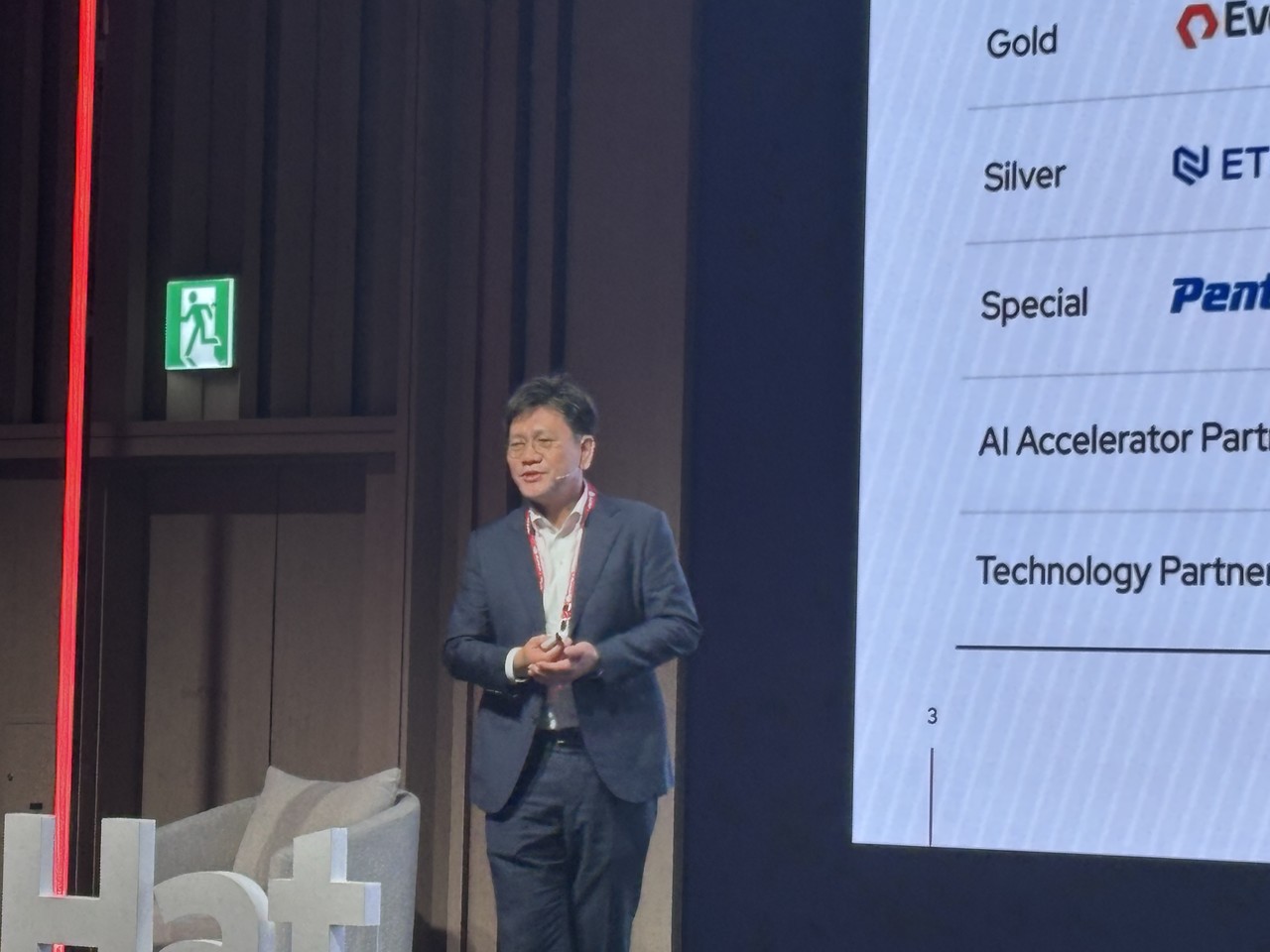
At the opening, Kim Kyung-sang, president of Red Hat Korea, took the stage. Kim appeared with Boston Dynamics' quadruped robot Spot for the opening demonstration and also delivered the welcome remarks.
In his welcome address, Kim defined the AI era as the third major turning point in IT history. He cited the adoption of Linux and the shift to cloud native as earlier turning points.
Kim said the forces shaping the future cannot be a single cloud, a single AI model, or the monopoly of a specific vendor. As conditions for successful companies, he presented open, open source-based foundations and the establishment of flexible systems optimized for their own environments.
That message continued in the keynote session. The presentation was delivered by Vincent Caldeira, Red Hat CTO, and the topic was the infrastructure dilemma facing companies in the AI era and strategies for resolving it.
The session subtitle was 'From Token Consumer to Token Producer.' Vincent Caldeira, CTO, explained that Korea accounts for 70% of global DRAM production, holds leadership in high-bandwidth memory (HBM), and ranks No. 1 in AI patent registrations per capita worldwide.
On that basis, he described Korea as a key hub in the AI ecosystem. A presentation photo from the event was also published, with photo credit to reporter Kwon Young-seok.
Corporate IT teams face the challenge of maintaining legacy systems while also managing increasingly complex AI infrastructure under stagnant budgets. In this situation, Caldeira CTO explained that the price per token for external frontier AI models is falling by 75% to 90% every year. At the same time, however, he said actual monthly AI costs are surging astronomically as corporate usage and application scope expand.
To respond to this cost structure, companies need to move away from dependence on external model APIs. They must shift toward controlling and optimizing workloads based on their own environments. Through this, companies aim to evolve into purpose-built Token Producer.
As a framework for implementing this transition, he presented a Metal-to-Agent architecture that spans everything from bare-metal hardware to the AI agent application layer. At the center of this architecture, he highlighted the OS layer RHEL, which encompasses NVIDIA accelerators and domestic NPUs such as those from Rebellions. He also introduced OpenShift, which runs VM, containers, and AI on a single platform, as another core component.
At Red Hat Summit Connect 2026, Caldeira CTO said companies that continue relying on external token consumption risk becoming dependent on monthly bills. He said companies need to secure control, and explained that they need optimization models sized appropriately for each business use case. He also suggested that models should run in self-hosted environments, saying companies need to shift to 'Token Producer.'
The theme of this session was SBOM security and virtualization integration centered on the 'operating model.' Caldeira CTO presented a shift in the security paradigm driven by AI, while also offering a solution for virtualization modernization. The photo was taken by reporter Kwon Young-seok.
He explained that recent AI models can autonomously detect thousands of high-risk vulnerabilities in software. He said the cost of vulnerability detection by recent AI models is only dozens of dollars. He also assessed that the time from vulnerability discovery to actual exploitation has shortened from around 60 days in the past to a few hours or even zero-day timing.
Caldeira CTO said a 'zero CVE' approach that fixes every potential vulnerability unconditionally is practically impossible. He explained that overly aggressive patching can also undermine environmental stability. Accordingly, Red Hat presented a multilayered security strategy instead of a method that fixes all vulnerabilities at once.
Red Hat's proposed solution consists of the lightweight container image 'Hardened Images,' which minimizes the attack surface, 'Trusted Libraries,' which ensure verified provenance, and the rolling release 'Fedora Hummingbird Linux,' which immediately incorporates the latest upstream patches. This is a response to the changing security environment described by Caldeira CTO, and part of the virtualization modernization approach he outlined.
As the virtualization market changes rapidly, Red Hat argued that the value of OpenShift Virtualization should be assessed beyond cost savings alone. Red Hat said that operating VM, containers, and AI agents in separate silos creates inefficiencies and security gaps, and that the three workloads need to be managed together on a single platform.
Red Hat announced that the number of VMs on OpenShift has surged by more than 400% over the past year. It also said it has completed migration assessments for more than 1 million VMs, and based on that, judged that the shift to virtualization is progressing rapidly.
Caldeira CTO said it is inappropriate to limit the virtualization transition debate to the simple issue of reducing licensing costs. He explained that virtualization transition should be addressed from the perspective of a fundamental operating model, and that expanding scalability and sustainability of corporate infrastructure can be secured when VM, container, and AI workloads are integrated and operated on a single open hybrid platform.
Source: IT DAILY · Kwon Young-seok
Original: https://www.itdaily.kr/news/articleView.html?idxno=242465
References
This article was produced with the help of an automated content generation algorithm.
Source: IT DAILY
View originalThis article was summarized and organized by BizCrush based on the original article from IT DAILY. For exact quotations and full details, please refer to the original article.