Saltware Secures Patent for Sensitive Information Detection Technology, Pushes to Expand AI Security Business
IT DAILY ·
✦ AI Summary
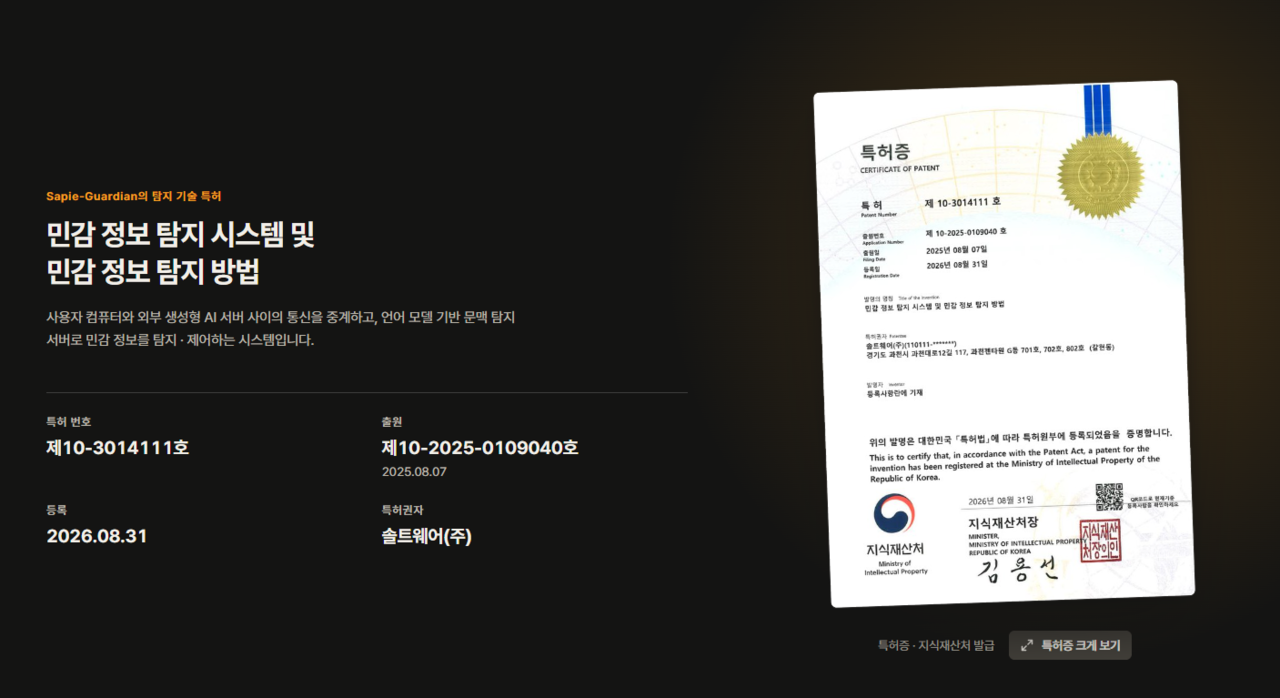
Saltware said on the 22nd that it had obtained a patent for the "Sensitive Information Detection System and Sensitive Information Detection Method" and also won a supply contract for financial firms.
The patent is related to its in-house AI security solution (AI DLP), "Sapie-Guardian," and includes functions that prevent sensitive information from being transmitted externally when using generative AI services.
Saltware said the financial-sector supply contract confirms its technological capabilities and business applicability in responding to the risk of corporate data leakage in generative AI environments.
Saltware said on the 22nd that it had obtained a patent for the "Sensitive Information Detection System and Sensitive Information Detection Method" and also won a supply contract for financial firms.
The patent covers technology related to its in-house AI security solution (AI DLP), "Sapie-Guardian."
Saltware said the patent acquisition and the financial-sector contract demonstrate its technological capabilities in responding to the risk of corporate data leakage during the use of generative AI, while also confirming the potential for real-world business application.
Sapie-Guardian is an AI security solution designed to prevent sensitive information from being sent outside when employees use generative AI services. For services such as ChatGPT and Claude, it inspects user-input prompts and attached documents before they are transmitted to the AI service, and controls data leakage risks according to corporate security policies.
This function is structured so that security capabilities can be applied without changing existing AI services or work environments. It allows the use of non-sensitive information depending on data sensitivity, can block information containing personal data or corporate secrets according to customer-defined policies, and can also apply masking and substitution methods to such information. As a result, companies can create an AI usage environment that considers both work efficiency and information security without having to broadly restrict the use of generative AI.
Sensitive information detection combines rule-based detection and AI-based contextual analysis. Information in fixed formats, such as resident registration numbers and account numbers, is detected through rule-based methods, while internal corporate information that requires contextual judgment is analyzed with AI technology.
During this process, detection keywords and regular expressions can be added according to customer needs, and security policies can also be made more granular. In addition, rule-based detection items can be expanded without separate GPU resources.
AI technology can also be applied flexibly depending on corporate security requirements and system environments. Applicable technologies include sLLM, fine-tuning, classification models, and RAG.
Saltware supports sensitive information detection in documents such as Hangul, Word, Excel, and PDF, and also provides masking for necessary sections. This function was designed to address the risk of data leakage in generative AI web services, and it was also designed to address the risk of data leakage in AI development tools such as Claude Code, Codex CLI, and Gemini CLI. It is configured to detect and control sensitive information in the process of moving between documents and AI services and development tools.
Saltware obtained a patent for the "Sensitive Information Detection System and Sensitive Information Detection Method." The patent covers technology that intermediates communication between a user computer and an external generative AI server, as well as technology that detects and controls sensitive information through language model-based contextual analysis.
With this patent acquisition, Saltware has secured in-house technology to respond to the risk of corporate data leakage in generative AI environments. It has also strengthened its technological competitiveness in the AI security market.
Saltware also won a supply contract for Sapie-Guardian in the financial sector. This is a visible achievement in the financial sector AI security market. Because the financial sector handles sensitive data such as customer personal information and financial transaction data, preventing data leakage and controlling access rights are important when introducing generative AI.
The contract was presented as an example of Sapie-Guardian's technological and business competitiveness in meeting financial-sector security requirements. Saltware plans to expand its AI security business based on this contract and identified financial services, manufacturing, and the public sector as target industries with high security requirements.
Saltware has its own integrated AI data platform, "Sapie-ADP." "Sapie-ADP" supports the use of corporate data and AI services in a single environment. Saltware is linking its various AI solutions, including Sapie-Guardian, and said it is moving toward providing an integrated operating environment for data utilization, AI service operation, and security management.
Lee Jeong-geun, CEO of Saltware, emphasized the importance of securely protecting internal corporate data and creating an environment for AI-driven work as the use of generative AI expands. He also mentioned a policy of continuously advancing Sapie-Guardian's security technology. In addition, he said the company will link various AI solutions centered on "Sapie-ADP" to provide an integrated AI environment for safe and efficient data utilization.
On the 21st, Saltware held a seminar titled "AI Agent End-to-End, from Data to Operations," co-hosted with Databricks and Datadog, and the seminar presented the full process from building AI agents to operating them as its main theme.
Source: IT DAILY · Kwon Young-seok
Original: https://www.itdaily.kr/news/articleView.html?idxno=242434
References
This article was produced with the help of an automated content generation algorithm.
Source: IT DAILY
View originalThis article was summarized and organized by BizCrush based on the original article from IT DAILY. For exact quotations and full details, please refer to the original article.