Spotting Defects, Reading Drawings... Industrial AI Expands Into Manufacturing and Office Work
TECHWORLD ·
✦ AI Summary
The use cases for industrial AI are expanding into manufacturing and office work.
At the "2026 Industrial AI Expo," AI application technologies for manufacturing processes and corporate operations, along with operations after deployment and reliability verification methods, were introduced.
The exhibition also featured attempts to link AI for different tasks such as quality inspection, design and quoting, and document processing with data management, infrastructure, and verification technologies.
The use cases for industrial AI are expanding into manufacturing and office work. On the factory floor, examples included using cameras to detect product defects and using the sound of parts fitting together to check assembly conditions. In office settings, applications introduced included analyzing drawing changes to support quote review and using site photos and voice recordings to help draft work reports.
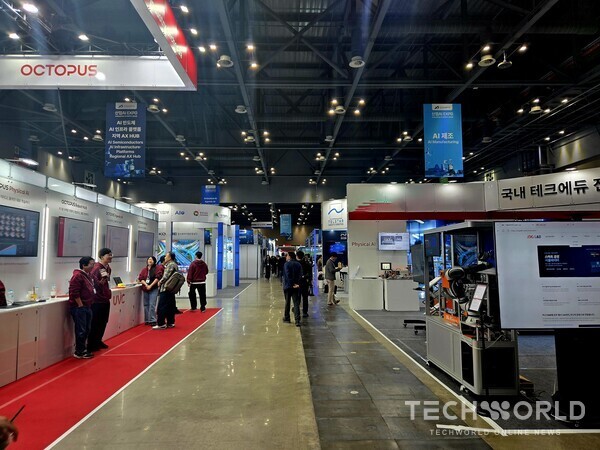
These technologies were introduced at the "2026 Industrial AI Expo," held at Kintex in Ilsan from the 21st to the 23rd. The event showcased AI application technologies for manufacturing processes and corporate operations. Participating companies presented use cases ranging from individual task automation to operations after deployment.
The event also highlighted technologies for improving models based on site data, linking with legacy systems, internal AI execution infrastructure, and AI reliability verification methods. As a result, the trend of industrial AI adoption expanding beyond individual task automation to overall operations stood out.
An "Industrial AI Convergence Special Pavilion" was also set up at the venue. Under the theme of Manufacturing AI Transformation (M.AX), the special pavilion outlined policy directions for the transition and introduced strategies and application cases that combine Korea's manufacturing industrial base, supply chains, and expert know-how with AI. Exhibits from companies focused on technologies that connect manufacturing data, models, and production equipment.
What was presented in the quality inspection field was defect detection capabilities and ways to accumulate and use inspection results. The discussion explained a flow in which quality inspection does not end with a simple judgment, but feeds results from the field back into model improvement.
Ibex was presented as a configuration that links vision inspection "AIVision," robot control "AIVot," model operations platform "AIVOps," and quality data management engine "AIVData." When a new defect is found on the production line, a worker checks the judgment, retrains the model based on confirmed data, and then redeploys the verified model to the field.
Inspection results are not left as one-time records, but are used as training data to respond to changes in product types and processes. In this way, the company has built a structure for accumulating and reusing on-site inspection results.
A technology that supplements conditions difficult to verify through images was also introduced: sound. Deeper's product, "Listen AI Industrial," analyzes fastening sounds and machine operating sounds to detect signals that differ from normal conditions. It is used to check connection states that do not appear externally and to detect signs of equipment abnormalities.
To connect data secured at manufacturing sites to actual process improvements, a support environment is needed that can develop and operate models on the premise that the data will be used. In that context, Mondrian AI exhibited its manufacturing-specific platform, "MonPlant."
"MonPlant" supports data integration, no-code model development and operations, and equipment control linkage. Its application areas are quality inspection and predictive maintenance.
The targets of AI use are broadening beyond production processes to include information accumulated in upstream and downstream tasks such as design and quoting. Accordingly, MakinaRocks introduced its drawing AI solution "DrawX," which provides functions for extracting materials from drawings, extracting dimensions from drawings, extracting shape information from drawings, supporting similar drawing searches, supporting change comparison, supporting cost analysis, and supporting manufacturability reviews.
MakinaRocks said that in customer cases, use of "DrawX" cut drawing review and management time by up to 90%. The focus is on reducing the time spent searching for scattered drawings and organizing information for quoting and procurement decisions.
It was also pointed out that applying AI to corporate operations requires not only the premise of using individual materials for work, but also the ability to understand relationships among related information. Wrtn AX presented an ontology-linking approach that connects equipment history, process conditions, inspection results, and work documents. The purpose of ontology linking is to structure the meaning and relationships of information, thereby helping AI understand business context. The areas of support are R&D, predictive maintenance, and quality management.
Seoul AI Hub formed a joint pavilion with tenant companies. The purpose of the joint pavilion was to introduce technologies that respond to challenges by business function. There, AIGment introduced an AI solution for reducing procurement costs, Cogcom unveiled its data integration and operations automation solution "Recolumn," and Planningo presented an AI- and 3D-based product configuration and quoting solution.
The joint pavilion also included a setup for companies that have difficulty sending internal data outside the company. Scionic AI and HyperAccel presented AI agents for closed networks and on-premises environments by combining the "STORM" platform with LPU-based inference infrastructure. This approach aims to use unstructured internal corporate data and secure inference efficiency.
The two companies presented use cases such as drafting work reports based on site photos and voice recordings, searching for changes in construction drawings, and searching for material information. To that end, they said they support organizing documents, drawings, and reports into forms that AI can read, and also support practical business use of the organized materials.
This trend involves converting various work materials into forms that AI can easily read and write, and then applying them to actual on-site work. Based on such organized materials, the two companies introduced use cases for drafting work reports, checking drawing changes, and searching for material information.
The Ellis Group introduced methods for document analysis and in-house knowledge utilization centered on the "Helpy Series." "Helpy Vision" is used for document analysis, "Helpy Context" for connecting related information, "Helpy Code" for development use and work support, and "Helpy Chat" for development use and work support.
The Ellis Group also supplies cloud-optimized software "ECI" and modular data centers "AI PMDC." As a result, its business structure is organized around providing both software for processing internal corporate data and execution infrastructure.
This article section covered operations and management after AI deployment, along with verification systems. Megazone Cloud used its booth signage to present its subsidiary AlphaCode's "Gravity," "NOVA," and "Zenith," and introduced technologies for managing data, models, and agents after deployment. "Gravity" was presented as a platform for data operations, "NOVA" as a platform for managing LLMs, and "Zenith" as a platform for managing agents.
Based on this, management functions by stage of AI use in companies were explained. Through a platform structure that separately handles data, LLMs, and agents, the flow of operations and management after establishing an AI operating system was presented, and the issue of verifying judgment and action alongside that system was also raised.
In this regard, Thinkforbill introduced a linkage plan involving "Re:In," Numalis's "Saimple," and AgentSure's "JANUS." "Re:In" is a tool for diagnosing how faithfully training and validation data reflect actual usage environments, "Saimple" is a tool for evaluating whether a model operates stably under unexpected conditions, and "JANUS" is a solution for checking security risks in the process of connecting agents with external tools as well as a means to verify and control compliance with work rules and permissions. Through this, an approach was presented that expands the scope of reliability management across data, models, and agent operations.
The exhibition showed attempts to link AI for different tasks such as inspection, design, and document processing with data management, infrastructure, and verification technologies. Accordingly, the competitive landscape for industrial AI companies is expected to expand from function development and supply to performance management after on-site deployment. In this process, key competitive strengths were presented as support for linking existing equipment and systems, reduced work time, reduced defect rates, and lower operating costs.
Source: TECHWORLD · Kim Seung-gi
Original: https://www.epnc.co.kr/news/articleView.html?idxno=408709
References
This article was produced with the help of an automated content generation algorithm.
Source: TECHWORLD
View originalThis article was summarized and organized by BizCrush based on the original article from TECHWORLD. For exact quotations and full details, please refer to the original article.