[Audit] Calls Grow to Overhaul Permitting and Tax Rules as AIDC Investment Expands... Bae Kyung-hoon Says Talks Will Move Quickly
IT DAILY ·
✦ AI Summary
At the National Assembly's science committee audit, lawmakers said AIDC investment plans need reforms to power, permitting, and tax credit systems if they are to lead to actual construction and operations.
Rep. Kim Nam-kuk called for clarity on the upper limit for exemption from the power grid impact assessment for AIDC projects outside the Seoul metropolitan area, permitting processing deadlines, and tax credit application standards.
Deputy Prime Minister and Minister of Science and ICT Bae Kyung-hoon agreed and said he would pursue talks on power standards, consultations with the fiscal authorities, and support for activating the domestic AI ecosystem.
During the National Assembly Science, ICT, Broadcasting and Communications Committee's audit on the 23rd, lawmakers said related systems need to be overhauled if AIDC investment plans are to lead to actual groundbreaking and operations. Among the audit points raised were the need to clarify power, permitting procedures, and tax credit standards to link AIDC investment to actual construction and operation.
Rep. Kim Nam-kuk of the Democratic Party of Korea reviewed AIDC build plans and the status of system reforms during the comprehensive audit of the Ministry of Science and ICT and other agencies held at the committee on the 23rd. In the process, Kim questioned Deputy Prime Minister and Minister of Science and ICT Bae Kyung-hoon.
Kim said there were differences of opinion over the upper limit for exemption from the power grid impact assessment for AIDC projects outside the Seoul metropolitan area. He presented this as an example of differing standards between ministries.
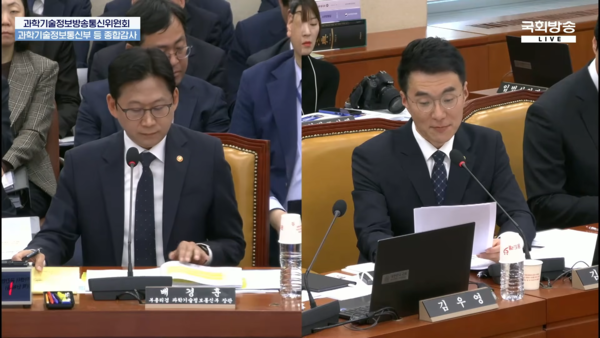
Kim said the Ministry of Climate, Energy and Environment was reviewing 50 MW, while the Ministry of Science and ICT was reviewing at least 100 MW. A screenshot from the National Assembly Broadcasting YouTube channel was also posted.
Kim said that rather than a compromise between 50 MW and 100 MW, the upper limit for exemption from the power grid impact assessment should be set as soon as possible by reflecting the number of applications from companies with actual AIDC power demand. He argued that the exemption cap should be set based on real corporate demand, not a simple numerical compromise.
He also raised concerns that there is no processing deadline at the preliminary stage of related permitting procedures. Kim said the 150-day processing deadline for major permits applies only after the case is transferred to the relevant agencies. He added that there is no processing deadline even at the review stage by the Ministry of Science and ICT and the National AI Strategy Committee, and said the overall processing timeline from application to transfer needs to be clarified.
Kim called for permitting procedures to be simplified starting from the preliminary review stage. He also called for parallel processing of reviews where possible and the establishment of a one-stop fast track.
In response, Bae Kyung-hoon, Deputy Prime Minister and Minister of Science and ICT, said he fully agreed. Bae said the Ministry of Science and ICT has been arguing for 100 MW and that the actual level of requests from companies exceeds 100 MW. He added that he would work with the Planning Ministry to negotiate and finalize the matter at the level proposed.
As AIDC investment models diversify into colocation and GPU services, uncertainty over tax incentives was raised, with the possibility that some investment assets could be classified as real estate leasing businesses and therefore excluded from tax credits. Bae said that currently there are no tax benefits for rental-type AIDC facilities.
Kim then asked Bae whether AIDC investment assets in colocation and infrastructure-provision models, other than self-build projects, could qualify for the national strategic technology tax credit, and whether related enforcement decrees could be revised within the year. He also called for an early decision on the tax credit application standards for each operating model and an early decision on post-management methods by operating model. In response, Bae said he planned to consult quickly with the fiscal authorities and also laid out a plan to pursue the project by creating conditions to attract foreign capital.
The need for AIDC support to be linked to the growth of domestic industries and the regional economy was also raised. Kim questioned whether national power, water, and government support could end up benefiting Nvidia and foreign-made GPUs and servers.
Kim said that for the government's AIDC mega project to secure legitimacy, it must go beyond building data centers and achieve shared growth across Korea's AI-related industries as a whole.
Bae said he would pursue the localization of domestic AI solutions, cooling equipment for data centers, and software and hardware technologies. He explained that the purpose of this push is to energize the broader industry.
Bae said the country is currently heavily dependent on Nvidia GPUs. He added that partners have recently been expanded to AMD and Intel, and said he would encourage and cooperate so that AMD, Intel, and others can form industries linked to the domestic NPU and AI ecosystem. He also said the government will support efforts to activate the domestic AI ecosystem.
Source: IT DAILY · Yang Seung-gap
Original: https://www.itdaily.kr/news/articleView.html?idxno=242416
References
This article was produced with the help of an automated content generation algorithm.
Source: IT DAILY
View originalThis article was summarized and organized by BizCrush based on the original article from IT DAILY. For exact quotations and full details, please refer to the original article.