AWS and Upstage Set Out Conditions for AI Performance Gains, Emphasizing Goals, Integration, and Trust
IT DAILY ·
✦ AI Summary
AWS and Upstage presented strategies for turning AI into actual business outcomes.
They said companies are defining the work to be improved in detail and measuring effects with KPI.
They said it is important to choose projects while considering integration with existing systems, compliance with governance, management and control costs, and ROI review.
As companies’ use of AI spreads, attention is shifting to the degree to which AI can improve work and create measurable results. In response, AWS and Upstage presented strategies for turning AI into actual business outcomes.
The two companies stressed the importance of setting clear performance goals. They also said it is necessary to choose projects while taking into account integration with existing systems, compliance with work procedures and governance, and the cost of management and control.
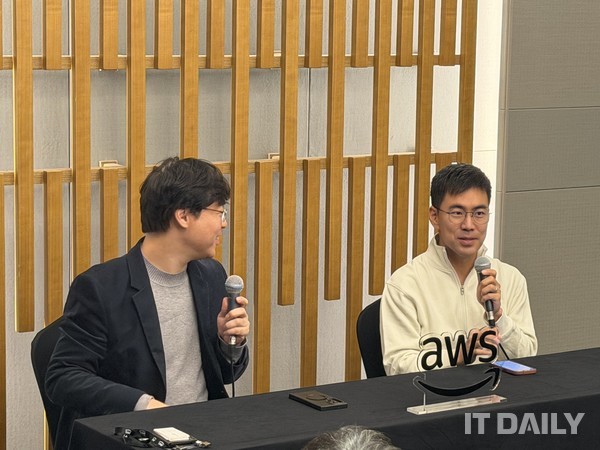
Choi Young-jun, head of AI technology at AWS Korea, and Kwon Soon-il, chief strategy officer (CSO) at Upstage, discussed those directions, along with changes in corporate needs and ways to apply agentic AI to business operations, at a press conference for the "AWS AI Wave 2026" held on the 23rd at the Grand InterContinental Seoul Parnas in Seoul. The people in the photo are Choi Young-jun, head of AI technology at AWS Korea, and Kwon Soon-il, chief strategy officer (CSO) at Upstage.
Kwon CSO said questions about AI itself are decreasing. He explained that, in the previous year, corporate inquiries were often broad questions centered on the intent to adopt AI rather than on clear use cases. He added that last year the focus shifted to whether it could be applied to specific purposes, and this year the demands have become more specific, with companies precisely identifying the work they want to improve.
Kwon CSO explained that companies are recently defining the work to be improved in detail and checking adoption effects against key performance indicators (KPI). Choi introduced a case in which an agent based on Bedrock was applied to GS Retail’s operational incident response as an example of this trend. In that case, the average time for incident analysis was cut from 30 minutes to about 2 minutes.
The importance of integration with existing systems was also emphasized. It was explained that this is because when using AI, companies must consider their existing operating systems and work procedures together.
Kwon CSO said that companies with a value chain cannot start their business from scratch. He explained that legacy systems are also rule-based structures for a reason. He added that if you ignore procedures and present only the result, it may look convincing, but it becomes a solution that a company cannot use.
Choi introduced the case of Kyungshin Holding and explained a way to apply AI while preserving existing governance. He said AWS supports the application of existing rules through Bedrock AgentCore and also supports natural-language use of in-house data.
Trust was raised as the biggest obstacle to actual business use. This was explained to mean that AI’s strong performance and the possibility that companies can delegate tasks to it with confidence are separate issues.
Kwon CSO explained this by comparing human and AI results in data interpretation tasks such as document parsing. He said human interpretation scores are around 91 to 92 points, including human error, while AI scores are close to 98 points. Even so, he said, many companies remain reluctant to deploy it without human intervention, and he feels there is still a lack of social consensus that AI is a trustworthy technology and one that can be entrusted with work.
In investment decisions, it was emphasized that ROI review should include management and control costs in addition to GPU and solution purchase costs. As ways to carry this out, top-down and bottom-up approaches were presented.
Kwon CSO explained that top-down means prioritizing projects that deliver greater benefits relative to management and control costs, even if they take time. He also cited strong executive decision-making and drive as necessary conditions for top-down implementation.
Kwon CSO explained bottom-up as a method that starts with four or five small projects, such as data automation and review automation. He said the idea is to expand the scope of application after people on the ground feel the effects. He also said neither approach is inherently superior and that each company’s suitable option has its own pros and cons.
The direction of cooperation between the two companies was also introduced. AWS and Upstage signed a strategic partnership agreement in 2024, and Upstage laid the groundwork for co-selling through participation in the AWS ISV Accelerate program. AWS and Upstage have been discussing ways to optimize model training on AWS infrastructure such as SageMaker.
Choi explained that when building ontology and AI-ready data, he recommends Upstage’s Document Parse as a key option for enterprise document parsing work.
Kwon CSO then said the company has carried out many technology collaborations in Korea so far. He said he hopes to expand cooperation with AWS as they move global, based on the business results and technical experience accumulated in Korea.
Source: IT DAILY · Yang Seung-gap
Original: https://www.itdaily.kr/news/articleView.html?idxno=242408
References
This article was produced with the help of an automated content generation algorithm.
Source: IT DAILY
View originalThis article was summarized and organized by BizCrush based on the original article from IT DAILY. For exact quotations and full details, please refer to the original article.