AWS Stresses Enterprise-Wide AI Adoption as It Seeks to Narrow the Gap Between Adoption and Results
IT DAILY ·
✦ AI Summary
AWS held "AWS AI Wave 2026" on the 23rd at the Grand InterContinental Seoul Parnas in Seoul.
Kim Ki-wan, head of AWS Korea's AI business, said enterprise strategy, a data foundation, an operating foundation, and continuous improvement and expansion of AI are key conditions.
Hanwha Solutions said it connects Claude CoWork to an LLM gateway and Amazon Bedrock within its AWS account to manage model usage status, costs, and history and operate governance including privacy protection.
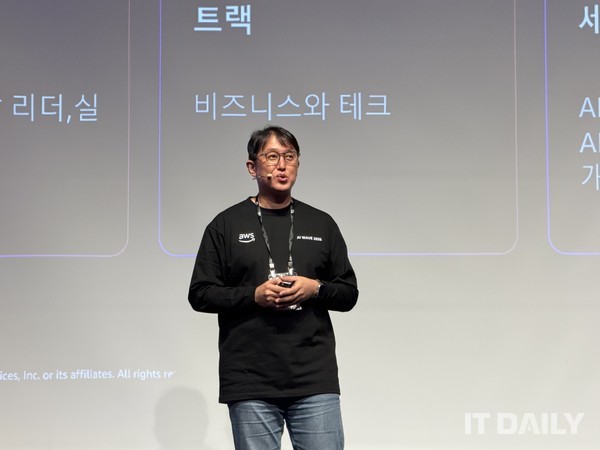
AWS held "AWS AI Wave 2026" on the 23rd at the Grand InterContinental Seoul Parnas in Seoul. Kim Ki-wan, head of AWS Korea's AI business, delivered the keynote address at the event.
At the event, AWS outlined the conditions needed to turn AI use into organizational results. The key condition AWS identified was establishing an enterprise-wide strategy.
AWS also cited securing a data foundation and an operating foundation as key conditions. It also named continuous improvement of AI and the spread of AI across all business functions as essential conditions.
The background behind AWS's position was a gap between AI adoption and results. While the use of AI tools such as development agents continues to rise, AWS said not all companies that have adopted AI are achieving sufficient results.
Kim Ki-wan, head of AWS Korea's AI business, said he sees strong potential for AI to improve individual productivity, but that he continues to deliberate over how to boost productivity at the organizational level. He noted that, unlike individual productivity gains, expanding results at the organizational level is not easy.
Kim pointed to the lack of an enterprise-wide strategy, insufficient data preparation, and an incomplete operating foundation as factors holding back organizational productivity gains. He also said there are questions about whether AI use is fundamentally creating business value. In addition, he said that without controls, it is difficult to measure the ROI of AI use, and it is also difficult to secure visibility into how employees are using AI.
He said the company is running a number of proof-of-concepts (PoC) to create small successes internally, but that concern is growing over how to scale those PoC across the enterprise and apply them across organizations, products, and services. He said the problem of PoC not leading to enterprise-wide deployment is emerging as an important challenge, and that expanding use at the organizational level is becoming a key task.
Kim said a product-centric organization is one strategy for narrowing this gap. He said AI applications and agents should be treated as products to be improved throughout their life cycle, with repeated hypothesis testing and quality improvements. He added that organizations must prepare a culture that can quickly adopt new technologies when they emerge, and that employees also need to strengthen their AI capabilities.
Kim said the benchmark should be results and real innovation first, rather than the platform itself. He said priorities need to be clarified around results, while also acknowledging the importance of platforms. However, he said it would not be desirable if actual innovation were delayed because of platform build efforts.
Next, Oh Sa-rang, a team leader at Hanwha Solutions, explained the company's operating system and control methods for stably expanding enterprise-wide AI use, in line with that concern. At "AWS AI Wave 2026," Oh Sa-rang, team leader at Hanwha Solutions, presented Hanwha Solutions' case of establishing AI governance, and Oh Sa-rang, team leader of Hanwha Solutions' AI/AX team, introduced the operating system for establishing AI use across the enterprise.
Hanwha Solutions configured all calls to Claude CoWork to be routed through its own LLM gateway within its AWS account and then delivered to Amazon Bedrock. The structure was designed to manage model usage status, costs, and history by organization, and it also included privacy protection through guardrails.
After this operating system was introduced, the deployment scope of the small team expanded to global sites, including Korea and the United States. The number of group affiliates pushing ahead with Claude adoption rose to 7.
Oh rejected the view that governance slows AI down, saying that it instead accelerates AI's establishment in a company's core business. He explained that adoption is a technology issue, but establishment is a management issue, emphasizing the role of governance and management at the establishment stage.
Kim Ki-wan, head of AWS Korea's AI business, then presented "AI-ready data" as the data requirement needed to execute this. He explained that "AI-ready data" means preparing data so that AI can use it by linking manufacturing-site terminology and rules with company-held data and business indicators.
Kim also cited agent development and operating foundations, along with data, as necessary infrastructure. He explained that AWS provides functions needed for agents, such as memory and authentication, through Bedrock AgentCore, and that Bedrock simultaneously offers frontier models and open weight models for agents. Accordingly, he added, lower-cost models can be applied to simple task sub-agents, and models can be selected by task.
LLM gateways were presented as the entity providing governance for a multi-model environment. They were described as handling integration with internal authentication systems, role-based access control, and the management of data needed for logs and audits.
Kim said that when multiple AI models are used together, the routing method among models is an important operational control factor. He said controlling the relationship between tokens and costs is also important. He also noted that guardrail design is important, as is ensuring that AI operates as intended.
Kim also said security responses are necessary when AI is applied to real work. He explained that in the early development stage, code vulnerabilities and threats are verified and fixed. In the post-deployment stage, he said security agents determine new threats and establish response measures. He added that there are situations in which AI must be used to block AI.
Against this backdrop, Kim said AWS's approach falls into two categories. He identified those categories as security for AI and AI for security.
Source: IT DAILY · Yang Seung-gap
Original: https://www.itdaily.kr/news/articleView.html?idxno=242406
References
This article was produced with the help of an automated content generation algorithm.
Source: IT DAILY
View originalThis article was summarized and organized by BizCrush based on the original article from IT DAILY. For exact quotations and full details, please refer to the original article.