Sky Intelligence Joins ABB and NVIDIA Physical AI White Paper, Proposes Talent Development Framework
TECHWORLD ·
✦ AI Summary
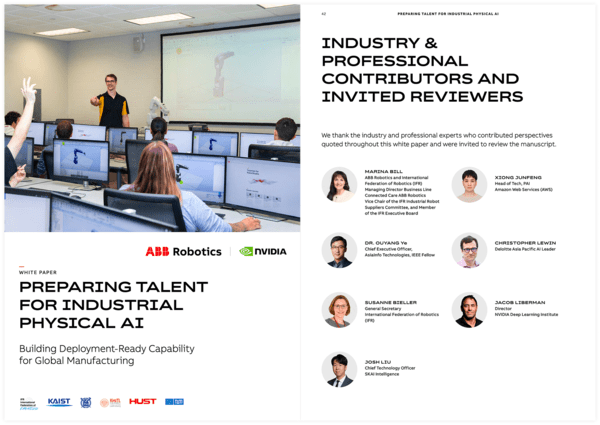
Sky Intelligence participated as a key contributor to the white paper "Preparing Talent for Industrial Physical AI," jointly published by ABB Robotics and NVIDIA.
The white paper defines industrial physical AI as an AI system centered on manufacturing that perceives and judges real physical environments and carries out tasks through robots and automation equipment, and proposes a framework that can be applied to industrial and educational environments in each region.
It also presents the physical AI learning process as five stages—understanding, simulation, physical validation, job application, and improvement—and proposes an evaluation method that confirms on-site applicability through system demonstrations, verification plans, simulations, and physical testing.
Sky Intelligence participated as a key contributor to the industrial physical AI white paper jointly published by ABB Robotics and NVIDIA. The white paper was released on the 20th, and its title is "Preparing Talent for Industrial Physical AI." AWS, AsiaInfo, and Deloitte also took part, along with Sky Intelligence.
Sky Intelligence joined the white paper to help present a learning framework for talent development and on-site deployment. The white paper defines industrial physical AI as an AI system centered on manufacturing that perceives and judges real physical environments and carries out tasks through robots and automation equipment. It then organizes the competencies, learning methods, and verification methods needed for technology adoption.
The white paper proposed a framework that can be applied to industrial and educational environments in each region. It was structured around presenting a framework that can be used according to local industrial and educational conditions.
According to a Deloitte survey of 3,235 senior executives at companies in 24 countries worldwide conducted in 2025 from August to September, and the white paper analysis based on it, there was a gap between the pace of physical AI adoption and the maturity of its use in industrial settings. Of those surveyed, 591 were respondents from the energy, resources, and industrials sector. The white paper highlighted the difference between the trend of broad deployment of physical AI on the ground and the maturity needed to operate and scale it adequately.
In the energy, resources, and industrials sector, 72% said they were using physical AI at least at a limited level. Meanwhile, 91% said they expected to use physical AI at least at a limited level within the next 2 years. By contrast, only 19% said they were using physical AI at an intermediate level or higher. The white paper concluded that operational and scaling capabilities remain at an early stage compared with the expansion of adoption.
The white paper also said a similar gap was found on the talent side. The share of respondents saying they were pursuing expanded training to improve AI usage capabilities was 53%, while 50% said they were designing and implementing upskilling and reskilling strategies. By contrast, 84% said they had not redesigned job roles to match AI capabilities. It said that while training expansion and retraining strategies are under way, job redesign has barely taken place, revealing the same type of gap.
Premised on the idea that physical AI is an area in which multiple technical elements and on-site conditions are interlinked, the white paper stressed that actual industrial deployment capabilities matter beyond simple AI training. It identified AI models, sensors, robots, control systems, data infrastructure, production processes, safety, and quality as components of physical AI. It also explained that the capabilities needed for physical AI must connect technology development with system integration and on-site operations.
In that context, the white paper said maintaining expertise in each field and the ability to collaborate across technical domains are necessary conditions for the spread of industrial physical AI. It then presented "Translational Capability" as a key element proposed by the white paper. It said this refers to understanding and connecting the technical and constraint conditions of disparate fields such as AI, robotics, and manufacturing processes.
Sky Intelligence participated in discussions in this white paper on building a learning framework that links real industrial environments and simulation. That content appears in Part 3 of the white paper, titled "Building a Scalable Learning Ecosystem." The views of Josh Liu, CTO of Sky Intelligence, were also reflected in Part 3.
The white paper presented the physical AI learning process as five stages: understanding, simulation, physical validation, job application, and improvement. The learning structure was organized around simulation and digital twin-based design and operational validation, followed by testing in real environments. It also said the test results are fed back into the improvement process.
Simulation, digital twins, and synthetic data were presented as areas of Sky Intelligence's physical AI technology development. The white paper said these technologies can be used for design and operational validation, rare-event data generation, operational decision-making, and talent training.
The white paper proposed an assessment method centered on verifying actual performance capabilities as the approach to education evaluation. It said the evaluation criteria should not be limited to course completion and passing tests. It also presented a method for confirming the potential for on-site application through system demonstrations, verification plans, simulations, and physical testing.
Lee Jae-cheol, CEO of Sky Intelligence, said that to drive the real-world spread of industrial physical AI, talent needs capabilities not only in technology but also in understanding, connecting, verifying, and operating it. He also said the company will pursue broader global industry discussions based on physical AI technologies such as simulation and digital twins. He also expressed his commitment to contributing to the establishment of an ecosystem that can be used in manufacturing sites.
Source: TECHWORLD · Kim Seung-gi
Original: https://www.epnc.co.kr/news/articleView.html?idxno=408553
References
This article was produced with the help of an automated content generation algorithm.
Source: TECHWORLD
View originalThis article was summarized and organized by BizCrush based on the original article from TECHWORLD. For exact quotations and full details, please refer to the original article.